


Venetian Enamels
Description
This section is from the book "A History Of Furniture", by Albert Jacquemart. Also available from Amazon: A History Of Furniture.
This section is from the "" book, by .
Venetian Enamels
Here is a special series of painted enamels which claims particular attention. We refer to those produced in Venice, and embellished no longer with subjects and figures, but with arabesques and reliefs tending to give them a very ornamental character as articles of church furniture, for which they were mostly intended. It was a piece of this description that enabled us to ascertain the date of a homogeneous specimen, which one might suppose produced, if not by the same hand, at least in the same workshop, and which nevertheless has borrowed nothing either from the Western enamels, or from those of the far East that have come under our notice. On a cylindrical ciborium, with dome-shaped lid, and supported on an elegant stand, is to be read a dedication made in the year 1502.
The colours of the Venetian enamels are limited - a deep blue or a green on the grounds, besides a turquoise blue, a white and more rarely red. The parts are generally disposed in gadroons on the circular pieces, their ornamentation more or less recalling the peacock's plumage. Thus, on the dishes or the foot or rim of the tazze, gadroons or flutings, repousse with the hammer, are alternately enamelled in blue and white, or green and red. Then a delicate ornamentation of gold foliage seems to suggest the central quill of the feathers, with the lateral plumes disposed as if to expand to the utmost extent, and by a still grander motive representing the eye, and occasionally relieved by touches of a bright enamel different from the ground.
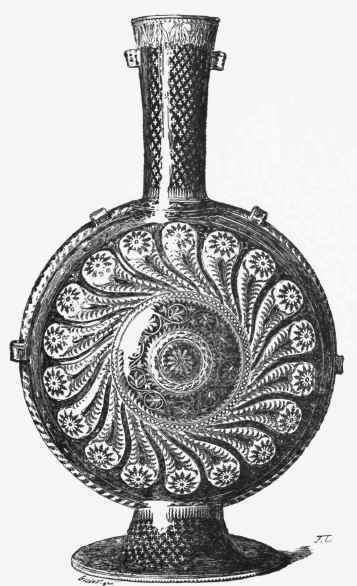
Flask in Venetian enamel. Sixteenth Century. (Louvre.).
The grand masses, on the other hand, are seme with gold, either small fleurs de lis, crosslets, or flowers (fleurous), disposed in a quincunx pattern.
The sacred objects include chalices, cibonums, monstrances, altar lanterns, custodes, and reliquaries. Those intended for profane use comprise tazze, several kinds of dishes, torches, hunting flasks, covered goblets and caskets.
Continue to:


My Books

