


Chapter V. Dutch Furniture
Description
This section is from the book "How To Collect Old Furniture", by Frederick Litchfield. Also available from Amazon: How To Collect Old Furniture.
Chapter V. Dutch Furniture
Old Flemish Gothic carving - Flemish Renaissance - Dutch influence on English furniture - The settlement of Huguenot refugee artisans in Holland, and also in England - Seventeenth century English furniture practically Dutch, either imported or made by Dutch workmen - The kinds of furniture made at this period - Sir William Chambers and Thomas Chippendale - Difference between French and Dutch designs and manufacture - Peculiarities of Dutch marqueterie - Descriptions of some of the articles made in Holland in the eighteenth century - Advice to purchase old Dutch furniture of this period - The marqueterie of some forty years ago - Made and "arranged" for auction sales - Belgian carved work - The South Kensington Museum - Old Dutch painted furniture.
THE countries which formerly were known as the Low Countries or the Netherlands, Flanders and Holland, were noted for. the skill and ingenuity of their wood-carvers, and the interiors of some of the beautiful cathedrals, churches, and town halls of Antwerp, Amsterdam, Bruges and Brussels, bear testimony to the fine work which was done, both in the old Gothic times and after the Renaissance movement had "come to stay" from Italy.
As the sixteenth century advanced, so did the prosperity of the burgomaster and the burgess, and the residences of the wealthy citizens of these old Flemish centres of industry gave employment and encouragement to the craftsmen of the period in the production of more comfortable furniture. Very little of the domestic furniture of Holland has been preserved to us of a time earlier than the late seventeenth century, but there are some very fine examples of the best Flemish Renaissance in the South Kensington collection. One of the most noteworthy is an ebony cabinet, on spirally turned legs, having the square doors which inclose the upper part, most beautifully carved with numerous figures and arabesques. I have given a full-page illustration of this important piece. There is also another cabinet, the drawer fronts of which are carved very minutely and carefully with figure-work in pear-tree. These are probably of seventeenth-century workmanship, which may be taken as the best time for Flemish Renaissance.
Towards the latter end of the seventeenth century the Dutch made great progress in the production of good furniture, and during the reign of Charles 11 and the short government of James II, Dutch taste exercised a growing influence on our English design and manufacture. This influence may be said to have culminated when "Dutch William" as the husband of Mary, daughter of James 11,ascended the English throne, and brought over with him to settle in the country of his adoption many of the leading families from Holland. There was also another influence which about this time affected to a considerable degree the industrial arts of both Holland and England, and that was the settlement of several thousands of the Huguenot refugees, who by the cruel revocation of the Edict of Nantes in 1685 were expelled from France. These refugees were mostly of the industrial class, silk weavers, glass workers, cabinet makers and joiners, and it is a well-known historical fact that some of our now old-established industries owe their origin in Holland and in England to this expatriation of skilful French craftsmen.
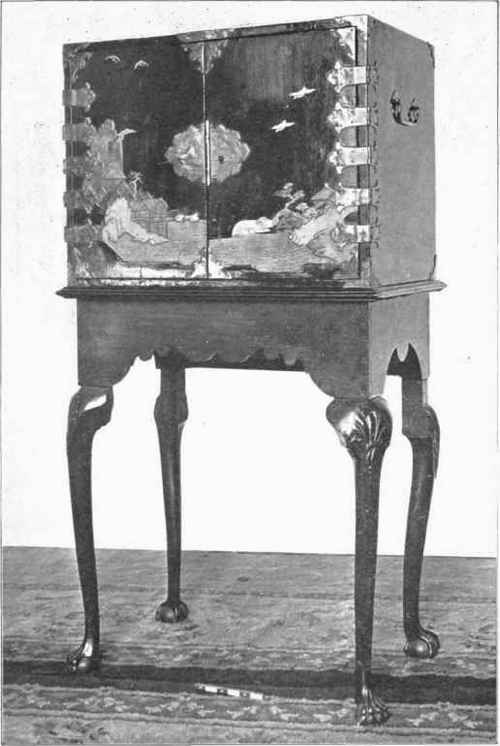
DUTCH LACQUER CABINET LATE SEVENTEENTH CENTURY.
It may sound like an Irish "bull" to say that the best English furniture of the end of the seventeenth and beginning of the eighteenth century is Dutch, but such is undoubtedly the fact, either by the actual importation of the completed article, or by the settlement in England of Dutch workmen to make the furniture at this time in vogue. The tall clock, well known under its title of "Grandfather," the chair with cabriole leg, sometimes ending in a claw and ball, sometimes with a plain round foot, the flat-shaped support in the middle of the back of the chair, and the shaping of the seat, formerly square, are all of Dutch importation or influence. Bureau bookcases, the upper part of which were intended to contain books and papers, generally filled with numerous recesses, pigeon holes and secret drawers, are from the same source. Lacquer cabinets with carved and gilt stands, made in Holland half a century earlier, with many fine pieces of the Flemish Renaissance furniture, already described, were brought over to England with the Oriental china vases which had long been imported from the East by the Dutch pioneers of trade with China and the East Indies.
During the reign of William and Mary, and also that of Queen Anne, Dutch influence was very strongly marked on our furniture and accessories, and, so far as the writer's observations have gone, it is not until the time of Sir William Chambers and of Thomas Chippendale that our English designer and cabinet maker asserted himself and established a new school. With these makers of the latter part of the eighteenth century I propose dealing in a separate chapter. For the moment to return to Dutch furniture; it is necessary to notice that the marqueterie of Holland of the earlier part of the eighteenth century was, as a rule of a much less variegated kind than that made in France - fewer kinds of veneers were used, and the forms of the pieces themselves were heavier and less graceful. In general outline the commodes and writing tables ornamented with marqueterie, were similar to those of late Louis XIV and early Louis XV, but with an important difference respecting the brass or gilt bronze mountings.
The art of producing beautiful and highly-finished metal mounts has never been carried to anything like the same extent in any other country but France, and even the best of the old Flemish commodes and tables in the French style, are inferior to those made in France, unless it be furniture made in the provinces, as distinct from the more highly-finished work of the Parisian ebeniste and mounter.
Continue to:


My Books

