


Thomas Chippendale
Description
This section is from the book "How To Collect Old Furniture", by Frederick Litchfield. Also available from Amazon: How To Collect Old Furniture.
Thomas Chippendale
It is difficult to assign any precise date to the first work of Thomas Chippendale. There is a chair in the Soane Museum, said to be the work of his own hand, and the original receipt for payment is stated to have once been in the possession of the museum. This is of the Dutch type, to which reference has already been made, and the date one would put at about 1720. There is also the illustration of a chair in "The Furniture of our Ancestors," which the author tells us was brought to England in 1727, and this has every appearance of being by Chippendale, and we know that the first edition of the famous "Gentleman and Cabinetmaker's Director" was published by him in 1754. Mrs. R. S. Clouston, who has written several articles for "The Connoisseur" on this famous •furniture designer and maker, thinks that his first work may have been done as early as 1715.
When we consider that the date of the publication of the third edition of the "Director " was in 1762, he would have been about seventy years of age at this time if any work of his was en evidence in 1715. I am inclined, therefore, to place the date of his first work somewhat later, say from 1720.
I725-Chippendale, who was a native of Worcestershire, established himself as a cabinet maker in St. Martin's Lane, probably somewhere about 17 20-1725, and at first made the kind of chairs which I have already alluded to, more Dutch than English in character, but of mahogany instead of walnut, which the Dutch more generally used. His second period seems to have derived its inspiration from Sir William Chambers, R.A., the architect of Somerset House, who about this time, 1745-1750, had travelled in the East and returned imbued with strong impressions of Chinese designs, which he introduced to his clients. He published a book, entitled "Chinese Buildings," in 1757, and built the Pagoda in Kew Gardens. Chinese pagodas, Chinese wall-papers and designs became a fashion, and Chippendale, who was more adapter than original designer, made his chairs and mirror frames to suit the rooms designed by Chambers. In several of the houses of Sackville Street, Dublin, and also in other parts of that city, there are still evidences of this combination; on the walls of the staircase and over the chimney-piece there is a panel inclosed by a rococo frame of stucco work, part of the original design of the house, and such panels could really have had no other suitable filling than one of Chippendale's rococo frames.

ENGLISH SETTEE IN WALNUT EARLY EIGHTEENTH CENTURY (CHIPPENDALE'S FIRST PERIOD).
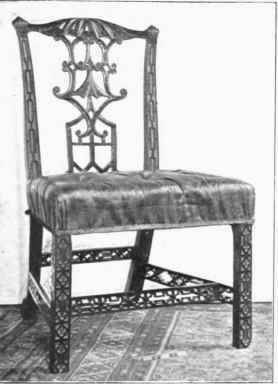
CHAIR ATTRIBUTED TO CHIPPENDALE.

CHAIR BY THOMAS CHIPPENDALE.
In the "Director" there are several designs for these, with a Chinese mandarin holding an umbrella on the top, and some quaint stork-like birds perched on conventional rockwork with dripping water. The frame is divided into several compartments by rococo scrolls and bevelled-sided little pilasters.
The chairs and some of the cabinets followed similar lines. The upper part of the cabinets are in imitation of a Chinese joss-house, and some of the chairs have an"Eastern lattice for the back, finishing at the top with a carved ornament resembling the roof of a pagoda.
Some years later we find that, taking fresh impressions from the lighter style of the French furniture of the time, that is, the more frivolous curves and scrolls of the Louis XV period, Chippendale made his chairs of more fanciful patterns, like the riband-backed design which is so well known and so frequently copied. To many of the drawings in his third edition of the "Director" we find the description " a French commode," or similar title, which shows that in following the prevailing fashion, Chippendale was adapting some of his new designs to French patterns.
In another book published about this time, and containing the reproductions of several of Chippendale's drawings, there is the following inscription on the title-page: "Upwards of one hundred new and genteel designs, being all the most approved patterns of household furniture in the French taste. By a Society of Upholders and Cabinet makers." This title-page bears no date, but it is said that Chippendale was formerly a member of the society, and after some disagreement, decided to publish his own book of designs independently. Within the last few years there have been published cheap reproductions of the original books, and readers can see for themselves the strong French bent which the ornamental furniture of this time was now taking.
Chippendale's furniture has been much criticised on account of the fanciful details of many of his designs, but some of the criticisms would lose much of their force if the articles of furniture, either made by him or by the best of his contemporaries, were before the critics, instead of only the designs. It is said that Chippendale handed his original drawings to the copperplate engraver, who would naturally endeavour to make his work as artistic as possible, and in so doing, while producing a charming design, rendered it scarcely practicable for a cabinet or chair maker, by reason of the fineness of the lines and consequent absence of strength and solidity. In really good old furniture by the best makers of this time, there is in the well-moulded sweep of the curves, some compensation for the apparent fragility of design, and in the chapter on "faked furniture" and in " Hints and Cautions " I have endeavoured to point out one of the signs by which the real old chair or frame may be distinguished from the imitation. It is this " sweep " which requires so much more wood, and consequently infinitely more skilful work. A chair frame which is apparently only two inches thick must be cut from mahogany of some four or five inches substance, to allow for the sweep in the lines of a good old Chippendale chair - but more of this has been said in the chapters already referred to, and we must return to the books of designs. There are several names of articles of furniture which are now but interesting links with the past: "Library case" instead of bookcase; "Bar-backed sofa," the settee of the period formed like three or four chairs placed side by side, with an arm at either end; "Confidante" or " Duchesse," the former being the two-chair settee of the time, and the latter the English equivalent of a French chaise-longue; " Tea chest" and " urn stand," which remind us of the time when tea was an expensive luxury, costing 10s. and 12s. a pound. The urn stand was a charming little table, sometimes oval and sometimes square on four tapering legs, with a little slide pulling out underneath its top to accommodate the teapot, which was filled from the urn. These are a few of the names of the two hundred designs in Chippendale's book.

CHIPPENDALE CHAIRS (SECOND PERIOD).

THREE PIECES 0F FURNITURE ATTRIBUTED TO CHIPPENDALE.
The full-page illustrations of specimens of Chippendale's furniture selected from those in the South Kensington collection, will demonstrate the different periods of his work, the earlier chairs showing the Dutch and then the Chinese influences, while the later ones show the lighter and more capricious lines which were adopted from the French fashions.
Continue to:


My Books

