


Haig And Chippendale
Description
This section is from the book "How To Collect Old Furniture", by Frederick Litchfield. Also available from Amazon: How To Collect Old Furniture.
Haig And Chippendale
By the kindness of Captain Herbert Terry of Ripley, an enthusiastic collector of old English furniture, I am able to give an illustration from a photograph of the first and last pages of an original bill receipted by Thomas Chippendale, junior, who had at this time a partner, the firm being Haig and Chippendale. The whole account, consisting of several folios, is for the furnishing of the town house of Sir Richard Frederick, who was Captain Terry's great-uncle, and the document has been in the possession of the family ever since it was rendered. As the photograph indicates, it was commenced in 1790, and the balance paid in 1796, and it includes a great many very ordinary household items, by no means of the ornamental kind that we are in the habit of associating with the name of Chippendale. On reference to the old London Directories in the newspaper room of the British Museum, there will be found the name of the firm described as "upholders and cabinet makers" of 60, St. Martin's Lane, Charing Cross, from 1790 to 1798, when the name of Thomas Chippendale, "cabinet maker" of the same address, appears alone, from which it is evident that either Haig died, or that the partnership had been dissolved. It is singular that the name of Haig should precede that of Chippendale, as if he were at the time senior partner, and it may be that the original Thomas, like so many men who did excellent work, died in circumstances that rendered it advisable that the son who succeeded him should seek the pecuniary assistance of a partner with capital to enable him to carry on the business, and that after the father's death the character of the business became less of a special, and more of a general furnishing character. We can only guess, but the account quoted above, rather leads one to this conclusion.
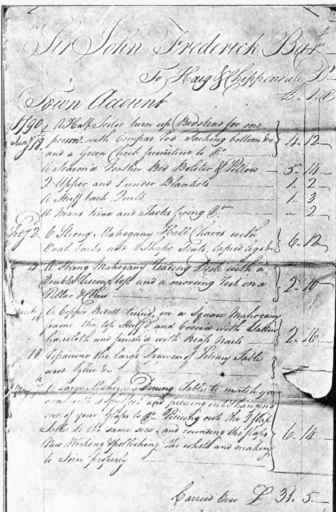
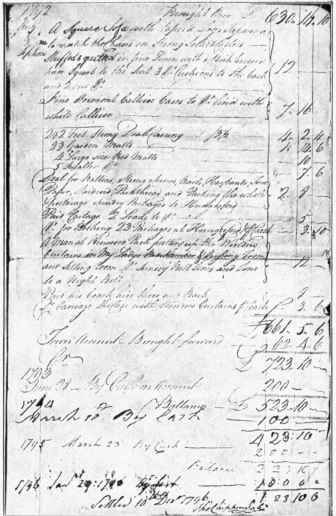
THE FIRST AND LAST PAGES OF HAIG AND CHIPPENDALE'S BILL, WITH THE SIGNATURE OF THOMAS CHIPPENDALE.
The prices charged for some of the articles afford material for interesting comparison with those which such things would realize at the present time. While on the subject of prices, however, it should be mentioned that it is only within the last twenty years that Chippendale furniture has appreciated at such a rapid rate. Twenty-five years ago, excellent Chippendale, Heppelwhite or -Sheraton chairs could have been bought for ten pounds each, and the more ordinary kinds for twenty-five to thirty-five shillings each.
The following is an extract from the above mentioned account of Haig and Chippendale.
£ | s. | d. | |
A very large mahogany wardrobe of good wood for the recess with folding doors and 7 slideing shelves lin'd with marble paper and baize aprons 2 long and 2 short drawers under. | 16 | 10 | |
0 |
A large oval work table with folding top made of fine black rosewood banded with white a drawer in front, and therm feet in strong socket castors. | £ | s. | d. |
5 | 16 | 0 | |
A large Wainscot press bedstead with folding doors and sacking bottom for nursery. | 3 | 10 | 0 |
12 neat carv'd Mahogany square back Parlor chairs the seats stuffed and covered with the finest green Morocco leather and finished with double rows of best gilt nails 48s. ea. | 28 | 16 | 0 |
6 ditto arm'd chairs seats stuffed and cover'd in the same manner 58s. | 17 | 8 | 0 |
It is worth while to note some points in the above extract. One of these is, that from the wording of the first item it is evident that "good" wood was then, as now, an appreciable quality; it occurs in other items in the bill, and proves that there was then, as now, "good," bad and indifferent, and that not everything that is old was necessarily made of good, that is, carefully selected and well-figured material.
In the second item, the work table is described as being made of "fine black rosewood." In 1803 Sheraton mentions this "black" rosewood as being the fashion, and therefore we may assume that somewhere about 1790, or a little earlier, this wood was in favour for a certain class of ornamental furniture. The "therm" feet are doubtless the tapered form supports which came in about this time, after the cabriole or scroll-form leg had gone out of fashion. On the first page of the bill, which is illustrated from a photograph, some chairs are described as having tapered legs. The set of eighteen "parlor" chairs, twelve single and six arms, have also an interest, as marking the time when these square-framed chairs with upholstered backs came into vogue, and if we turn to one of the illustrations of Sheraton's designs, this kind of chair will be seen. It is quite evident, then, that Haig and Chippendale conformed, like most other manufacturers, to the fashions of the day,which altered between 1780 and 1790 to the more sedate and sober lines which are generally associated with the names of Sheraton and Heppelwhite.
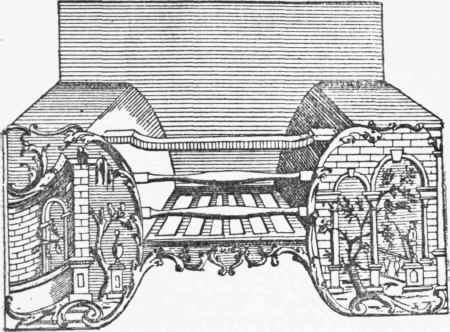
A BATH STOVE, BY INCE AND MAYHEW.
Captain Terry's brother still has in his possession the wardrobe for which the sum of £16 10s. was charged in this account.
Continue to:


My Books

