


Louis Quatorze
Description
This section is from the book "How To Collect Old Furniture", by Frederick Litchfield. Also available from Amazon: How To Collect Old Furniture.
Louis Quatorze
After Louis XIV came to the throne a new era may be said to have begun for French decorative art, and in the palaces of Versailles, the Louvre, the Musee du Garde Meuble, and in such collections as that lately given to the nation by Lady Wallace, and the Jones Bequest in South Kensington, we have proofs of the degree to which the manufacture of sumptuous and elegant furniture was carried. Under the superintendence of Colbert, the king's minister of finance, the most generous encouragement was given to artists and skilled craftsmen, and the making of gorgeous furniture was raised to the level of painting and sculpture. Orders were given for special designs, and cabinet makers were encouraged by royal patronage and favour, being honoured by such newly-coined titles as Maitre Ebeniste and Ebeniste au Rot. Immense sums of money were expended to produce those magnificent examples of the cabinet maker's art and industry, justly entitled to the description Meubles de luxe.
Berain and Lebrun furnished the designs executed by Andre Charles Boulle, his sons and successors, and the kind of furniture identified with his name, but which has since become vulgarized and common, came into fashion. The process adopted by Boulle is pretty well known, but can scarcely be passed by without a word of explanation. The design was enlarged from the original drawing into a full-sized diagram, and then cut out in sheets of tortoise-shell and brass, prepared beforehand for the purpose. Such portions of the design as were intended to remain in brass were then eliminated from the sheet of tortoise-shell, and a similar plan was adopted with the brass which it was intended to replace with tortoise-shell. The two sheets of different materials thus treated were then pressed into each other, much in the same way that we have seen children's puzzle pictures and maps, when the design of the paper picture of which the puzzle is a copy has been completed. A strong solution of glue was well brushed into the crevices between brass and shell; paper was then laid over the work, and it was allowed to get hard and dry. In a day or two the paper would be scraped off, and the Boulle work, which I should have mentioned had already been laid upon the foundation of the piece of furniture it was proposed to ornament, would be ready for scraping, rubbing down and polishing. The engraving of the surface thus prepared was a very important branch of the work; the design was, to use a technical term, "blind," until the deft hand of the artist-engraver gave it life. For an instance let us take the well-known design in old Boulle work which we call the "squirrel" pattern, because part of its ornament consists of that little animal represented in brass inlay. That portion of thin brass which is part of the sheet I have described, would simply represent the shape of the squirrel until a little shading, the indication of paws, tail, eye and other touches from the engraver's tool, here and there, had given the squirrel form and life. It is the same with each figure, each scroll and flower, so that it must be obvious that much of the merit and spirit of the work, depends upon the skill of the engraver. When this process was complete a black pigment like thick ink was rubbed into the lines made by the graver, which showed up all the details of the design, and this, having the dark shell as a background, made a rich picture. Boulle may be black, red or brown; sometimes pieces are enriched by panels of blue, and I have seen panels of green. These colours are produced by placing underneath the veneer, a colouring matter which shows through the transparent portions of the tortoise-shell, a material which everyone knows is partly opaque and partly transparent. Under the shell, which was intended to remain brown, gilding was sometimes introduced to heighten the effect. In the panels of a piece of furniture which the ebeniste intended to be more fanciful, he would sometimes insert a piece of horn, which, unlike the shaded effect of tortoiseshell, was wholly transparent ; under this horn he would place a grayish blue colour, which would come as a relief to the black boulle and produce a very decorative effect.
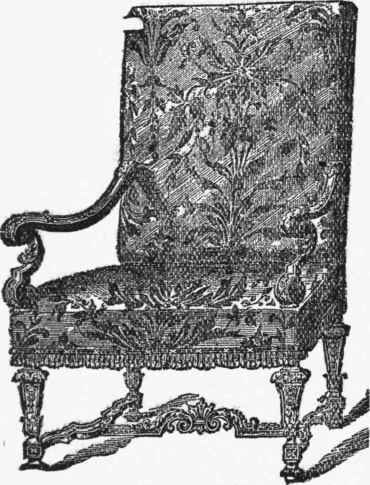
ARMCHAIR IN TAPESTRY (LOUIS QUATORZE).
A little later than the preceding illustration.
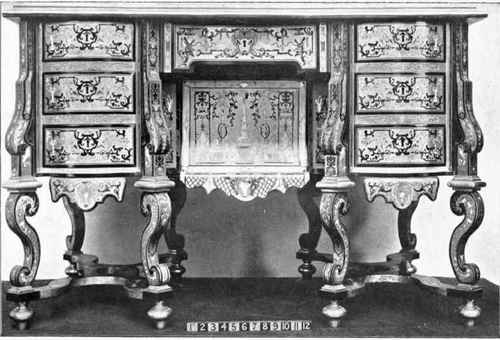
FRENCH KNEEHOLE TABLE BY ANDRE CHARLES BOULLE (LOUIS QUATORZE).
The furniture made by Boulle in this manner was further ornamented by massive mountings of gilt bronze; some of the beautiful cabinets in the Louvre have figures in high relief, scrolls, birds, and ornamental mouldings standing out from the surface of the boulle work. The handles of the chests of drawers or commodes are massive and handsome. The reader will find the best productions of boulle in the Louvre "Galerie d'Apollon," in the Jones Bequest at South Kensington, and in the Wallace Collection at Hertford House, Manchester Square, London.
Long after Boulle and his sons and successors had passed away, and years after his work had gone out of fashion, a revival of the taste for this highly decorative furniture came about, and boulle-work, or buhl, as it is more generally written and pronounced, was made by several firms in London and Paris. Of course, save for the fact that the process invented by the originator has been adopted, there is not much real similarity between a showy buhl table made in London or Paris, and sold for from fifteen to thirty pounds, and the magnificent boulle armoire in the Jones Bequest, which cost that collector about £5,000.
Quite apart from this modern and cheaper class of buhl there are reproductions of the fine old pieces made in Paris by such first-class makers as Zwiener, Beurdelet, Dasson,and one or two others; these are really on the lines of the old work, well made and of fine finish, and worth purchasing by those who admire the style, but are unable or unwilling to pay enormous prices for what are practically museum specimens.
More will be said presently about these first-class reproductions of museum specimens, but before dismissing Boulle work I will explain a little matter which often puzzles, amateurs.
When the sheets of shell and brass are cut and, as already explained, certain portions of each material are withdrawn, so that the designs may be completed in the respective proportions of each material which were arranged in the original drawing, these deleted pieces of brass and shell remain over as a surplus. In some instances these were discarded altogether, and sold to smaller makers; in the majority of cases they were used for the side panels of a cabinet, where they would not be so much en Evidence, or they were made up into a piece of furniture corresponding in form to the original piece, but the relative portions of the design would be exactly the reverse of the original - where was brass would now be shell, and vice versa.
This kind of buhl was called contre partie, sometimes by English cabinet makers I have heard the two parts called "positive" and "negative," or distinguished as "male" and "female" ; and I remember a very amusing incident in which a lady asked me for the explanation of the puzzling remark which a certain connoisseur colonel, a friend of hers, had made, by telling her that her buhl card table was only the "feminine" kind. Of course this kind of buhl, which the French more appropriately term the contrepartie, is of much less value than the premiere partie, or first selection of the cut sheets of the design.
The importation of different choice woods from the West Indies no doubt encouraged the production of marqueterie furniture. A rich dark West Indian wood, something like Rosewood, darker than mahogany, was called bois du roi, or "Kingwood," because it was favoured by the king. A yellowish and striped veneer was called "tulip" wood because its pretty variegated appearance somewhat resembled the colours of the common tulip. Holly-tree wood stained different colours, Citron, Coromandel, Brazil, Zebra wood, Sandal, and other fancy and variegated veneers, were used to give colour and variety to the marqueterie enrichment of the furniture of the time.
The designs were numerous and diverse; sometimes the veneers of the same wood were placed different ways of the grain or figure, so that the four sections of a panel would have the figure pointing towards the centre, the outer edge of the panel being banded by a different, generally a darker wood, with a key pattern or other design as a framework. The panel would sometimes contain a trophy of musical instruments, a basket of flowers, or a landscape. Riesener, one of the first ebenistes of the time of Louis XV and his successor, affected a box-pattern marqueterie as a groundwork of some of his pieces. He also made some of his beautiful cabinets in three compartments, the centre one slightly projecting and having a panel inlaid with a vase of flowers, while the side compartments slightly receded and were ornamented by the lozenge-shaped squares or diamonds which were a favourite form of decoration with him. Lacquered panels and boxes had been brought from China and Japan by collectors and merchants; these were taken to pieces and parts mounted into the furniture of the period, but as there was considerable difficulty in procuring the lacquer from Tonking or Fouchow, the clever French craftsman was not long before he contrived to produce a similar article, and this he used in the panels of his tables, secretaires, and commodes. Mounting in gilt bronze completed the ornamental enrichment of the furniture of the Louis Ouatorze period. These mounts are of dignified and restrained designs; the broken scroll is a characteristic ornament, the curves are graceful, and generally the work is stately and massive; slabs of rare marbles and of Egyptian porphyry surmounted some of the sumptuous pieces.
Continue to:


My Books

