


Chapter X. Varieties Of The Cupboard: Dressers, Desks
Description
This section is from the book "Old Oak Furniture", by Fred Roe. Also available from Amazon: Old Oak Furniture.
Chapter X. Varieties Of The Cupboard: Dressers, Desks
IN old inventories and specifications we find the term livery cupboard' frequently employed. This name has in our own day lost all significance, and it is difficult to determine how the name came to be used, or, indeed, to what particular class of article it was applied. It is not always easy to determine the exact nature of pieces of furniture referred to in old writings, owing to the habit prevalent with writers of giving the generic only instead of the specific name, though the latter would be perfectly well known to them. Thus one finds them speaking of 'cupboard' only instead of 'court cupboard,' 'livery cupboard,' or 'credence.' On the other hand, the true character of a piece may sometimes be ascertained from the author's description of its features, although it is not defined in name.
According to Parker, livery cupboards were pieces of furniture which did not possess 'the little ambries of safes,' and, 'instead of being used like the court cupboard or buffet for the display of plate, were for placing the dishes upon as they were brought into the hall.'
He cites the contract for building Hengrave Hall, Suffolk, which is a classic authority, and in which it is stated: 'Ye cobards they be made ye facyon of lieuery yt is wtoute doors' If this correctly describes the livery cupboard, it was probably merely a species of sideboard having an intermediate shelf resting on carved supports and acting as a dumb waiter for the disposal of the dishes and plates. A fine Elizabethan piece answering to this description is in the great hall of Christchurch College, Oxford.
Another much-used article of furniture in old times was the 'dressor,' or dresser, as it is now termed - a type which approximates somewhat to the credence. These 'dressors' in the Middle Ages were fitted with little shutters or doors like the credence, and also possessed a superstructure of several shelves, but the difference between them and their prototype is that the table surmounting the cupboards is of too high an elevation for the purpose of carving meats upon, and the whole structure is lighter in design and workmanship. The superstructure referred to is actually but a surviving feature of the old storied court cupboard. In making these latter remarks about English-made articles, I must confess that one is relying on somewhat meagre sources. English dressers of the Perpendicular and early Renaissance periods bearing the superstructure referred to are practically non existent in our own country, though I have heard that some specimens are to be seen in the museum at Copenhagen amidst the glorious collection of antiques gathered there.
Of French and Flemish contemporary examples a good many still remain, and these, together with such MS. illustrations as we possess, form the basis of our knowledge of those wonderful pinnacled 'dressors,' so richly suggestive of ideas of old Court life, which the antiquary and collector now sigh for in vain.
The collection left by the late Sir Richard Wallace to the nation contains a superb three-storied 'dressoir' of walnut in the French flamboyant style of the fifteenth century, and the Louvre and Cluny collections in Paris afford equally wonderful examples, which may be studied with advantage.
A magnificent and almost unique specimen of a dresser remains in the solar chamber in the Neptune Inn, Fore Street, Ipswich, but it is a fixture embedded within the wall, and hence belongs more properly to the province of fitted furniture.
The dressers of the Middle Ages are distinctly different, both in construction and outline, from the dressers of the later period; and, indeed, it is noteworthy that there is a break in the continuity of this species of furniture. It appears, during the time of Elizabeth, to have become merged into the buffet, or sideboard, and not to have reappeared - in its distinct character, at any rate - before the reign of Charles I., when its features were totally changed. The seventeenth-century buffet at Rye House, with its upper shelf supported by little pillars, which was mentioned in the last chapter, is the nearest approach to a connection between the two types which can be mentioned. The type with which the name is generally associated seems to have sprung into existence during the second half of the seventeenth century, and presents details, both of construction and moulding, which can hardly be assigned, at the earliest, to a period prior to the reign of Charles II. This revival in outline is very similar to the kitchen dresser of the present day, differing chiefly in the fact that it is a movable piece and not a fixture, and that it is a much more elaborate article of furniture, intended for the living-room, and not for use in the domestic offices.
The dresser in this form is a table-like structure, measuring some 6 feet, more or less, in length, furnished with drawers and supported on turned legs. The drawers are frequently panelled in geometrical outlines and fitted with drop-handles. Possessing a tall upright back, which would be placed against the wall, this dresser would be provided with shelves, something after the manner of the earlier examples, for the purpose of carrying plates, hooks also being inserted in the outer edge of the shelves to hang mugs and cannikins upon, and the dresser, so decked out with its household accompaniments, must have presented a picture of homely comfort in the middle-class dwelling of the time. Of the dressers of the later variety which have survived, a great many will be found without the superstructure; but, though not invariably the case, an examination will often show that the back and shelves were once there, but have been removed. The weakness of construction has no doubt mainly contributed to the loss of the back.
During the reign of William III. or Queen Anne the superstructure is elaborated by the addition of little cupboards, sometimes decorated by the addition of inlay; but at this time the oak period was fast merging into the mahogany, of which material dressers, as well as other articles of furniture, commenced to be made. An interesting specimen of dressers of the end of the oak period, with its high-shelved back furnished with pewter, is in the Victoria and Albert Museum (Nos. 503 to 506, 1898). 13

FIXED DRESSER OR SIDEBOARD IN THE NEPTUNE INN, IPSWICH, TEMP. HENRY VIII.

DRESSER, SECOND HALF OF THE SEVENTEENTH CENTURY.
Desks doubtless had their origin in the old monkish establishments, since in the early Middle Ages the cowled brethren were the scribes of the community. In England similarly, in the case of chairs, we have the book-rests and reading-desks attached to the choir-fittings of our cathedrals and minsters, but apart from these instances there is a lamentable lack of homemade desks of the earlier periods. The wealth of Gothic desks such as we see in missal paintings, or, to come to a modern authority, occasionally in the book-illustrations of that wonderful artist and antiquary De Neuville, have hardly a counterpart in this country. The superb series of black and white illustrations to Guizot's 'History of France,' which were the work of the artist just mentioned, should be studied by every one interested in historic fittings and furniture, for they are all founded on fact, assisted by De Neuville's extensive and minute knowledge of his subject. At the Victoria and Albert Museum, however, is an English writing-desk of the fifteenth century, carved with Perpendicular arches, simple in design, and solid in construction (No. 143, 1898).

DESK CARVED WITH PERPENDICULAR TRACERY.
In the Victoria and Albert Museum, fifteenth century.
The essential shape of the desk is so obvious that, apart from the decoration, there is little to call for description. During the Elizabethan period desks appear to have been made without a substructure, so as merely to be placed upon a table when required for use, but about the middle of the sixteenth century we find that they were placed upon stands having turned legs connected by rails. Nevertheless, it is rare to find such pieces intact, for the desk and the stand were detachable, not being made in one piece. Hence it follows that many Goths and Vandals who possessed such desks, and were desirous of multiplying their articles of furniture, converted each part to a separate use, turning the stand into a table through the simple addition of a flat top. Desks of the seventeenth century were often provided with secret drawers, several instances of which are quoted in the chapter on 'Furniture with Hiding-places.'
Of medicine cupboards or 'spice chests' there is little to say. They were small upright receptacles intended for hanging against the wall, having a single door opening cupboardwise, and partly fitted with a series of small drawers for the purpose of containing herbs, simples, and other remedies of the day. These 'chests' were often carved on the front with some simple pattern, and occasionally, after the middle of the century was passed, decorated with mother-of-pearl and ivory inlay, similar to the sideboards in the 13 - 2
Dutch style described in the last chapter. One of the earliest dated specimens of this form of decoration which the writer has seen was on a medicine cupboard dated 1654. This, curiously enough, is a date some years in advance of the actual time when the Dutch fashion was set by Charles II. in England after his wanderings in the Low Countries. In all such movements as this change in taste there are little beginnings which usually pass almost unnoticed, but which, nevertheless, herald the approaching fashion.
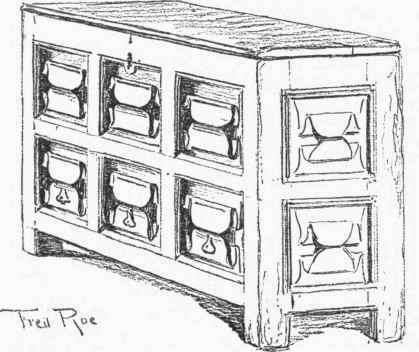
INGLE-NOOK SEAT WITH BOX TOP AND DRAWERS, FRENCH OR FLEMISH, ABOUT 1500.
Continue to:


My Books

