


Chapter XI. Settles And Benches
Description
This section is from the book "Old Oak Furniture", by Fred Roe. Also available from Amazon: Old Oak Furniture.
Chapter XI. Settles And Benches
ONE of the most homely and useful pieces of furniture that has ever been invented is the old-fashioned settle, and it is difficult to understand why its use has declined in modern life. We have very few settles earlier than the Elizabethan period remaining in England, but that they were extensively used during the Middle Ages we know, and, indeed, in common with coffers and chests, the settle formed one of the few staple pieces of furniture which existed in almost every house above the rank of the labourer's cottage. This can be readily understood when we consider the ill-fitting doors and shutters which were provided to even such palatial mansions as Haddon Hall, where, by the way, they may be seen in all their primitive crudeness.
Improvements in the joinery and construction of domestic dwellings, perhaps, contributed to the partial abandonment of the settle, which would lose a good deal of its purpose in a room in which there were no draughts. At all events, the degeneration of the settle commenced simultaneously with the freer introduction of the sash window. Still, flanking the fire on a chill autumn or winter night, there is no other piece of furniture ever invented which so admirably contributes to comfort.
Which of us wanderers in search of the picturesque cannot call to mind some evening spent snugly ensconced in its sheltering corner by the open hearth of the village inn? Fortunately, even in these days of modern innovation, many inns throughout the country still retain their ancient settles, some of them almost encircling the room, as at the Green Dragon, Wyrnond-ham, or the White Hart, Bletchingley, and I for one should be more than sorry to hear any suggestion of their being replaced by 'up-to-date' furniture.
Probably one of the oldest settles existing in England is that which remains in the south ambulatory of the choir of Winchester Cathedral. This is a very massive and rough monks' bench, the back formed of huge upright planks of oak mortised or tongued together. It is undoubtedly very ancient, but unfortunately there is absolutely no decoration whatever to afford a clue to its date. Tradition goes in the neighbourhood that it dates from Saxon times, but this, like many other ecclesiastical legends, must be taken cum grano sails.
Infinitely more interesting is an inn settle in the little village of Combe St. Nicholas, in Somersetshire. This is an excellent type of the 'long settle' in use during late Gothic times, and, further, there is no doubt whatever as to its approximate date. It is a huge piece of furniture, its back decorated with simple linen panels, and surmounted by a cornice carved with a double ribbon pattern. Near the door is a draught-stop, and above the latter a massive limb juts out somewhat after the manner of a 'hammer-beam,' such as we see in open-timber church roofs. This beam terminates in the figure of an angel (as is usual with hammer-beams), bearing in its grasp a shield, on which appears the device of a goat's head, and immediately beneath this singular projection, and surmounting the draught-stop, is a diminutive, carved figure, seated on something that resembles a wheatsheaf. These two figures, from their singular position, were known to the rustics who assembled here as 'the parson and the clerk.' I say 'were known,' for 'the parson' has now disappeared from his elevation, and gone to grace the collection of curios of some local Oldbuck.
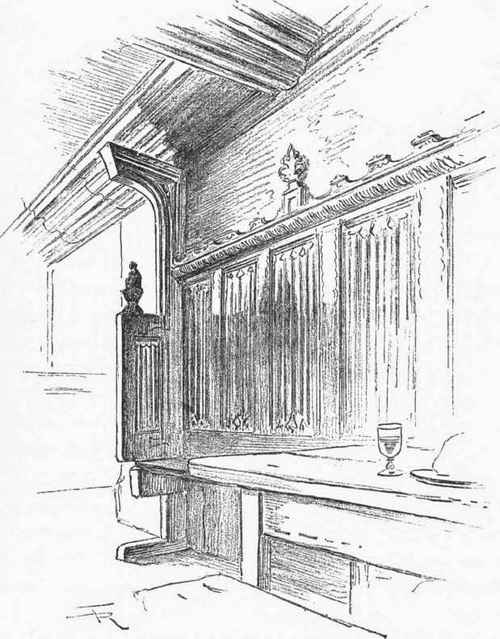
FIXED LINEN-PANELLED SETTLE IN THE GREEN DRAGON INN, COMBE ST. NICHOLAS, SOMERSET.
It appears, from the position of this hammer-beam, that it originally formed part of the support of the roof itself, which may have been, and most probably was, of the open timber character, commonly constructed in late Plantagenet and Tudor times. This instance of utilizing the principal piece of furniture as a part of the room itself is remarkable, and as regards domestic dwellings, perhaps unique. The Combe St. Nicholas settle should be compared with the dresser at the Neptune Inn, Ipswich, both being characteristic specimens of fixed furniture made at a fairly contemporary date, and of exceeding rarity.
Settles of an age earlier than late Elizabethan or Jacobean times are so rare that, except for a very few instances in this country, we can only seek for them successfully in MS. illustrations. There used to be a solitary specimen of late Gothic construction in the porch of one of the prebendal houses at Lincoln, but it was weathered and in bad condition when I saw it, having apparently stood out in the open for many years.
Plain, small, and low-backed, this belated waif from the monastery, though perfectly 'true,' was insignificant compared to the elaborate and imposing structures which we come across in MS. illustrations. In the well-known picture of the money-changer in the 'Mirrour of the World' (MS. Bodleian, 283), the settle on which the usurer is seated has a handsome turreted and panelled back, one end of the seat being flanked by a larger wing than the other - a species of variation which was customary with the medieval designer and draughtsman.
As regards settles, this peculiarity has a distinct object, for we often find that high settles of even the Jacobean period have the end which would be farthest from the fire enlarged into a sort of wing as a protection against draughts, the other end being merely terminated by an arm. Linen-panelled settles and benches are also excessively scarce in England, though they may occasionally be met with on the Continent.
Among the illustrations to Froissart's 'Chronicles ' in the British Museum, in the plate depicting that hackneyed subject the tragical masque of Charles VI. of France, the ladies witnessing the display are represented as seated on a linen-panelled settle of simple but massive form. This settle is placed directly in front of the hooded stone fireplace, but, curiously enough, with its back turned towards the fire. Large settles such as this were usual accompaniments to the great hall, the other domestic apartments being doubtless furnished with benches of smaller dimensions.
Continue to:


My Books

