


Chapter XVII. Some Vicissitudes Of Old Furniture
Description
This section is from the book "Old Oak Furniture", by Fred Roe. Also available from Amazon: Old Oak Furniture.
Chapter XVII. Some Vicissitudes Of Old Furniture
THE Baron de Cosson, the well-known authority on arms and armour, in his book on helmets and mail, * makes the following pithy remark:
'This . . . was a most impudent forgery, and it would seem, from an observation of many of the numerous forgeries that have appeared in this country during the last thirty years, that, as a rule, the more impudent the forgery, the more circumstantial was the story with which it made its appearance.'
This comment in general as to histories attached to armour certainly very often applies to ancient furniture, but with this difference: that while very few pieces of armour that come into the market have any history worth noting, many specimens of furniture, on the other hand, may be found with histories which may be regarded as authentic. The reason for this may perhaps be as follows: Gothic and Jacobean furniture, although thoroughly out of fashion in Georgian times, still continued to be used to some extent for practical purposes, whereas armour, since the introduction of firearms, ceased to have any practical purpose at all, and, from want of use, its history gradually became forgotten. However, these records do not always bear investigation, even when the piece of furniture in itself is absolutely genuine, and has stood in the place for which it was made for many generations. For example, the number of bedsteads in old Tudor houses in which Queen Elizabeth is said to have slept is really remarkable, but in most cases the bedsteads themselves belong to a period long subsequent to her time.
In more than one instance the initials 'E.R.'are actually visible upon the ceiling of the room; but while the hangings of the bed which it contains might possibly be assigned to the Elizabethan period, the bedstead itself certainly does not belong to a date anterior to that of Queen Anne.
* 'Ancient Helmets and Examples of Mail: A Catalogue of the Objects exhibited in the Rooms of the Royal Archaeological Institute of Great Britain and Ireland, June 3 to 16, 1880.'
One of the best authenticated records of which I know where a piece of furniture has left the place with which its early history is connected is attached to a chair in my own possession. The chair in question is a leather backed and seated production of the seventeenth century with a spiral rail in front, which might date from the reign of Charles II. It was one of three which formerly stood on the dais in the Assize Hall of Taunton Castle, and which were actually used by the Court over which the notorious Judge Jeffreys presided at the Bloody Assize in 1685. Not many years ago. Taunton Castle was turned into a museum, in which the usual collection of savages' weapons and other familiar curios were placed. This chair and some other local relics, instead of being treasured with the greatest care, were sold and dispersed. The Jeffreys'chair, as I shall call it, passed into the possession of a lady, who, on her part, presented it to a gentleman whose family were associated with the borough, and he, in his turn, knowing my fondness for such antiquities, made it over to me, and it now remains one of my best-treasured possessions.
Richard Kilburne, of Hawkhurst, and a master of Staple Inn, was a member of a very old Kentish family, who wrote, amongst other works, the Survey of the County of Kent, which is still sought after and referred to as an authority.* He was born in 1605, and in the year 1631, at the age of twenty-six, he became possessed of the mansion known as 'Fowlers,'in the above-named village, 'God's providence having there left him an inheritance/ It was doubtless in the possession of his father and grandfather, as the 'coat of arms belonging to the family apparently long previous to his day was granted to the Kilburnes of Hawkhurst and London.' † Richard Kilburne died in 1678, the term of his residence at 'Fowlers'having extended to about twenty-eight years. For some reason or other, unexplained, when he vacated the mansion, he left behind him an elaborately-carved piece of furniture, in the shape of a linen-chest with a long drawer under, having its centre panel decorated with the family arms: 'On a field argent, a chevron azure between three bald coots sable, heads argent and beaks tawny.
Crest: A bald coot proper.'*
* 'A Topographie, or Survey, of the County of Kent, with some Chronological, Historical, and other Matters touching the same, and the several Parishes therein, by Richard Kilburne, of Hawkhurst, Esquire. Printed by Thos. Mabb for Henry Atkinson, and are to be sold at his shop at Staple Inn Gate in Holborne. 1659.'
† 'The Antiquities and History of the Name and Family of Kilbourne, in its varied Orthography,'Newhaven, U.S.A., 1856.
As years passed by several families inhabited the old Jacobean residence known as 'Fowlers,'but about the middle of the last century the attention of Mr. Goodwin Kilburne, Principal of Tudor Hall Academy, and a descendant of the Kentish topographer, was directed to the chest, which had remained in the house as a stock piece of furniture since the first half of the seventeenth century. Sir Edmund Hardinge, who then inhabited the mansion, presented the relic to Mr. Goodwin Kilburne, and it now remains in the possession of his son, Mr. G. G. Kilburne, R.I., the well-known water-colour painter, thus affording an excessively rare instance of a piece of furniture which has returned to the family for whom it was undoubtedly made after the lapse of some two hundred years. The features are the Kilburne arms before mentioned, surmounted by a helmet and lambrequin, four terminal pilasters, and conventional representations of dragons on the uprights and panels of the drawer. It will be noticed that the conventional Gothic flowering, so prevalent about the juncture of the fifteenth and sixteenth centuries, has here degenerated into a queer-shaped object, something resembling a pine-cone, which may be seen towards the bottom of the centre panel on each side of the shield.
* Edmonson's 'Heraldry.'
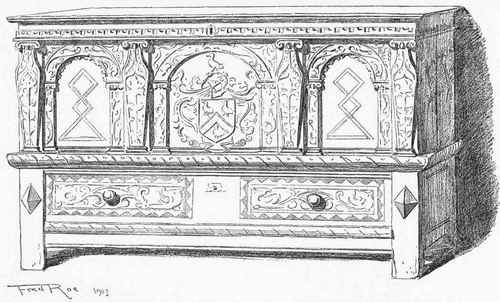
CHEST CARVED WITH THE ARMS OF RICHARD KILBURNE, OF HAWKHURST, AND NOW OWNED BY G. G. KILBURNE, ESQ., R.I., MIDDLE OF THE SEVENTEENTH CENTURY.
Continue to:


My Books

