


Old Furniture With Hiding-Places. Continued
Description
This section is from the book "Old Oak Furniture", by Fred Roe. Also available from Amazon: Old Oak Furniture.
Old Furniture With Hiding-Places. Continued
At Newport Church, in Essex, may still be seen a very ancient ecclesiastical coffer, which possesses a hiding-place in full working order. The coffer is an enormous and weighty piece of construction, clamped with bands of iron, and carved on its front with shields, from which the painted heraldic devices have now disappeared. Inside the lid are some very remarkable paintings in oil, depicting our Saviour on the cross and the four Evangelists. The bottom of the coffer appears at first sight to be formed of horizontal planks of oak, strengthened at equal distances by two stout oak transom bars. A further inspection reveals that one of the transoms can be removed and a section of 19 the centre plank slipped out, disclosing a space of some 2 or 3 inches in depth, now, alas ! empty. The device and mechanism of this piece of deception are so purely simple and clever that it would be difficult, indeed, to discover, without some indication were afforded by those who have inherited the secret.
Coming down to later times, a majority of the old secretaires appear to have possessed some form of hiding-place, this mostly being a space at the back of the pigeon-holes. Some acquaintances of mine, after having possessed an oak secretaire for many years, accidentally became enlightened as to the peculiarities of its structure. In a space similar to that which has been described were found two miniature paintings, one evidently representing Prince Charles Edward, the young Pretender, and the other an unknown young lady.
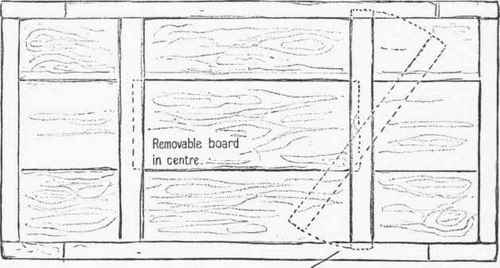
Removable cross-bar, turning in slots cut in front and back of Coffer.
MECHANISM OF HIDING-PLACE IN THE NEWPORT COFFER, ESSEX.
In a well-known collection is an oak desk, carved with the conventional representation of the tulip - a form of decoration, needless to say, brought over from Holland by the 'Merry Monarch.'It is likewise incised with the date '1660'and the name 'Robert Baker,'and contains no less than seven hiding-places, several of them being very artfully contrived. It may be mentioned that this desk originally came from the vicinity of Stratford-on-Avon, and may have been made for that family of Baker which was connected with the Hathaways of Shottery. Ann Hathaway's cottage, before being purchased by the Government, was kept by a Mrs. Baker, a descendant of the old stock; and the pride with which the old lady was wont to show the fine Elizabethan carved oak bedstead, which tradition says William Shakespeare presented to the Hathaway family, as well as other objects of interest associated with the family, will no doubt be recollected by many.
One of the most usual places for the concealment of money and valuables during the reign of Elizabeth was a recess formed by hollowing out the legs of bedsteads, and providing them with a close-fitting door. This device was of such frequent occurrence that it must ultimately have lost the quality of secrecy, which probably accounts for our not finding it in bedsteads of a rather late date. The celebrated bedstead from Turton Tower has a hiding-place of this description. This example, dated 1593, and carved with the arms of the Courtenays of Devon, is now deposited in the Bethnal Green Museum. It is only fair to state that this latter specimen has been much restored, though doubtless in conformity with the original design, as far as the secret recess is concerned. A bedstead with a recess of a different description is in the possession of Mr. Dyer Edwards, of Prinknash Park, Gloucestershire. A narrow longitudinal recess runs through the panelled tester at a point just above the pillows, and may possibly have been designed to contain weapons of defence, for the space - at any rate, till quite recently - was utilized for the reception of a sword and dagger.
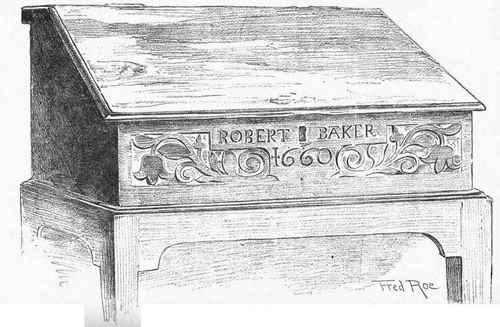
WRITING-DESK CARVED WITH TULIPS AND THE DATE l660 The stand is of later date.
In The Antiquarian and Topographical Cabinet, 'published in 1809, we find the following interesting anecdote incorporated in an account of Glastonbury Cross:
'In the place of the porter's lodge was erected a good dwelling-house, the owner of which, in the last century, pulled down an old mantelpiece, and placed it in the street, where it lay for several years. He was once offered three shillings for it, but his price being three shillings and fourpence, the bargain was declined; at length his daughter, having occasion to build a small chamber, directed the mantelpiece to be sawed into pieces for stairs, when, in a private hole, which had been purposely made in it, was found near a hundred pieces of gold, of the time of Richard II. and Edward III., of the value of about eleven shillings each.'
Some few years ago a curious chest of drawers was discovered buried amongst a miscellaneous collection of lumber in St. Chad's Chapel in Lichfield Cathedral; the piece was with some difficulty saved from being broken up, as it was at the time in an excessively dirty and neglected state. The front is incised with the date 1663, and each drawer is also carved with an initial. What this highly-interesting article of furniture could have been intended for is not very obvious; the fact remains that it possesses several secret drawers concealed in a simple but ingenious manner.
A friend of mine recently purchased a cabinet or nest of drawers elevated on turned legs, probably of the time of William and Mary, which, on examination, was found to contain no fewer than seventeen different hiding-places. Yet another friend, after an expenditure of much time and trouble, discovered a secret recess in a piece of furniture which had been bequeathed to him, only to find that its contents consisted of 'one brass farthing.'
Continue to:


My Books

