


Coffers And Chests From The Norman Times To The Renaissance. Part 2
Description
This section is from the book "Old Oak Furniture", by Fred Roe. Also available from Amazon: Old Oak Furniture.
Coffers And Chests From The Norman Times To The Renaissance. Part 2
In the first half of the fourteenth century the construction of coffers remained very much the same as in the preceding period, though the carved embellishment became more elaborate. It was not until the latter portion of the century that chests began to take the form of framework enclosing a multiplication of panels. Curiously enough, this advance in construction was actually heralded in some few cases by the carved decoration, which represents on the surface of a single coffer panel several compartments bearing tracery and enclosed in ornamental borders - a reversal of the process of evolution characteristic of later times.
An example of this peculiar superficial subdivision exists in the coffer in Dersingham Church, Norfolk. Fine specimens of chests of the Decorated period may be seen, amongst other places, in St. Mary Magdalene's Church, Oxford; Faver-sham Church, Kent; Haconby Church, Lincolnshire; Che-vington Church, Suffolk; Alnwick Church, Northumber-land; and Wath by Ripon, Yorkshire.
The Faver-sham coffer is, in design, perhaps the most beautiful specimen of its kind in the country. The decoration of the front is in the form of an arcade, each bay being filled with elaborate tracery. The main arches are applied, as also are the buttresses which support them. The construction of this coffer - or, at least, the front of it, for the sides and back have been villainously restored with deal - heralds the approaching change to framed panelling, which took place in the early part of the fifteenth century. This coffer possesses almost identical counterparts in Rain-ham Church, Kent, and St. John's Hospital, Canterbury, leaving little dobut that they are specimens of Kentish Gothic work produced by the same craftsman.
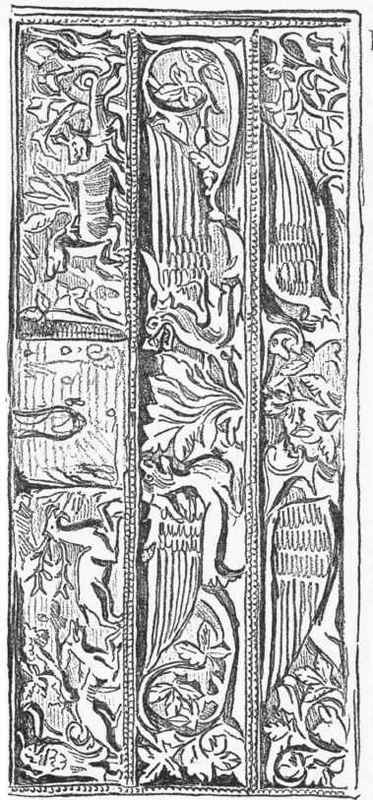
PANEL OF THE ALNWICK COFFER.
The coffers at Alnwick and Wath exhibit amongst their decorative carvings representations of huntsmen blowing horns and dogs hunting stags, as well as the usual chimaeras on the uprights. In the Alnwick coffer, however, traceried decoration is absent, the front panel being divided into three longitudinal compartments carved with the subjects before mentioned.
The last-named coffer is traditionally said to have come from Jervaulx Abbey, but it is extremely probable, from the purely secular character of its decoration, that the Alnwick example was originally intended for other than ecclesiastical purposes. Two strange, winged human-headed figures which adorn the lower tier on the front panel are locally said to represent jesters, merely from the fact that they wear the hooded tippet, or liripipe, as it was anciently called. This peculiar form of head-dress was, however, commonly worn by the middle and lower classes during the fourteenth and fifteenth centuries, and its representation gives no indication as to the meaning of the sculptures. There can be little doubt, from the remarkable similarity in their decorative handling, that the Wath and Alnwick coffers, as well as a slightly later specimen at Brance-peth, emanated from the same workshop.
A particularly fine type of a fourteenth-century box, of a more developed type than those just mentioned, exists in Huttoft Church, Lincolnshire. This, though to all intents and purposes a coffer, being actually made with a single longitudinal panel in front, is divided into compartments fitted with applied decorated tracery, separated from each other by buttresses. It is evident that the craftsman subsequently learnt that the decoration carved on the surface of several panels was a truer and more satisfactory method of producing precisely the same effect.
The ornamentation of coffers of this period was not confined to formal architectural design alone, for we have some excellent specimens remaining which bear spirited scenes from the legend of St. George and the Dragon, tilting matches, and other popular amusements. It is noticeable that in these, architectural details, if represented at all, most frequently take the form of castellated or domestic structures. Although these coffers are mainly deposited in churches, it is more than probable that their original use was secular; they may have been the depositories of the manor court rolls, or even have been employed in what was once known as the garderobe chamber. Owing to their exceeding scarcity, these specimens are generally regarded by those who have not studied the matter as of foreign production, in accordance with the usual tendency of the unskilled to attribute any unusual type which they cannot quite understand to a Continental origin. Specimens of this type may be seen in the Victoria and Albert and Dublin Museums, York Cathedral, and Harty Church, Kent, and at least one example exists in Belgium, which I think can be referred to English production.

THE BRANCEPETH COFFER.
There are very good grounds for assigning most of these so-called tilting-chests to the end of the fourteenth century. Details of costume, and especially armour, are unerring guides, and sufficiently prove this to be the case. What is termed the 'pig-snouted bascinet' appears upon the figures of the knights in most of them, and this form of headpiece, as well as the dagging or Vandyked border, which appears upon the edges of the long sleeves, are mannerisms peculiar to the reign of Richard II.
In the Musee de Cluny in Paris, however, are two coffers bearing armed figures, which belong to two different dates. The first exhibits on its front the figures of twelve knights armed cap-a-pie, and standing beneath early ogival canopies. The lid, which is slightly convex, is carved with a variety of secular subjects, jousting, wrestling, and other amusements being represented. This coffer, which has been much restored, has been assigned by the highest authorities to the latter part of the thirteenth century, and its real origin dates probably not later than 1300. The other Cluny coffer is a much rougher, production. The material of which it is constructed is light walnut, and the details of the arms and armour of the combatants on its front show it to be of a date not anterior to 1500. The lock on this latter coffer is a most elaborate and beautiful piece of hammered ironwork, but the execution of the wood-carving has such a singularly archaic appearance that it induces one to believe that the coffer came from some old-world district such as Provence, where most of the arts remained in a very backward condition.
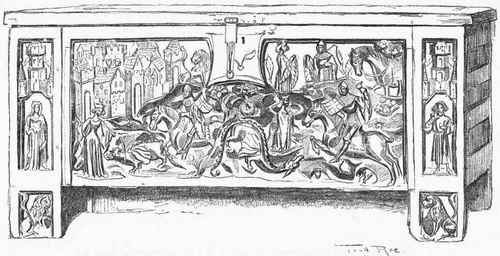
KNIGHTLY COFFER OF LATE FOURTEENTH-CENTURY WORK IN YORK MINSTER.
Length, 6 ft. 2| in.; height, 3 ft. 1/2 in.; depth, 2 ft. 6 in.; panel, 2 ft. 2 1/2 in. x 4 ft. 9 in.
Continue to:


My Books

