


Cupboards And Sideboards. Part 3
Description
This section is from the book "Old Oak Furniture", by Fred Roe. Also available from Amazon: Old Oak Furniture.
Cupboards And Sideboards. Part 3
The Minehead cupboard belongs to this category. The doors, centre panel, and drawers in its front exhibit some elaborate tracery and the initials 'J. M. C.,' while the back shows panels carved with the emblems of the Passion, traceried windows, and two shields, which display the arms of England and France quarterly, and a dolphin between three mullets. There is considerable difficulty in identifying the origin of this cupboard, for though the tracery, as well as a lily pot which appears on one door, hints at the work of a Flemish, or more probably a French, craftsman, the shape and make of the piece are undeniably English, and this is confirmed by the presence of our royal arms. The dolphin, too, is not the device of the Dauphin of France, as that Prince's heraldic fish is differently disposed, and is not accompanied by any mullets. Considering the peculiarities of construction and decoration, there is every reason to believe that the piece was built in England at the workshop of a master-craftsman, while the decorative panels were carved by a fo7'eign workman in his employ.
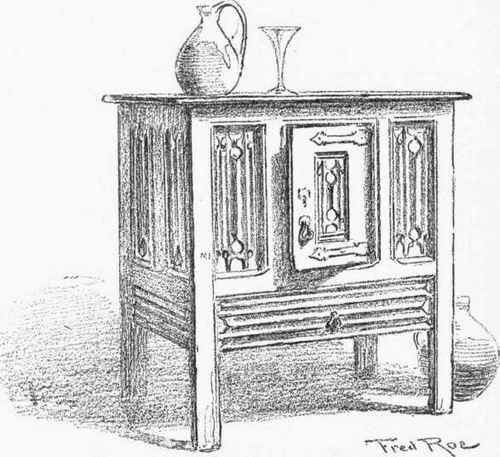
LINEN-PANELLED CREDENCE.
In the possession of Guy F. Laking, Esq., M.V.O.
Mr. Guy F. Laking, M.V.O., the Keeper of the King's Armoury, possesses another of these central cupboards, a small English piece of good proportions, elevated on tall legs and decorated with linen panels inserted in all its four sides. It is not uncommon to find that these credences have tops made from a lighter wood than the body of the structure, but through want of knowledge on the part of the owners such tops have been sometimes condemned and replaced by fresh ones of oak. The known indifference of early craftsmen to interpolations of different material ought to prevent such vandalism as this. The top of the credence, as devoted to its original use, would be concealed by a linen cloth or' other napery, and its construction of uniform material would be of little consequence.
In the case of one fine credence, which was discovered during recent years in a Suffolk cottage, the replacement of the original top by a conformable one of oak was strongly advocated by an over-zealous restorer to whom the piece was entrusted for renovation. It may be mentioned that the original top, of elm, was of fine colour, and scored with marks for playing the old game of 'shuffle,' or shovel-board, but these features had little attraction for the restorer, who wished to make a 'job' of the piece, and, in his eyes, render it complete; but, fortunately, his proposal was not assented to.
Food lockers of a type quite dissimilar from the credence were also in use during the Middle Ages. In nearly every case these may be known by the perforations, mostly in the shape of Gothic windows, which were introduced in their doors and sides. These perforations were generally backed with red cloth, which, while it excluded dust, admitted air. Traces of this cloth and its attachments may still be found on the inner side of these old Gothic food lockers. A maker of such cupboards lived in late Gothic times in the county of Sussex, and his productions, which are evidently all by the same hand, in some cases are absolutely identical in their decoration. One of these lockers is in the possession of Mr. Morgan Williams, of St. Donat's Castle, Glamorganshire, to whose collection we have had occasion to refer several times, and who has been successful, I believe, in securing no less than four specimens of this maker's work. The tracery with which the wood is pierced is so late in character that it is rather difficult to assign a date to these pieces, but the probability is that they were made about the time of Henry VIII.
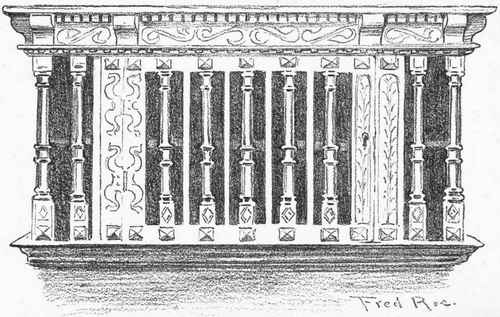
SEVENTEENTH-CENTURY ALMERY (ONE OF THREE) IN ST. ALBANS' ABBEY CHURCH, HERTS.
The almery, or dole cupboard, is usually a receptacle with a railed, open front, which, as its name indicates, was designed to contain gifts of bread and other necessaries distributed to the poor. Many of these are used at the present day, and probably the fact of their having been in constant use has contributed to their preservation. In a Norman recess in the south transept of St. Albans' Abbey Church stand three picturesque old almeries in which temporarily is deposited the bread which on each Sunday is distributed to the poor of the city.* They are quaint shallow little receptacles, each capable of holding about a dozen small loaves. Their fronts are fitted with delicate rails through which comes the appetizing odour of newly-baked bread. The most elaborate, which may date from the reign of Charles I., is carved with strap ornaments and further embellished with brackets. The hinges are of the 'cock's-head ' pattern, so called from their bearing a fanciful resemblance to a crowing cock. The door of this almery, as may be seen in the illustration, has been additionally strengthened by inter-railing, probably during Georgian times - a very expressive testimony to the easy honesty which may exist even where church doles of dry bread are concerned.
The other two plainer almeries are of later make, dating from the time of Charles II., to whose reign the greater part of the railed examples remaining may be attributed. A finer specimen than either of the St. Albans almeries exists in the Calverley Hotel at Tunbridge Wells. The lower part of this piece is enclosed with small unpierced doors, beautifully inlaid with intricate geometrical patterns in lighter woods. At that wonderfully picturesque old establishment, Christ's Hospital, at Abingdon, Berkshire, is an almery which combines the functions of a dole-cupboard and a table. This is a truly magnificent piece of furniture, possessing bulb-legs surmounted by pillar-caps similar in outline to the Dinton and Kensington examples described in the chapter on tables. It is really part of the furniture designed for the hospital in its early years, but that institution was founded in 1553, and the almery-table, which is typically Elizabethan in character, can scarcely be of quite so early a date as the foundation. An almery of quite a different description exists in the Parish Church at Coity, Glamorganshire, where it has probably fulfilled the purpose of an Easter sepulchre in bygone days.
It possesses a coped and crocketed lid profusely decorated with flowing tracery, while the front panels are carved with the various emblems of the Passion in medallions, the corners of which are fitted with Gothic spandrels. In spite of its superficially early appearance, this piece probably does not belong to a date prior to Henry VIII.'s reign.
* The custom is said to have been kept up at St. Albans for three hundred years.
Continue to:


My Books

