


Cupboards And Sideboards. Part 4
Description
This section is from the book "Old Oak Furniture", by Fred Roe. Also available from Amazon: Old Oak Furniture.
Cupboards And Sideboards. Part 4
In the time of Henry VIII. a large substantial press was used which partook very much of the nature of the armoire, and was, in fact, a stage in the development of that species of furniture into the court cupboard, a domestic equipment which continued in vogue for some 200 years.* The type associated with Henry VIII.'s reign is flat in outline, having two large doors which close the greater portion of the structure, while above these the space is divided into two or three compartments furnished with small square doors. The frame panels to all the doors are usually carved with portrait heads enclosed in medallions, and are further decorated with arabesques in the style of the Renaissance. Such mouldings as these cupboards possess often partake of a Gothic character, showing that the older style had not entirely died out. A very fine specimen of this description, having its top story further decorated with pilasters, and with its original ironwork intact, was discovered in a cottage near Watford some few years ago, and is now in the collection of Sir Charles Lawes-Wittewronge. It sometimes happens that in specimens of this class the heads on the smaller top doors project considerably in relief, having the appearance of thrusting themselves out from the surface of the panel.
If such pieces as bear this peculiarity are closely examined, it will be found that the wood from which the projecting heads are formed has been applied in the block and afterwards carved. When the old residence, No. 7, Delahay Street, Westminster, commonly known as Judge Jeffreys' House, was demolished in 1892, some panels of the latter description, which had evidently formed part of a cupboard, were brought under notice. The heads in this case wore the peculiar flat cap with cheek-pieces which was so characteristic of Holbein's portraits. A very good example of this application of the material for the purpose of carving the mask on can be seen in the central head on the overmantel of the oak room (2,011, 1899), in the Victoria and Albert Museum. We shall have occasion to refer again to this interesting room in the chapter on panelling.
* The De Vere cupboard at Castle Hedingham, described in ChapterXVI., is a good specimen of this type, semi-Gothic in character and flat in outline. It probably dates from about the junction of the reigns of Henry VII. and Henry VIII.
There is a curious cupboard, exhibiting decorative mouldings of the style in vogue during Henry VIII.'s reign, at Chetham's College, Manchester, which is at first sight puzzling to those who do not know its history. The piece in question, a large press of oak, with paned posts at the corners, was originally a four-post bedstead, made about the middle of the sixteenth century for one Adam Hulton, whose initials appear upon it. The accompanying date of 1655 was added at the instance of the celebrated merchant, Humphrey Chetham, who at that time presented the relic to the college to accompany his endowment for the purchase of 'godly books.' It is said that this bedstead was slept in by Prince Charles Edward during his mad descent on Lancashire in 'the 45' The transformation of the bedstead into a cupboard has been effected since the Pretender's Rebellion, but at what date we do not precisely know. At the present it remains one of those strange, nondescript pieces of furniture which result from a good article being spoiled.
During Elizabeth's reign a modification was introduced into the flat, upright cupboard of her father's reign, which then became what is generally known as the court cupboard. The upper story of the piece was recessed, having a ledge on which articles could be placed in front of the small doors when closed. The canopy which overhung the doors was supported at each end by detached balusters, which frequently took the form of jewelled bulbs. Inside the moulded canopy was usually a small space, which, though it can hardly be described as a hiding-place, being a feature of such common occurrence, was nevertheless in some measure a place of concealment for small articles. In some pieces of this kind the large cupboard underneath is dispensed with and the space left open, so that any 12 - 2 articles placed on the base would be exposed to view. The upper tier of lockers would in this case be supported by large balusters of a similar character to those immediately above. Occasionally instances are found where the top story possesses but one compartment, having the door in the centre and the sides receding diagonally to the back.
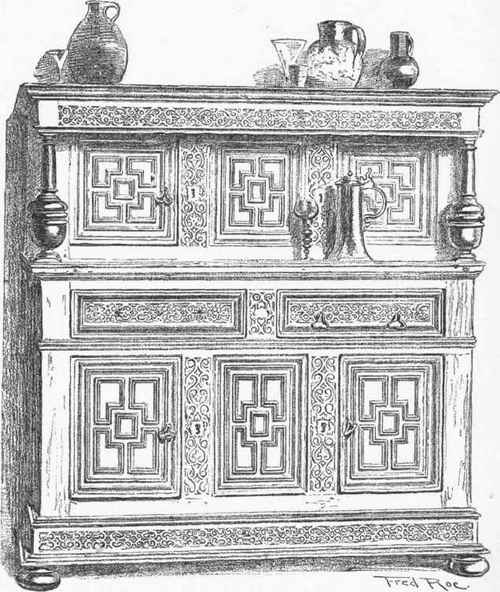
COURT CUPBOARD, COMMENCEMENT OF THE SEVENTEENTH CENTURY.
Mr. Ernest Crofts, R.A., to whose ancestral furniture we have already referred, owns no fewer than three exquisite specimens of this type of cupboard, the very finest productions of their kind. The melon-shaped baluster and black and white inlay are common features of these fine pieces of furniture. One of them, moreover, possesses on its drawer that graceful reminiscence of Gothic art the running grape-vine. Another richly carved and inlaid cupboard belonging to the same owner is especially worthy of remark. It is a low credence-shaped cupboard decorated with caryatides, and bearing the inlaid date of 1626. The curious thing about this cupboard is that, while its details are in the style of the early seventeenth century, the form and construction of the piece are late Gothic in character, and call to mind the Louth and Minehead hutches.
Continue to:


My Books

