


Oaken Chairs And Stools From The Renaissance To The End Of 17th Century. Part 3
Description
This section is from the book "Old Oak Furniture", by Fred Roe. Also available from Amazon: Old Oak Furniture.
Oaken Chairs And Stools From The Renaissance To The End Of 17th Century. Part 3
It is certain that the high-backed type at this stage was quite foreign to the Eastern Counties, where we even have evidence that in the early years of the seventeenth century chairs assumed a somewhat squat or stunted appearance, very unlike their Northern contemporaries. Some exceedingly interesting and striking specimens of local work of this period may be seen in the old Trinity Bede Houses at Castle Rising, in Norfolk, where the ancient furniture has remained almost intact and in use since the time of the foundation of that institution. The Bede Houses were erected by the charity of Henry Howard, Earl of Northampton, in 1609-1615, for the benefit of twelve poor women, but, owing to the death of the Earl a year before the completion of the building, the grant of £100 for their support was made by Thomas, Earl of Arundel, cousin and next heir of the deceased. The very costume of the aged beneficiaries has remained unchanged since the foundation of the hospital, and consists of a tall steeple-crowned hat covering a white cap, and a large scarlet cloak, embroidered on the left side with the badge of the Howards.
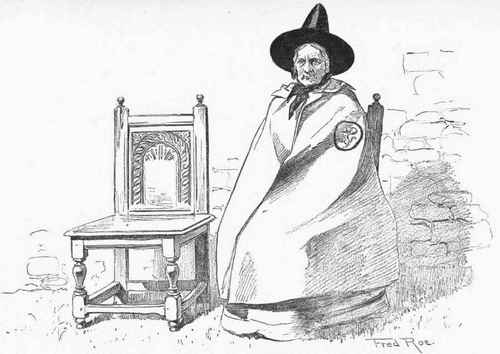
AT CASTLE RISING, NORFOLK.
In the picturesque dining-hall which is attached to the hospital are some excellent specimens of carved oak, which evidently formed part of the domestic articles with which the place was originally furnished on its completion. Particularly noticeable amongst these are the chairs referred to - low, quaint pieces, with an arch incised on their back panels, which arch, however, possesses neither plinth nor capital, but is decorated simply with a running scroll resembling a sort of involved guilloche passing over it from one side to the other. These chairs are likewise very low in the seat, the latter being supported by squat but well-proportioned legs.
This interesting suite may be accepted as a fair type of what was produced in Norfolk about the year 1615. Each of the twelve residents possesses a similar chair, though in one instance its authenticity may be more than doubted. A close comparison between the chair specified and any one of its brethren cannot fail to be instructive, for it will speedily be discovered that the spurious specimen possesses evidence of its comparatively modern origin in the exaggerated depth of its decorative carving (nearly always a bad sign), in the sharpness and want of wear on its cutting, in the inferior imitative outline of its turned legs, and, lastly, in the absence of the appearance of age, which is produced by centuries of use. Whether some accident has deprived the set of one of its pieces, necessitating replacement, or whether the original chair has been pirated stealthily into the collection of some unscrupulous dilettante, it is now impossible to say. The pseudo-antique just mentioned shows signs of considerable effort in the cultivation of surface, but it is probably not more than fifty years old. I shall have occasion to treat further of some of the other pieces of furniture in this old-world refuge.
As at Abbot's Hospital, Guildford, the Leicester Hospital, Warwick, and many similar spots, one can linger at Castle Rising for a short time enjoying picturesque and living memories of a past age.
Another chair of the slighter class of build associated with the period of the early Stuarts is that in which the back, instead of being panelled, is formed of two or three open arches fitted with small turned, acorn-shaped knobs or pendants. I cannot assign these chairs to any particular district or county, but the probability is that the greater number come from the Northern Midlands, whence they are mostly to be traced, though specimens actually come from their original homes as far west as Devonshire. Two very good examples of this class are now in the cemetery chapel at Brighton.*
Chairs of the time of Charles I. can scarcely be said to be very rare, though a good many often assigned to that monarch's reign actually belong to a slightly later date. In Lubenham Church, Northamptonshire, is an arm-chair with a fluted panel back, which is said to have been used by Charles I. before the historic conflict at Naseby. The legend may probably be true; at all events, the chair represents a typical example of the early Stuart period, but other chairs to which this temporary royal occupation is attributed were without doubt made long after Charles I.'s time. An instance of this is furnished at the Great House, Cheshunt. This dilapidated fragment of what was once a princely mansion contains a number of interesting and instructive relics, and is well worthy a visit by the connoisseur. It may in a way be associated with Charles himself, who as a child is said to have stayed at Theobald's, close by. Some parts of the house date from the early part of the fifteenth century, but in a dreary upper apartment termed 'the haunted room' (which, however, is of a date subsequent to Charles's time) may be seen an extremely curious child's toy - a rocking-horse and a high leather-backed chair, with flanged cheek-pieces, to which local tradition has long assigned the dignity of having been used by Charles I. The rocking-horse is a deeply interesting object to the historical student, and I am strongly inclined to think that in this case oral tradition is true, and that the toy may have come from the now-vanished palace of Theobald's, and have been actually used by the ill-fated baby Prince.
* See illustration on title-page.
The chair referred to, however, though peculiar in its shape and dimensions, could hardly be older than the time of William III., and might easily be later. The height of the back is so astonishing, and the curves of the flanges and arms are so uncommon, that it is rather difficult to date it accurately; but this chair is perhaps the precursor of the 'grandfather' chair, with cheek rests and cabriole legs, which we associate with the days of Queen Anne. The history attached to the rocking-horse may probably have been foisted on to the chair in order to increase public interest, or may be a modern imagining due to the ignorance of styles.
Continue to:


My Books

