


Oaken Chairs And Stools From The Renaissance To The End Of 17th Century. Part 4
Description
This section is from the book "Old Oak Furniture", by Fred Roe. Also available from Amazon: Old Oak Furniture.
Oaken Chairs And Stools From The Renaissance To The End Of 17th Century. Part 4
A child's chair having every probability of being connected with the royal House of Stuart was sold a year or so ago by Messrs. Christie, Manson, and Woods. This beautiful specimen, which was traced back to an old hall near Framlingham, in Suffolk, was of early seventeenth-century design, with nothing particularly uncommon in its shape or carved decoration. Its chief interest, however, lay in the fact that on the summit of the uprights of the back was incised the device of a rose surmounted by a crown, these hair-line incisions being inlaid with silver, after the manner in which we so frequently find pistol-butts decorated during the seventeenth century. Holes for a foot-rest were visible on the front legs. There is every probability that this chair, whose early history is unknown, was used by either Prince Henry or Prince Charles, sons of Charles I.
Mr. George Kilburne, R.I., of Hampstead, whose remarkable family chest we have occasion to deal with in another part of this work, possesses a fine child's high chair of this period - perhaps slightly earlier - which has a back panel sculptured with the conventional rose. This chair, like the chest, is also a family relic of the Kilburnes of Hawkhurst.
In the Lady Chapel at St. Alban's Abbey are two wonderfully fine specimens of seventeenth-century armchairs. One of them bears on its back panel a carved rose enclosed in a lozenge, while the other, of later character, and probably dating from Charles I.'s reign, is of a bold architectural outline, having a mitred panel in its back. The seats in each case are supported by pillar legs.
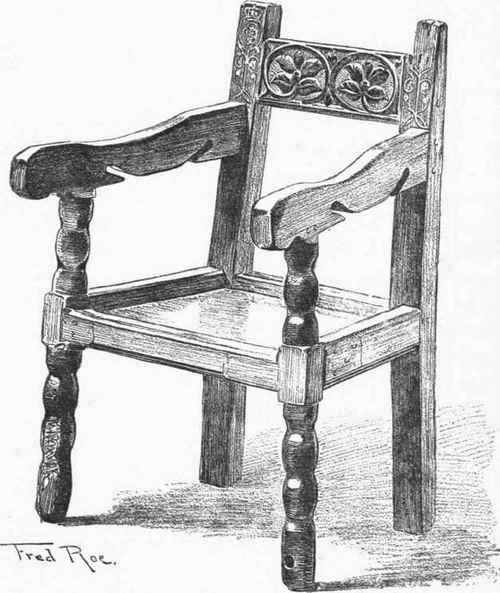
Child's Chair, inlaid with the royal rose and crown in silver, first half of the seventeenth century.
Another class of seventeenth-century chair which, like the excessively tall-backed specimens mentioned some few pages back, is also popularly known by the appellation of the 'Yorkshire type,' is that which has transverse bars in the back, moulded severally into arches, profusely carved, and fitted with small pendants. The approximate date of production of these examples may be ascertained from the appearance of a mask roughly resembling the features of Charles I., which is included in the ornamental carving. This detail fixes such pieces as bear it as being of a time not long subsequent to the death of the martyred monarch, when the custom of perpetuating his memory both in the decoration of their furniture and the hilts of their 'mortuary swords' was inaugurated by loyal families. When the mask is not clearly represented, a vague resemblance formed out of ornamental scrolls may nevertheless sometimes be detected in the carved decoration.
The Commonwealth period was too short for any radical change to have taken place in the design of furniture. In brief, it may be said that the details during this period commenced to show an artistic decline. The most ordinary form of chair in use for domestic purposes possessed a low, stuffed, and padded back, the material being leather, brocade, or other material, which was also stretched across the frame to form the seat, and was fastened with brass or gilt-headed nails.
There is a good specimen of the Carolean low-backed type of chair in the Victoria and Albert Museum, upholstered with contemporary woolwork, which bears upon its back amongst the floral decoration the initials G. S. C. and the date 1649. This chair has the twisted spiral on its rail and legs - an early instance of the introduction of this feature into English furniture, though its Italian prototype was in vogue on the Continent some time previous to the date mentioned.
The engraved frontispiece to 'Nature's Pictures' - a work by Margaret, Duchess of Newcastle, published in 1656 - represents a convivial party at the Duke's house, the whole company being seated on chairs of this description.
Dutch and English pictures and engravings of this period are so numerous, and represent objects with such scrupulous accuracy, that we are at no loss to determine the dates of articles of a similar nature with considerable exactitude. This low-backed and leather-seated type of chair was so intimately associated with the Cromwellian period that the designation of 'Cromwell chairs' was actually attached to numerous reproductions of the style made to suit the taste of some fifty years ago, and not always distinguishable by the novice from the original article.

CHAIR WITH PANELLED BACK AND RECESSED SEAT FOR CUSHIONS, MIDDLE OF THE SEVENTEENTH CENTURY.
In the Northern Counties of England chairs of a hybrid pattern were made at a time shortly subsequent to the Commonwealth, which were a sort of cross between the massive carved chair of the Carolean period and the newer style with twisted rails and splats in the back. There is no doubt that the makers, being far away from the influence of Metropolitan fashion, while possessing some inkling of the later style, were unable wholly to detach themselves from the more weighty and massive attributes of the furniture of the first half of the century.
Lighter oak chairs of a time subsequent to the Commonwealth may be met with in numbers in our old English mansions. Knole House, Sevenoaks, in Kent, possesses galleries full of these, as well as other earlier examples. Hatfield House, Hardwick Hall, and Penshurst (the ancestral home of the Sidneys), also contain characteristic examples of the period. Many of these are stuffed on the seats, backs, and arms, but the types which are most popularly and accurately attributed to the Commonwealth and the reign of Charles II. are, firstly, the short, leather-backed and leather-seated chairs, decorated with brass studs, and having twisted rails; and, secondly, the taller cane-backed and cane-seated productions, which are so often surmounted by the regal crown supported by cupids. Specimens of the former type are numerous, and may be frequently met with in country districts; Warwickshire, to particularize, was for many years the happy hunting-ground for collectors of this special type. A complete, uniform, and untouched set of such chairs was recently sold for a fabulous price by one of the London dealers. Instances of the latter type may be seen in the chancel of St. Peter's Church, Derby; the Lady Chapel, Waltham Abbey; and many other places of worship.
Continue to:


My Books

