


Oaken Chairs And Stools From The Renaissance To The End Of 17th Century. Part 5
Description
This section is from the book "Old Oak Furniture", by Fred Roe. Also available from Amazon: Old Oak Furniture.
Oaken Chairs And Stools From The Renaissance To The End Of 17th Century. Part 5
One in particular - a most characteristic arm-chair - stands in the chancel of Cobham Church, Surrey. Unfortunately this is not entirely intact, having had a carved splat fitted into its back during the so-called Abbotsford period in place of the old cane, which has disappeared, though the holes through which the latter was laced remain in evidence.
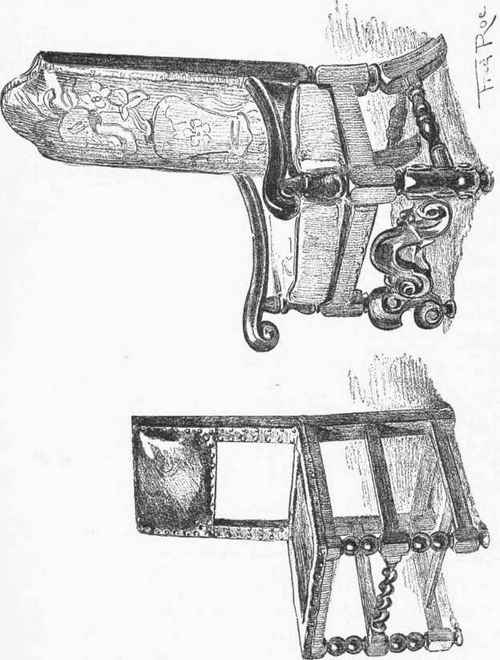
TWO CHAIRS, SECOND HALF OF THE SEVENTEENTH CENTURY.
1 Leather-backed and seated chair, used at the ' Bloody Assize,'Taunton.
2 Arm-chair with stuffed back and cushion, temp. Charles II or William III.
While examining this chair, I was gratuitously informed by an ancient attendant that it was given to the church over 400 years ago - 'But there's no knowin' how old the chair is; nobody can tell that.' I verily believe that custodians increase the sum total of years of local objects every time they relate their little tale. A refutation of this romance, however, was incised upon the reverse of the back, whereby it appears that the chair was presented to the church by one of the churchwardens in 1837, when the incongruous splat was doubtless added.
An entire suite of Charles II. chairs of fine quality is distributed throughout the Minstrels' Gallery and 7 the Great Stairway at that wonderful old mansion, Hardwick Hall, Derbyshire. Other excellent examples exist amongst the furniture in the Long Gallery at Hatfield House, Herts, and some equally good diversified specimens are at Oxburgh Hall, Norfolk. The construction of these cane-furnished chairs is very faulty, and the leverage on the back so great that they cannot be trusted with safety for the purposes of repose. The frequent appearance of the crown upon their backs and stretchers no doubt marks the spirit of the times, when both craftsman and purchaser were glad to show their appreciation of royalty restored. Some very singular evidence as to the precise date of certain of these chairs may be obtained by testing the accuracy of a very popular legend concerning the state furniture in Holyrood Palace. There are a good many chairs and settees of late seventeenth-century pattern at Holyrood, which, with other pieces, have been for generations shown and described as belonging to Mary Stuart's time.
One piece especially, a tall-backed chair with an oviform fitting of cane, and bearing on its summit, as well as on its stretcher, the royal crown flanked with conventional thistles, is actually dubbed with the title of 'Queen Mary's Chair,' while to another piece of furniture, a couch or settee, surmounted with carved cherubs and bearing also on its upholstery the royal crown, a yet more circumstantial fable is attached. The latter relic is said to have been made expressly for the nuptials of Mary Stuart and the weak-minded Darnley in 1565.
Tradition is hard to set aside, perhaps as much so in Scotland as anywhere, but in this case tradition happens to be peculiarly vulnerable. It is well known to students of history that when James, Duke of York, and Mary of Modena visited Edinburgh in 1679 they found residence extremely inconvenient at the palace of Holyrood, owing to the empty and dilapidated state in which it had remained since Cromwell's visitation, when his Ironsides, who had used the palace as their common barracks, had, with their usual destructive zeal, looted and broken up, or otherwise destroyed, every particle of furniture in the place, and for thirty years the building had stood an uncared-for and semi-ruinous shell.
The Duke of York and his consort did not make any very prolonged stay on the occasion of their first visit to Holyrood, but they returned in the autumn of the following year, when the palace had been made habitable and furnished, and for some months James and Mary held their Court here with great magnificence. Accounts are still in existence in respect of this renovation, and point indisputably to the fact that the Holyrood furniture belongs approximately to the date of Charles II.'s reign. The pleasure-seeking public cares little whether such articles were made for Mary Stuart in the sixteenth century, or Mary of Modena at the end of the seventeenth. The former personage stands out a picturesque figure in national history, and is, moreover, associated intimately with the traditions of the palace itself; while of Mary of Modena they know but little, and care less, and her short reign of three years contains perhaps as few striking personal events as her exile of thirty. And so details, specious and pleasant, but essentially false and misleading, are allowed to mislead the popular judgment.
Who can say but what loose fables such as the Mary Stuart legend may be responsible for a goodly proportion of the numerous anachronisms which have been perpetrated during the early and mid-Victorian era, both in historical painting and book illustration? *
Some of the finest chairs of this description are in the possession of Mr. Ernest Crofts, R.A., whose ancestral cupboards and chests will be treated in their proper place. Of the chairs in question, which are not quite uniform, the most elaborate is carved not only with the crown, but with the royal arms; while amongst the scrollwork in the back appear two cupids bearing shields whereon are the letters I.R., the cipher of James II. Furthermore, each of the back uprights, instead of being surmounted with the usual acorn-shaped ornament, is terminated with a diminutive head wearing a jockey-shaped cap such as we now associate with the uniforms of the Royal Horse Guards bandsmen. This chair can undoubtedly be assigned to a time between the years 1685-1689 - a rare instance of internal evidence enabling an undated specimen to be dated with such close accuracy. This magni-ficent piece, together with other articles of antique oak in Mr. Crofts' possession, is all the more interesting in that the Crofts of Suffolk, from whom the present noted historical painter is descended, were, in the seventeenth century, intimately connected with the House of Stuart. *
* Since writing this chapter the author has discovered the following allusion to the subject in Strickland's account of Mary of Modena: 'The crimson damask state bed, which was preserved from the conflagration at Leslie house, is very similar to the bed now shown at Holyrood as that of Mary Stuart; and certainly, both are a hundred years too modern for beds of the sixteenth century. If the Duchess of York occupied the crimson bed at Holyrood, it would, of course, be styled " Queen Mary's bed " after her consort succeeded to the regal office; and, retaining her name after she had been forgotten by the vulgar, has probably been thus added to the numerous goods and chattels with which tradition has fondly endowed Mary of Scotland.' - 'Lives of the Queens of England.'
Continue to:


My Books

