


Oaken Chairs And Stools From The Renaissance To The End Of 17th Century. Part 6
Description
This section is from the book "Old Oak Furniture", by Fred Roe. Also available from Amazon: Old Oak Furniture.
Oaken Chairs And Stools From The Renaissance To The End Of 17th Century. Part 6
It should be mentioned that the panelling of the apartment in which Rizzio was murdered, as well as its window casements, are all replacements of the date of James and Mary's occupation, while even its ceiling is ornamented with the cipher C.R. It is difficult to understand how Sir Walter Scott, in his 'Tales of a Grandfather,' could so have overlooked these facts as to state that 'the cabinet and bedroom still remain in the same condition in which they were at the time' - i.e., of Rizzio's murder.
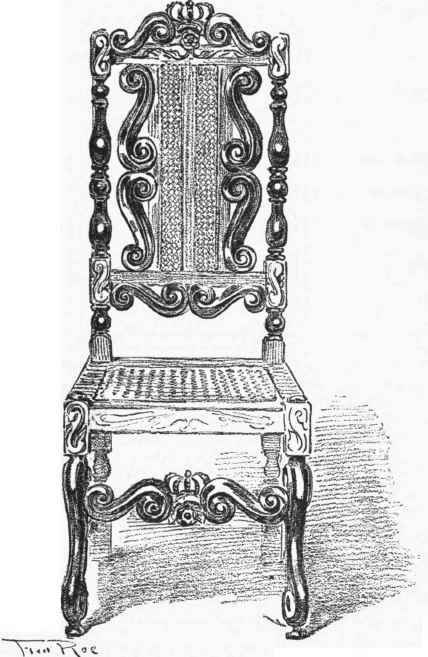
CANE-BACKED CHAIR CARVED WITH ROYAL CROWN, ONE OF A SET IN THE POSSESSION OF SIR CHARLES LAWES-WITTEWRONGE, BART.
The furniture formed part of a vast quantity which is believed to have come originally from West Stow and Saxham Halls, the ancestral seats of the Crofts. This collection was handed down in its entirety for generations, but was finally distributed amongst various members of the family.
* Sir William Crofts was the great grandson of Thomas Crofts, High Sheriff of Suffolk, in the thirty-seventh year of Elizabeth. Having been brought up from his youth at Court, he was appointed Captain of the Guard to Queen Henrietta Maria, and Gentleman of the Bedchamber to the Duke of York, by whom he was also sent to France in 1661 to congratulate Louis XIV. on the birth of the Dauphin. He enjoyed the confidence of the Stuarts, by his adherence to whom he had greatly suffered, and Charles II., while at Brussels, created him a peer of the realm under the title of Lord Crofts of Saxham. He afterwards became Gentleman of the Bedchamber to Charles II. and guardian to the Duke of Monmouth on the death of the latter's mother, Lucy Walters. Lord Crofts died in 1677 without male issue, and was buried in Saxham Church, where an elaborate marble effigy of him was erected and may still be seen. At his death the property passed to an uncle. West Stow Hall still remains, but his residence at Saxham was destroyed in 1771, together with a magnificent apartment which the former owner had added for the reception of Charles II. The estate at Saxham, however, was still in the possession of the Crofts family in the early part of the last century.
As this particular chair has the initials of I.R., it is clear that it must have been originally made over to a member of the Crofts family other than Lord Crofts, who died some eight years before James became King.
It is really surprising how many good chairs of this class are still to be found in various parts of the country with some sort of tradition or family history attaching to them. The University of Cambridge owns a highly ornate example, which is said to have been used by Charles II. when he visited the town. This chair was utilized for the purpose of seating our present Sovereign, King Edward VII., at the Senate-house on the occasion of his visit to Cambridge in March, 1904. At Christie's, in the same month, during the dispersal of the Townshend heirlooms, two pairs of very elaborate arm-chairs of Charles II.'s time were disposed of for sixty guineas per pair. The author has a vivid recollection of their ornate characteristics from seeing them when on a visit to Rain-ham Hall some years ago. Mr. Thomas Grylls, of Park Gate, East Finchley, has two remarkable armchairs, of a somewhat similar character to the Townshend examples, which formerly belonged to the noble family of Lovelace. They are of a date contemporary with the celebrated Lord Lovelace, who plotted so remorselessly against James II. on behalf of William of Orange, and may possibly have figured in the secret meetings of the Whig conspirators at Lady Place.
Inexperienced collectors should be on their guard against a species of bad imitation of the tall-backed Charles II. chair which was produced in large numbers during what is known as the Abbotsford period - that is, in the revival of the taste for antiquities which was created by Sir Walter Scott. These abominations may be easily detected by their coarse and commonplace details, heavy imitations of natural flowering, by the vulgar turning of their spiral rails, and by an entire absence of restraint, the whole surface being covered with an excess of ornament.
Although oak chairs of the seventeenth century and later are plentiful, the same can hardly be said of domestic stools. What is known as the 'joint-stool' - a term which has already been explained - is not a difficult article to acquire, and rough specimens may be found all over the country. The writer has seen them disposed of in country market-places for half a crown apiece, these, however, being usually examples which the connoisseur of fine furniture would not be proud to possess. It will be noticed that joint-stools belonging to the latter part of the Stuart period had quite lost the beauty of members and outline which they possessed in earlier times. The superb example of Renaissance work mentioned in the last chapter, and figured on the left of page 71, would have been quite an impossibility in this degenerate age. An exceedingly interesting, though plain, specimen may be seen at the Buckingham Chapel at Whitchurch, near Edgware. This stool has a history. Handel, who was chapel-master to the Duke of Buckingham and Chandos, is credited with composing his oratorio of 'Esther,' for the consecration of his patron's chapel, and during his residence at the ducal mansion of Canons he composed several anthems and other works, using this stool as he sat at work in the organ-loft.* The stool, which shows signs of considerable hard use, has plain classic pillars for legs, and is of extremely simple design, being a very characteristic example of the artistic severity of the latter end of the seventeenth century.
Continue to:


My Books

