


Chapter I. Old Oak, Old Leather, Turkey Work, Etc
Description
This section is from the book "The Old Furniture Book", by Hannah Hudson Moore. Also available from Amazon: The Old Furniture Book.
Chapter I. Old Oak, Old Leather, Turkey Work, Etc
WITH the revival of interest in all "antiques," which is so widely spread at this time, any of us who chance to own an old piece of furniture feel an added degree of affection for it if we can give it an approximate date and assign it to a maker or a country. There is much good old furniture in the United States, chiefly of Spanish, Dutch and English make, though there are constant importations of other makes, notably French, since it is recognized on all sides that Americans are becoming the collectors of the world. Our public museums are gradually filling with works of art presented by broad-minded citizens, while the private galleries are rich and increasing every day. To keep pace with these possessions, furniture from old palaces and manor-houses is being hauled forth and set up again in our New World homes. Indeed, whole interiors have been removed from ancient dwellings, and the superb carvings of other days become the ornaments of modern houses, like the gilded oak panels from the Hotel Montmorency which were built into the Deacon House in Boston, or like Mrs. Gardiner's Venetian carved wood which decorates her palace in the Boston Fens.
Oak panelling, like everything else, passed through various periods and styles. In Queen Elizabeth's time the panels were carried to within about two feet of the cornice; then, after some years, there came a division into lower and upper panelling, the upper beginning at about the height of the back of a chair from the floor. Pictures became more common, and they were frequently let into the upper panelling, and then it was discarded altogether, only the lower half or dado being retained. This, too, after some years, became old-fashioned, and the board known as skirting, or base-board, was all that was left of the handsome sheathing which extended from the floor almost to the ceiling. This old oak panelling was entirely without polish or varnish of any kind, and grew with years and dust almost black in colour. Sometimes it was inlaid with other woods, and often it was made for the rooms where it was placed. Where the panels are carved, they are generally bought in that state and set in plain framework by the household joiner. If, however, the frame is carved and the panels plain, they were made to suit the taste and purse of the owner of the mansion. Oak panelling took the place of the arras, tapestry hangings, and crude wood-work of earlier times.
Of course it was adopted by the rich and luxurious, for it rendered more air-tight the draughty buildings.
The oldest furniture was made of oak, more or less carved, whether of Spanish, Italian, Dutch, or English make. The multiplication of objects which we consider necessary as "furnishings" were pleasingly absent, and chests used as receptacles for clothes or linens, for seats by day and beds by night, with a few beds also of carved oak, and tables, made up the chief articles of domestic use.
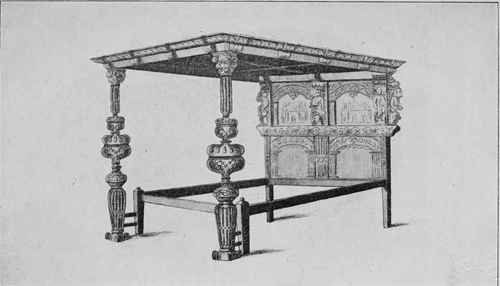
Figure 1. OLD OAK BEDSTEAD.
Even the very word "furniture" itself is of obscure origin and was used formerly, as now, to describe the fittings of houses, churches, and other buildings.
There are a few terms applied to furniture referring either to its decoration or process of manufacture with which it is well to become acquainted. They are given here in the order of their importance.
Veneering is the process of coating common wood with slices of rare and costly woods fastened down with glue by screw presses made to fit the surface to be covered. It was first used in the reign of William and Mary, in the last decade of the seventeenth century. Until that time furniture had been made of solid wood. Veneer of this early period, particularly burr-walnut veneer, was about one sixteenth of an inch thick, and was sometimes applied to oak. Chippendale, Hepplewhite, and Sheraton used mahogany and satin-wood both solid and for veneers. When used as veneers they were all hand-cut, as they are in all high-class furniture to-day. It was not till the late Georgian period that machinery for cutting veneer was first used, and slices were produced one thirty-second of an inch in thickness. Most of the cheaper kinds of modern furniture are veneered.
Marquetry is veneer of different woods, forming a mosaic of ornamental designs. In the early days of the art, figure subjects, architectural designs, and interiors were often represented in this manner.
Rococo, made up from two French words meaning rock and shells, roequaille et coquaille, is a florid style of ornamentation which was in vogue in the latter part of the eighteenth century.
Buhl, or Boulle,is inlaid work with tortoise-shell or metals in arabesques or cartouches. It derived its name from Boule, a French wood-carver who brought it to its highest perfection.
Ormolu refers to designs in brass mounted upon the surface of the wood. This metal was given an exceedingly brilliant colour by the use of less zinc and more copper than is commonly used in the composition of brass, and was sometimes still further made bright by the use of varnish and lacquer.
Baroque. This word, which was derived from the Portuguese baroco, meant originally a large irregular pearl. At first the term was used only by jewellers, but it gradually became technically applied to describe a kind of ornament which became popular on furniture early in the nineteenth century, after the rage for the classic had passed. It consisted of a wealth of ornament lavished in an unmeaning manner merely for display; and scrolls, curves, and designs from leaves were used to cover pieces, making them lack beauty and that grace which comes from pure and simple lines.
Lacquer is coloured or opaque varnish applied to metallic objects as well as wood. The name is obtained from "resin lac," the material which is used as the base of all lacquers. In the East Indies the whole surface of wooden objects, large and small, is covered with bright-coloured lacquers. The Japanese lacquers are the finest that are made. They excel in the variety and exquisite perfection of this style of work, and under their skilful manipulation it becomes one of the choicest forms of decorative art. The most highly prized lacquer is on a gold ground, some specimens of which reached Europe in the time of Louis XV.
Continue to:


My Books

