


Chapter XI. Clocks
Description
This section is from the book "Furniture Of The Olden Time", by Frances Clary Morse. Also available from Amazon: Furniture of the Olden Time.
Chapter XI. Clocks
UNTIL about 1600, clocks were made chiefly for public buildings or for the very wealthy, who only could afford to own them; but with the seventeenth century began the manufacture of clocks for ordinary use; these clocks were of brass, and were known as chamber clocks. The earliest form in which they were made was what is now called the "birdcage" or "lantern" clock. Inventories in this country from 1638 to 1700 speak of clocks with valuations varying from £2 to £20, and occasionally a "brass clock' is specified. This must refer, as some of the others may also have done, to the lantern clock. The lantern clock in Illustration 339 is owned by William Meggatt, Esq., of Wethersfield. The illustration shows the form of the clock, from which it naturally derived the names "lantern" and "bird-cage." The clock is set upon a bracket, and the weights hang upon cords or chains passing through openings in the shelf; the pendulum also swings through a slit in the shelf. The dial projects beyond the frame of the clock, and is six inches in diameter, and there is but one hand. The dome at the top is partially concealed by the frets above the body of the clock. Different clock-makers had frets of their own, and the design of the fret is often a guide for determining the date of such clocks. The one upon the clock in Illustration 339 is what was called the "heraldic fret" from the small escutcheon in the centre, and it was used upon clocks made from 1600 to 1640. The fret with crossed dolphins was in use from 1650, and is the pattern of fret most frequently found upon these clocks. The long pendulum must have been a later substitution, for it was not commonly used until 1680, clocks up to the time of its invention having the short or "bob" pendulum. There is no maker's name upon this clock.
Illustration 340 shows a "lantern" clock in the house of Charles R. Waters, Esq., which has a fret of a later period, and the long pendulum. The dial is slightly larger than the one in Illustration 339, and upon it is engraved the name of the maker, Jno. Snatt, Ashford. This name is not in Britten's list of clock-makers, so it is probable that Jno. Snatt was a country clock-maker. The clock was made about 1680. The brackets are modern.
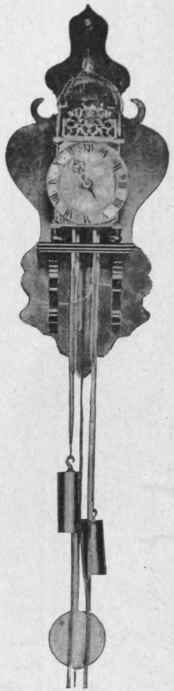
Illus. 339. - Lantern or Bird-cage Clock, First Half of Seventeenth Century.

Illus. 340. - Lantern Clock, about 1680.
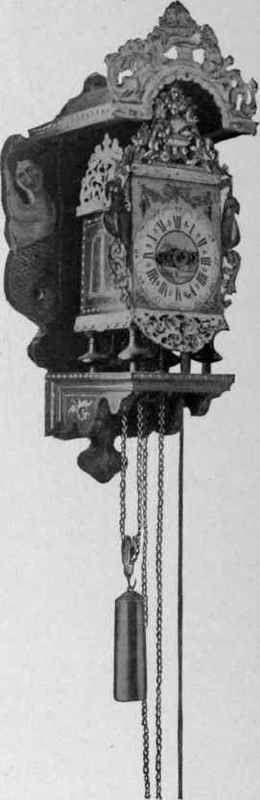
Illus. 341. - Friesland Clock, Seventeenth Century.
A clock which was made during the seventeenth century is shown in Illustration 341. It is known as a Friesland clock, from the fact that clocks of this style are common in the north of Holland, having been in use there over two centuries. The pendulum of this clock swings above the shelf. The frame rests upon four wooden feet, and its sides and back are of glass. The face and ornaments are made of lead, the ornaments being gilded, except the parrots at each side, which are painted in vivid parrot greens. The mermaids upon the bracket are painted in colors, and the face also is painted, the whole making a gay bit of decoration. The Fries-land clocks generally have mermaids and parrots as part of the decoration of clock and bracket. There is a small brass dial in the centre of the face, which can be set for the alarm. Friesland clocks were in use in the seventeenth century in this country, probably having been brought here by Dutch settlers. This clock is owned by the writer.
Bracket clocks were made during the last years of the seventeenth century with wooden cases, and they were very popular during the eighteenth century. They generally have a brass handle at the top by which they can be carried. A bracket clock with brass face and sides may be seen upon the mantel in Illustration 388. It has the plate of the maker over the dial, with the name Daniel Ray, Sudbury, probably an English clock-maker. This clock was made about 1760.
Illustration 342 shows two bracket clocks in the collection of the late Major Ben: Perley Poore. The larger one has the top made in the arch form instead of the bell top like the clock in Illustration 388, and this would place its date about 1780. The name upon this clock, George Beatty, Georgetown, was that of the owner. The smaller clock has an inlaid case, and was evidently made after Sheraton's designs of 1790-1800. Both clock-cases are of mahogany.
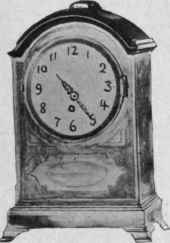
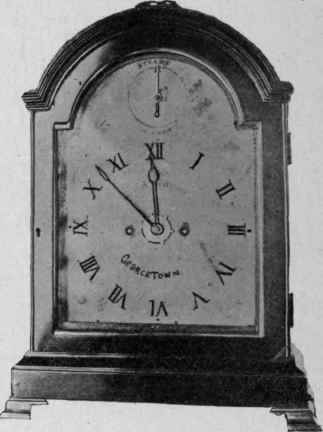
Illus. 342. - Bracket Clocks, 1780-1800.
The earliest mention of tall clocks in inventories is in the latter part of the seventeenth century, where they are always spoken of as "clock and case." The use of the long pendulum was probably the cause of the development of the tall clock from the "lantern clock," which had often a wooden hood over it; and when the long pendulum came into use in 1680, the lower part of the tall clock-case was made to enclose the pendulum, and sides and a glass front were added to the hood. The first cases were of oak or walnut, and the dials were square, but early in the eighteenth century the arched top was added to the dial, suggested perhaps by the shape of the dome.
The ornaments which fill in the spandrels, or corners of the face, are somewhat of a guide to the date of a brass-faced clock. The earliest spandrels had cherubs' heads with wings, and this design was used from 1671 until 1700, when more ornaments were added to the cherub's head. Later came a still more elaborate design of two cherubs supporting a crown, until about 1750, when the scrolls were made without the cherubs, but with a shield or head in the centre of the spandrel.
Continue to:


My Books

