


Fires And Lights. Part 4
Description
This section is from the book "Furniture Of The Olden Time", by Frances Clary Morse. Also available from Amazon: Furniture of the Olden Time.
Fires And Lights. Part 4
"Skreans" are mentioned in very early inventories, and indeed they must have been a necessity, to protect the face from the intense heat of the large open fire. They afforded then, as now, an opportunity for the display of feminine handiwork. The dainty little firescreen in Illustration 328 was made about 1780, and is owned by Mrs. Johnson-Hudson of Stratford, Connecticut. The frame and stand are of mahogany, and the spreading legs are unusually slender and graceful. The embroidered screen was wrought by the daughters of Dr. William Samuel Johnson, the first president of Columbia University. The same young girls embroidered the top of the card-table in Illustration 199, and the work is done with the same patient industry and skill. The vase which is copied in the embroidery is of Delft, and is still owned in the family.
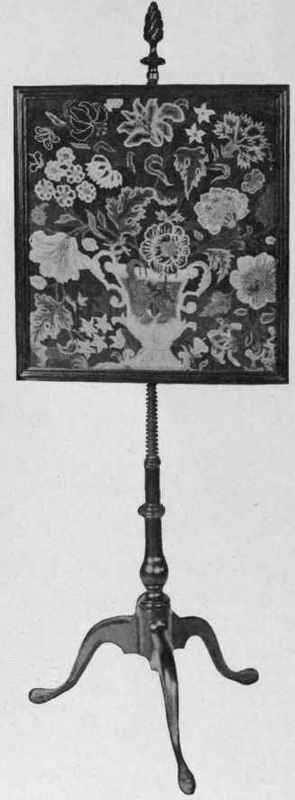
Illus. 328. - Embroidered Screen, 1780.
A very curious and interesting piece of work is shown in Illustration 329. It forms the back of a sconce owned by Francis H. Bigelow, Esq., and in his book "Historic Silver of the Colonies," Mr. Bigelow describes the candle bracket, made in 1720 by Knight Leverett, which fits into the socket upon the frame. Benjamin Burt, the silversmith, in his will left to a niece "a sconce of quill work wrought by her aunt." In 1755 a Mrs. Hiller advertised to teach "Wax work, Transparent and Filligree, Quill work and Feather work." "Quill work" is made of paper of various colors, gilt upon one side, rolled tightly, like paper tapers. Some were pulled out into points, others made into leaf and petal-shaped pieces, and when finished they were coated with some waxy substance, and sprinkled with tiny bits of glass, all in gay colors, and when the candles were lighted the quill work glistened and sparkled.
The quill work in this sconce is made into an elaborate design of a vase with flowers, and it is set into a very deep frame, and covered tightly with glass, which accounts for its perfect preservation. The top ornament to the frame is cut in the manner of looking glass frames of the period.
The tripod screen in Illustration 330 is owned by Dwight M. Prouty, Esq. The little shelf for the candlestick drops on a hinge when not in use. The tripod feet have a light springing curve, and end in a flattened claw-and-ball. The original embroidery is still in the frame.
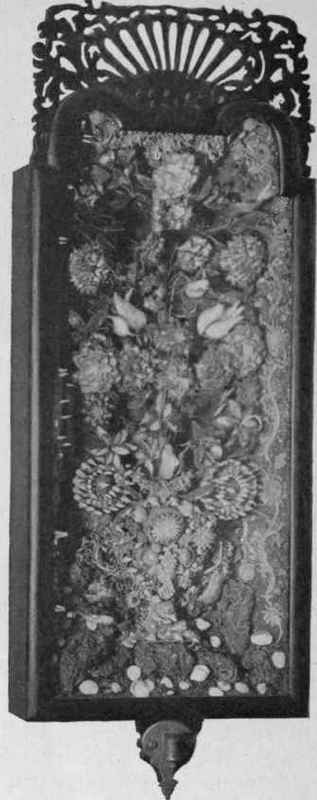
Illus. 329. - Sconce of Quill Work, 1720.
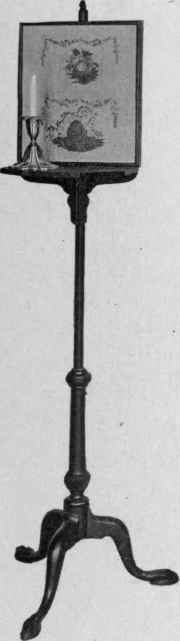
Illus. 330. - Tripod Screen. 1770.
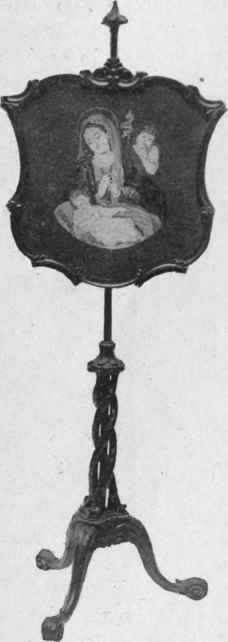
Illus. 331. - Tripod Screen, 1765.
Another tripod screen is shown in Illustration 331. It is owned by Cornelius Stevenson, Esq., of Philadelphia. The embroidery and the frame upon it were made in the nineteenth century but the stand is much earlier and is finely carved in the Chippendale style, with the French foot. Three serpents encircle the pole, from which they are completely detached. The wood is mahogany. Screens were sometimes made of a piece of wood perforated, in order that the heat might not be entirely shut off. Illustration 332 shows one of these screens in the collection of the late Major Ben : Perley Poore. Both the screen and the candle-stand in the illustration are made of mahogany. The candlestick upon the stand is a curious one, of brass, with a socket for the candle set upon an adjustable arm, which also slides upon a slender rod, which is fastened into the heavily weighted standard. Both screen and candle-stand were made in the latter half of the eighteenth century. Candle-stands were designed by all the great cabinet-makers, and in those days of candlelight they were a useful piece of furniture.
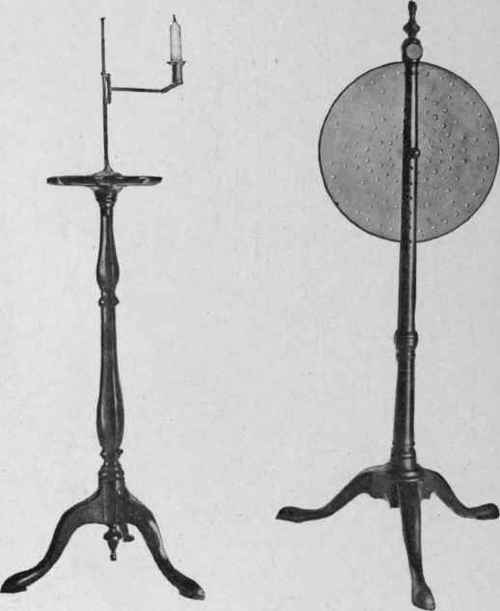
Illus. 332. - Candle-stand and Screen, 1750-1775.
A candle-stand in the finest Chippendale style is shown in Illustration 333. It is one of a pair owned by Harry Hark-ness Flagler, Esq. The intention was presumably that a candle-stand with candelabrum should be placed at each side of the mantel. A pair of candle-stands similar to this are in the banquet hall at Mount Vernon, and are among the few pieces of furniture there which are authenticated as having been in use during Washington's occupancy of the house. The candle-stand in the illustration is forty-two inches high, and its proportions are beautiful. The legs and the ball at the base of the fluted pillar are very finely carved. The legs end in the French foot, the scroll turning forward, which was such a favorite with Chippendale. The top is carved out so that there is a raised rim, like that upon the "dish-top" table in Illustration 246.
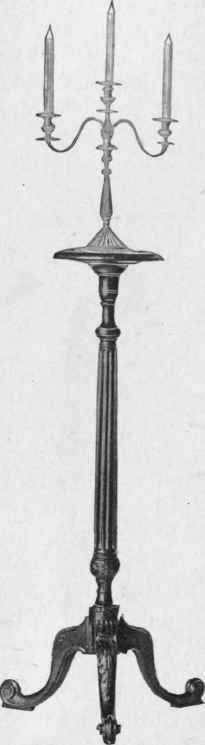
Illus. 333. - Chippendale Candle-stand, 1760-1770.
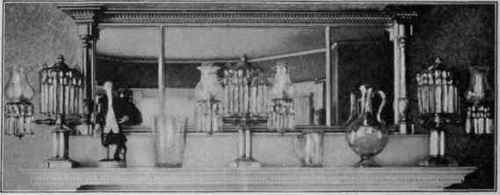
Illus. 334. - Bronze Mantel Lamps, 1815-1840.
The first recorded instance in this country of lighting by artificial gas is in 1806, when David Melville of Newport, Rhode Island, succeeded in manufacturing gas, and illuminated his house and grounds with it. In 1822 Boston was lighted by gas, but it did not come into general use for lighting until 1840-1850.
During the second quarter of the nineteenth century it was fashionable to use candelabra and lamps which were hung with cut-glass prisms. Sets of candelabra for the mantel were very popular, consisting of a three-branched candelabrum for the middle and a single light for each side. The base was usually of marble, and the gilt standard was cast in different shapes, - of a shepherd and shepherdess, a group of maidens, or a lady clad in the costume of the day. From an ornament at the base of the candle, shaped like an inverted crown, hung sparkling prisms, catching the light as they quivered with every step across the room. A handsome set of these is shown in Illustration 318 upon the mantel.
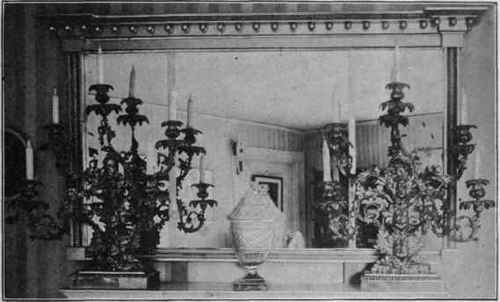
Illus. 335. - Brass Gilt Candelabra, 1820-1849.
Illustration 334 shows a set of mantel lamps of bronze, mounted upon marble bases and hung with cut-glass prisms. The reservoir for the oil is beneath the long prisms. This set is owned by Francis H. Bigelow, Esq.
Illustration 335 shows a fine pair of brass gilt candelabra also owned by Mr. Bigelow. They have marble bases, and the five twisted arms are cast in an elaborate design.
Illustration 336 shows a hall lantern which was formerly in use in the John Hancock house. It is now owned by Harry Harkness Flagler, Esq. Such lanterns were hung in the entry or hall, and were made to burn either a lamp or candle. "Square glass, bell glass, barrel or globe lanthorns for entries or staircases" were advertised as early as 1724 and formed a necessary furnishing for the hall of a handsome house.
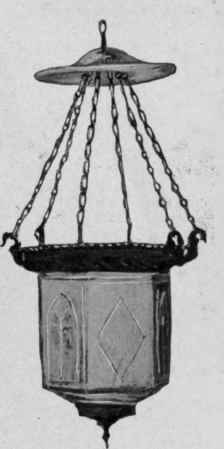
Illus. 336. - Hall Lantern, 1775-1800.

Illus. 337. - Hall Lantern, 1760.
Illustration 337 shows a hall lantern owned by Dwight M. Prouty, Esq. It is of a globe shape, and very large and handsome, with deep cutting on the glass. The bell-shaped piece of glass above is missing. This bell was to prevent the smoke of the candle from blackening the ceiling. The metal piece below the globe contains the socket and can be removed to change the candle.
Illustration 338 shows one of two lanterns hung in the hall of the house built for the Pendelton Collection, in Providence. It is unusually large, and the glass is red with cuttings of white. Instead of chains the lantern is held by scrolls of metal like the frame of the glass. Such a lantern as this may have been in the mind of Peter Faneuil of Boston when in 1738 he sent to Europe for "a very handsome Lanthorne to hang in an Entry way."
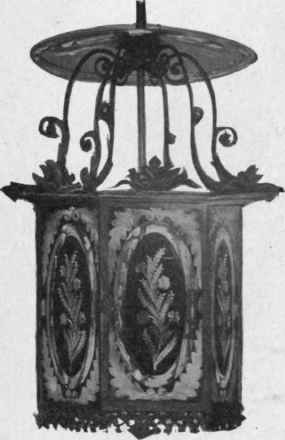
Illus. 338. - Hall Lantern, 1760.
Continue to:


My Books

