


Chapter VIII. Tables
Description
This section is from the book "Furniture Of The Olden Time", by Frances Clary Morse. Also available from Amazon: Furniture of the Olden Time.
Chapter VIII. Tables

The earliest form of table in use in this country was inventoried in 1642 as a "table bord," and the name occurs in English inventories one hundred years earlier. The name "board' was given quite literally from the table top, which was a board made separately from the supporting trestles, and which, after a meal, was taken off the trestles, and both board and trestles were put away, thus leaving the room free. These tables were long and narrow, and had in earliest times a long bench or form at one side only, the other side of the board being left free for serving. In the Bolles collection is a veritable "borde" rescued from the attic of a deserted house, where it had stood for scores of years. The board is about twelve feet long and two feet one inch wide, and bears the mark of many a knife. It rests upon three rude trestles, presenting a wonderfully interesting example of the "table borde" of the sixteenth and early seventeenth centuries, and one which is extremely rare.
It will be easily seen how the expression "the festive board" originated. Presently it became the custom to leave the board upon its trestles, instead of removing both, and in time the piece was called a table, which name covered both board and trestles. Some of the different forms of the table mentioned in inventories are framed and joined tables, chair tables, long tables, drawing-tables, square, oval, and round tables. The framed and joined tables refer to the frame beneath the board. The other tables derive their names from the shape or construction of the tops. A drawing-table was one made with extension pieces at each end, supported when out by wooden braces, and folding back under or over the table top when not in use.

Illus. 232. - Chair Table, Eighteenth Century.
A chair table is shown in Illustration 232. The table top is put back in the illustration, so that the piece can be pushed against the wall and used as a chair. Chair tables always had the drawer beneath the seat. They are inventoried as early as 1644.

Illus. 233. - Oak Table, 1650-1675.
This chair table belongs to Dwight Blaney, Esq., of Boston.
The framed or joined table had turned legs, with stretchers between, and a drawer under the table top. Illustration 233 shows an oak table formerly owned in the Coffin family, and now in the building of the Newburyport Historical Society. The table is a good example of the framed or joined table early in the seventeenth century. The legs and stretchers are of the same style as those upon wainscot chairs, which belong to the same period as the table.
Illustration 234 shows a table with slate top, owned by the American Antiquarian Society of Worcester. The slate top originally filled the eight-sided space in the centre of the table, but only the middle section is now left. Beside the piece of slate is a paper written by the late ink-stains cover the marquetry border around the top, and whose feet have worn the stretchers. Slate-top tables are very rare, and there are but few known to exist. The turned legs and stretchers and the drawer in the table are features which appear in tables of the same date with wooden tops. There is one drop handle left upon the drawer, the frame around which has the early single moulding.
John Preston of New Ipswich, New Hampshire, in 1847, when he gave the table to the Antiquarian Society, detailing the history of the table from the time it was given to his ancestor, the Rev. Nehemiah Walter, who graduated from Harvard University in 1682. The table was used by generation after generation of ministers and lawyers, whose Illustration 235 shows a curious little table, several of which have been found in Connecticut, and which were probably made there. It has the turned legs, with plain stretchers, of the tables in Illustration 233. The oval top has drop leaves which are held up by wing-shaped braces, from which comes the modern name for this table, of "butterfly table."

Illus. 234. - Slate-top Table, 1670-1680.

Illus. 235. - "Butterfly Table," about 1700.
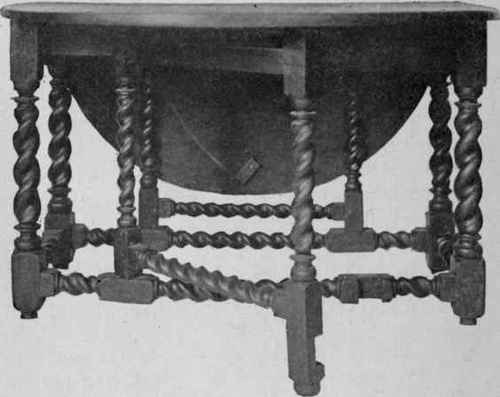
Illus. 236. - "Hundred-legged Table," 1675-1700.
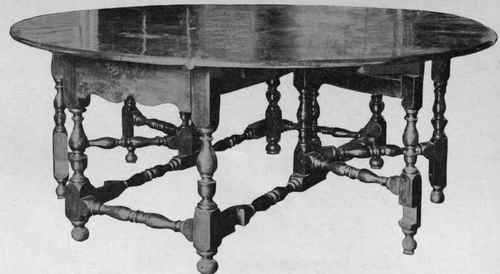
Illus. 237. - "Hundred-legged Table," 1680-1700.
The table in Illustration 236 is an unusually fine example of what is now called a "hundred-legged" or "forty-legged" table, evidently from the bewildering number of legs beneath it, which are wofully in the way of the legs of the persons seated around it. This table is made of oak, with twisted legs, and measures four feet by five and a half. The supporting legs, when not in use, swing around under the middle leaf. The table is owned by Dwight Blaney, Esq.
Illustration 237 shows a superb walnut dining-table, now in the rooms of the Albany Historical Society. It measures six and a half feet by six feet. It belonged to Sir William Johnson and when confiscated in 1776 from that Royalist, it was bought by Hon. John Taylor, whose descendants loan it to the Society. These tables are also called " gatelegged," from the leg which swings under the leaf, like a gate.
Illustration 238 shows a very small, and very rare gate-legged table with trestle feet upon the middle section, enabling it to stand firmly with the leaves dropped. It belongs to Dwight M. Prouty, Esq.
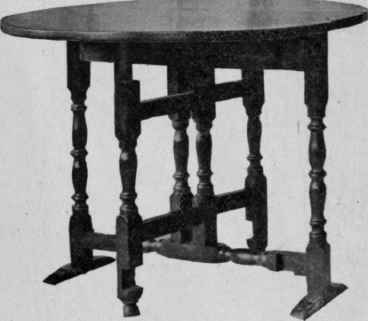
Illus. 238. - Gate-legged Table, 1680-1700.
Continue to:


My Books

