


Tables. Part 2
Description
This section is from the book "Furniture Of The Olden Time", by Frances Clary Morse. Also available from Amazon: Furniture of the Olden Time.
Tables. Part 2
Illustration 239 shows a spindle-legged, gate-legged table, a type exceedingly rare like all spindle-legged furniture. The slender legs have Dutch feet. This dainty table has descended to Mrs. Edward W. Rankin of Albany, from Kath-erine Livingstone, who brought it with her when she came to Albany in 1764, as the bride of Stephen Van Rensselaer, the Patroon. It must then have been an inherited piece.
Illustration 240 shows a forty-legged table, such as is not uncommonly found. It measures four feet in length. The large Sheffield plate tray on feet was made in the early part of the nineteenth century, when trays of various sizes upon feet were fashionable. The tea-set upon the tray is one made about 1835, and is extremely graceful in shape. The table and silver are owned by the writer.
The little Dutch table in Illustration 241 has the next style of leg used upon tables, which were made in all sizes, and were presumably very popular, for such tables are often found. One leg slides around on each side to support the leaves. This table was made about 1740, and belongs to Francis H. Bigelow, Esq. The same Dutch leg is seen in Illustration 242 upon a dainty little mahogany card-table, with slides at each end to hold the candlesticks. This table belongs to Miss Tilton of Newburyport.

Illus. 239. - Spindle-legged Table, 1710-1720.

Illus. 240. - "Hundred-legged Table," 1680-1700.
Illustration 243 shows a mahogany table with claw-and-ball feet owned by the writer. The top measures four feet four inches across, and its date is about 1750. The double coaster upon wheels, filled with violets, was made to hold decanters of wine, and one can imagine these wheels rattling down the mahogany table as the evening grew late and the decanters empty.
As early as 1676 stands are spoken of in inventories, and during the eighteenth century they were a common article of furniture. The tops were square, oval, or round, and the base consisted of a pillar with three spreading feet. Illustration 244 shows the early foot used for these stands, about 1740. This table is owned by Miss Mary Coates of Philadelphia, and the silver pieces upon it are heirlooms in her family. These stands came to be known as "Dutch Tea-Tables," and the bases were often elaborately carved. The tops of the handsomest tables were carved out of a thick piece of wood, so as to leave a rim, to keep the china from sliding off. This carved rim was in different forms, the finest being what is now called "pie-crust," with an ogee scallop. The plain rim is now known as the "dish-top." Illustration 245 shows a pie-crust table owned by Dwight Blaney, Esq. Illustration 246 shows a dish-top table belonging to Francis H. Bigelow, Esq. Both tables have claw-and-ball feet, and they are made, like all of the Dutch tea-tables, with the top revolving upon the pillar. When not in use the top could be "tipped," and the table put back against the wall; and when the top was to be used, it fastened down with a snap.

Illus. 241. - Dutch Table, 1720-1740.

Illus. 242. - Dutch Card-table, 1730-1740.

Illus. 243. - Claw-and-ball-foot Table, about 1750.
Illustration 247 shows two of the finest type of tea-tables.
They are owned by Harry Harkness Flagler, Esq. One has the pie-crust edge, and the other a scalloped edge. The pillars of both are reeded, and the legs are carved.

Illus. 244. - Dutch Stand, about 1740.

Illus. 245. - "Pie-crust Table," 1750.
A great difference can be noted between these two bases, in the sweep of the spreading legs, and in the claw-and-ball feet, which are especially fine upon the pie-crust table. The proportions of this table are unusually good, the central pillar being slender, and the finely carved legs having a spread which gives a very graceful and light effect.
Illustration 248 shows another fine table and chair owned by Mr. Flagler. The chair is described upon page 183. The table has an oval top, carved, not in a regular scallop, but in rococo scrolls. It has a heavier pillar than the pie-crust table in the last illustration, and the legs have a smaller spread.
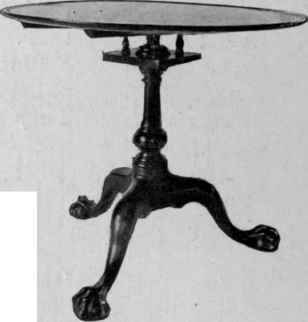
Illus. 246. - "Dish-top Table," 1750.
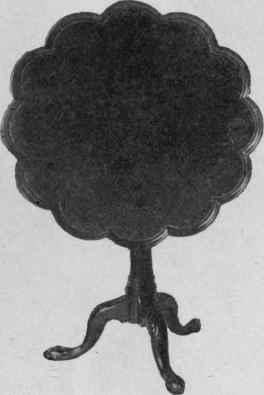

Illus. 247. - Tea-tables. 1750-1760.

Illus. 248. -Table and Easy Chair, 1760-1770.
A tripod table with a remarkable top is shown in Illustration 249. It belongs to J. J. Gilbert, Esq., of Baltimore. The rim is carved and pierced like the mahogany trays of the time.

Iilus. 249. - Tripod Table, 1760-1770.
Continue to:


My Books

