


Chapter VI. Chairs
Description
This section is from the book "Furniture Of The Olden Time", by Frances Clary Morse. Also available from Amazon: Furniture of the Olden Time.
Chapter VI. Chairs
CHAIRS are seldom mentioned in the earliest colonial inventories, and few were in use in either England or America at that time. Forms and stools were used for seats in the sixteenth and early seventeenth centuries, and inventories of that period, even those of wealthy men, do not often contain more than one or two chairs. The chair was the seat of honor given to the guest, others sitting upon forms and stools. This custom was followed by the American colonists, and forms or benches and joint or joined stools constituted the common seats during the first part of the seventeenth century.
The chairs in use during that period were "thrown" or turned chairs; wainscot chairs, sometimes described as "scrowled" or carved chairs; and later, chairs covered with leather, or "Turkey work," and other fabrics.
The best-known turned chair in this country is the "President's Chair" at Harvard University. Dr. Holmes has written of it in "Parson Turell's Legacy": -

Illus. 120. - Turned Chair, Sixteenth Century.
"- a chair of oak, - Funny old chair, with seat like wedge, Sharp behind and broad front edge, - One of the oddest of human things, Turned all over with knobs and rings, - But heavy, and wide, and deep, and grand, - Fit for the worthies of the land, - Chief Justice Sewall a cause to try in, Or Cotton Mather, to sit - and lie, - in."
In the Bolles collection is a chair similar to the Harvard chair, and one is shown in Illustration 120, owned by Henry F. Waters, Esq., of Salem. A turned chair of the same period with a square seat is owned by the Connecticut Historical Society.
Provision was made for the youngest of the large family of children, with which the colonist was usually blessed, in the high chair, which is found in almost every type. A turned high chair is shown in Illustration 121, brought by Richard Mather to America in 1635, and used to hold the successive babies of that famous family, - Samuel, Increase, Cotton, and the others. The rod is missing which was fastened across the front to hold the child in, and only the holes show where the pegs were placed to support the foot-rest. This quaint little chair is owned by the American Antiquarian Society of Worcester.
A style of turned chair more commonly in use is shown in Illustration 122, said to have been brought on the Mayflower by Governor Carver. The chair in Illustration 123, originally owned by Elder Brewster, is of a rarer type, the spindles being greater in number and more finely turned. Both of these chairs are in Pilgrim Hall, in Plymouth. Turned chairs are not infrequently found of the type of Illustration 122, but rarely like the Brewster chair or the turned chair in Illustration 120.

Illus. 121. - Turned High-chair, Sixteenth Century.
The wainscot chair was made entirely of wood, usually oak, with a panelled back, from which came the name" wainscot." Its valuation in inventories was two or three times that of the turned chair, which is probably the reason why wainscot chairs are seldom found.
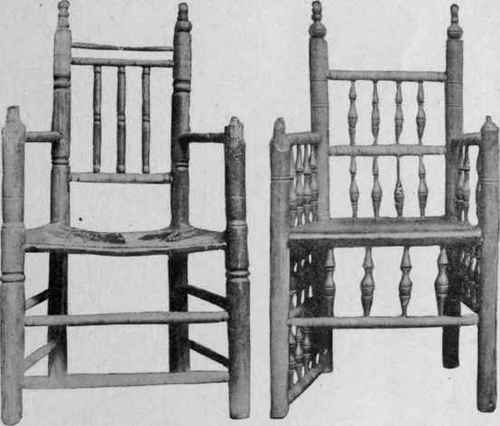
Illus. 122 and Illus. 123. - Turned Chairs, about 1600.
The finest wainscot chair in this country is shown in Illustration 124. It belongs to the Essex Institute of Salem, having been given to that society in 1821 by a descendant of the original owner, Sarah Dennis of Ipswich, who possessed two of these chairs; the other is now the President's chair at Bowdoin College.
A plainer form of the wainscot chair is shown in Illustration 125. It was brought to Newbury in the ship Hector, in 1633, and is now in the collection of the late Major Ben : Perley Poore, at Indian Hill.
By the middle of the seventeenth century chairs had become more common, and inventories of that period had frequent mention of leather or leather-backed chairs. Some of the earliest leather chairs have the under part of the frame similar to that of the wainscot chair, with plain legs and stretchers, while others have the legs and back posts turned. Illustration 126 shows a leather chair made about 1660, in the Waters collection. The seat and back have been covered with leather in the same manner as they were originally, as enough remained of the old cover to copy.
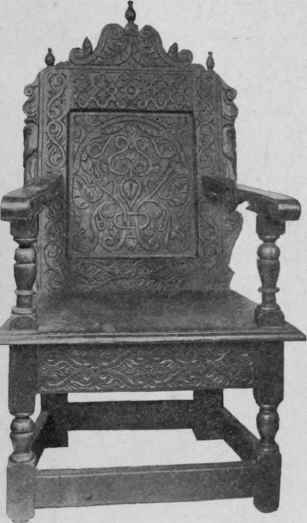
Illus. 124. - Wainscot Chair, about 1600.
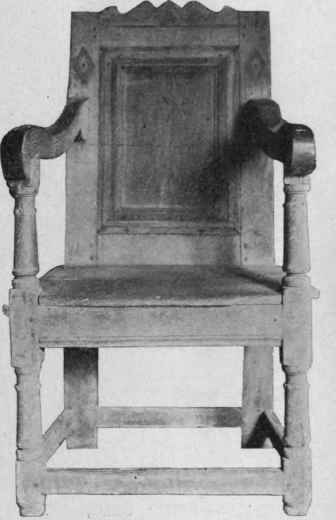
Illus. 125. - Wainscot Chair, about 1600.
Continue to:


My Books

