


Desks. Part 5
Description
This section is from the book "Furniture Of The Olden Time", by Frances Clary Morse. Also available from Amazon: Furniture of the Olden Time.
Desks. Part 5
After the publication of the designs of Shearer, Hepplewhite, and Sheraton, the heavy desks were superseded by those of lighter design, and the slant-top bureau desk was seldom made after 1790. Sheraton says: "Bureau in France is a small chest of drawers. It has generally been applied to common desks with drawers made under them. These pieces of furniture are nearly obsolete in London." Slant-top desks do not appear in cabinet-makers' books published after 1800, and it is safe to assign a date previous to the nineteenth century to any such desk.
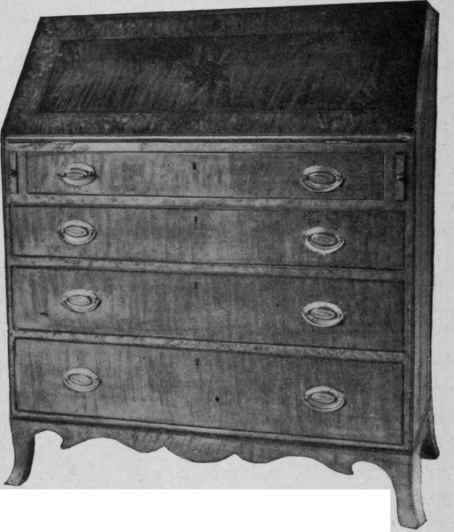
Illus. 113. - Maple Desk, about 1795.
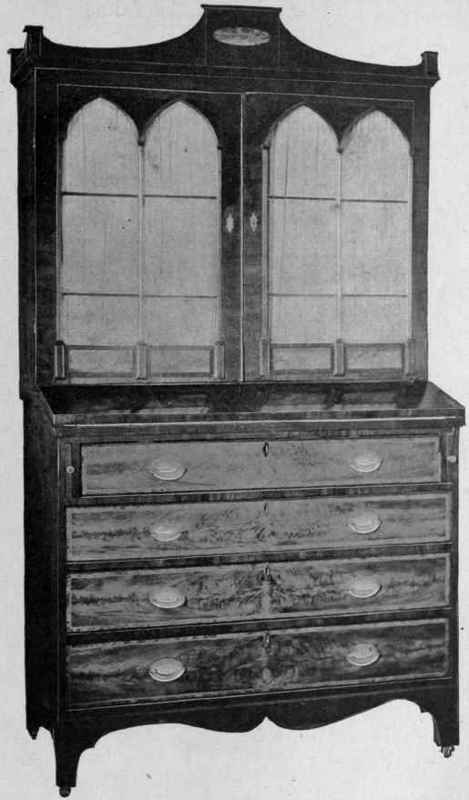
Illus. 114. - Hepplewhite Desk, Cabinet Top. 1790.
Illustration 113 shows the latest type of a slant-top desk, made in 1790 - 1795. The frame is of maple, the drawers being of curly maple edged with ebony. The lid is of curly maple framed in bird's-eye maple with ebony lines, and in the centre is a star made of mahogany and ebony. The small drawers inside are of bird's-eye maple, three of the drawers having an ebony and mahogany star. The base is what Hepplewhite calls a French base, and the desk, which measures only thirty-six inches in length, is a good example of the artistic use of the different varieties of maple with their golden hues. This desk belongs to the writer.
Illustration 114 shows a Hepplewhite desk with cabinet top owned by the writer, and made about 1790. The drawers are veneered with satinwood, with a row of fine inlaying of holly and ebony around each drawer front. The base is after Hepplewhite's design, and has a row of ebony and holly inlaying across it. The slightly slanting lid turns back and rests upon two pulls to form a writing-table. The pigeonholes and small drawers are behind the glass doors, which are made like two Gothic arches, with three little pillars, and panels of satinwood between the bases of the pillars. The pediment at the top of the cabinet is quite characteristic of the period.
Illustration 115 shows a charming little Sheraton desk owned by W. S. G. Kennedy, Esq., of Worcester. It is made of bird's-eye maple with trimming of mahogany veneer, and a row of ebony and holly inlaying below the drawers. The upper part has one maple door in the centre, with a tambour door of mahogany at each side, behind which are pigeonholes and small drawers. The lid shuts back upon itself, and, when open, rests upon the two pulls at each side of the upper drawer. The wood of this desk is beautifully marked, and the whole effect is very light and well adapted to a lady's use.
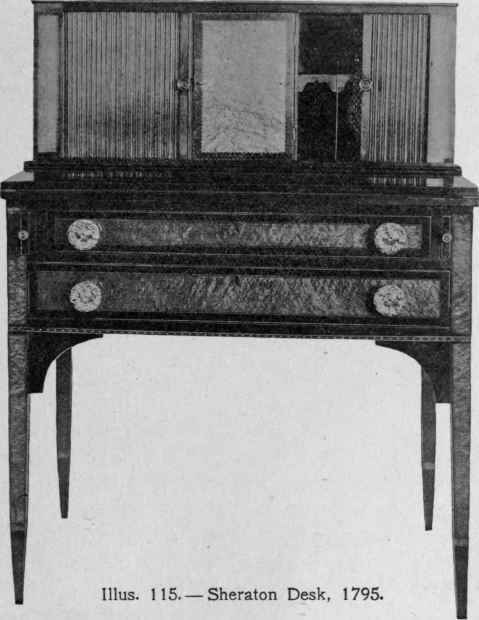
The word "tambour" is thus defined by Sheraton: 'Tambour tables among cabinet-makers are of two sorts; one for a lady or gentleman to write at, and another for the former to execute needlework by. The Writing Tambour Tables are almost out of use at present, being both insecure and liable to injury. They are called Tambour from the cylindrical forms of their tops, which are glued up in narrow strips of mahogany and laid upon canvas, which binds them together, and suffers them at the same time to yield to the motion that their ends make in the curved groove in which they run. Tambour tables are often introduced in small pieces where no strength or security is desired."
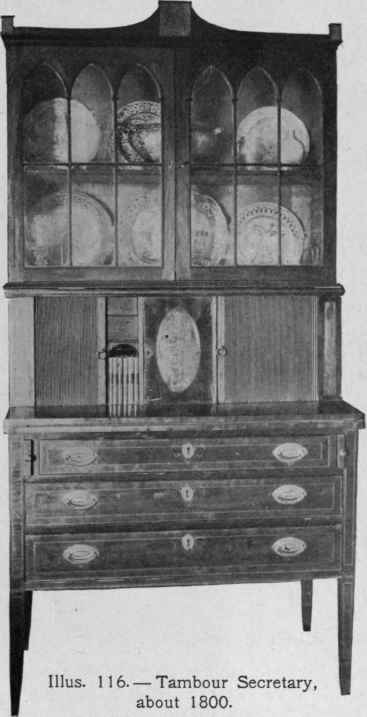
In his will, George Washington left to Dr. Craik "my beaureau (or as cabinet-makers call it, tambour secretary)." Illustration 116 shows what might be called a tambour secretary. It is made of mahogany with lines of light wood inlaid. The lid of the lower part is folded back upon itself. Above it are two tambour doors, behind which are drawers and pigeonholes and a door in the centre with an oval inlay of satinwood. Above these doors is a cabinet with glass doors. The pediment is like the one in Illustration 114. This secretary was made about 1800, and belongs to Francis H. Bigelow, Esq., of Cambridge.
Illustration 117 shows a small Sheraton writing table for a lady's use, also owned by Mr. Bigelow. It is of simple construction, having one drawer, and when the desk is closed, the effect is that of a small table with a flat top.
Illustration 118 shows a desk which was copied from one of Sheraton's designs, published in 1793, and described as "a lady's cabinet and writing table." The legs in Sheraton's drawing are slender and straight, while these are twisted and carved, and the space, which in the design is left open for books, in this desk is closed with a tambour door. The slide which shows above the compartment pulls out, with a mechanism described by Sheraton, and when fully out, it drops to form the cover for the compartments. The Empire brasses upon the top are original, but the handles to the drawers are not. They should be brass knobs. This beautiful little desk was made about 1810 for William T. Lane, Esq., of Boston, and is owned by his daughter, Mrs. Thomas H. Gage of Worcester.
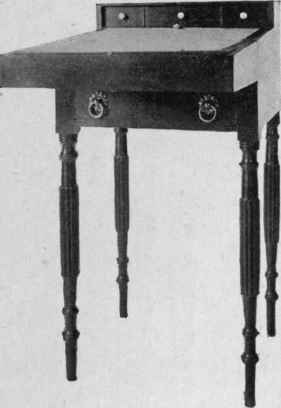
Illus. 117. - Sheraton Desk, 1800.
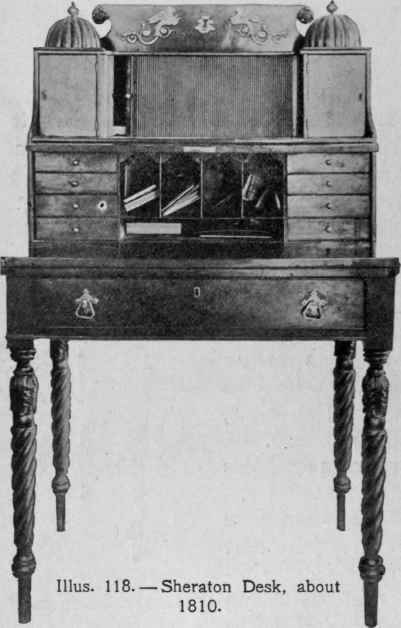
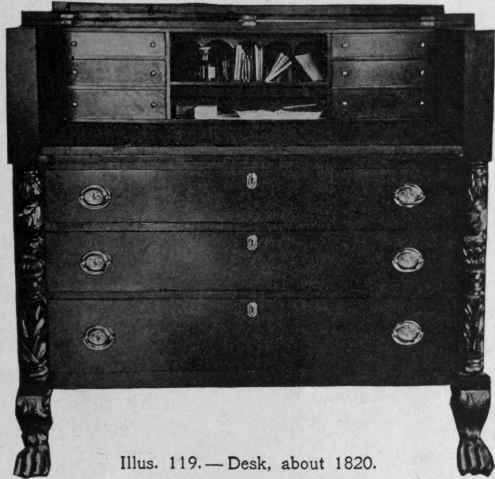
Illustration 119 shows a bureau and desk, belonging to Mrs. J. H. Henry of Winchendon. The lid of the desk turns back like the lid of a piano. The carved pillars at the side are like the ones upon the bureau in Illustration 37, and upon other pieces of furniture of the same date, about 1820.
Continue to:


My Books

