


Chapter I. Chests, Chests Of Drawers, And Dressing-Tables
Description
This section is from the book "Furniture Of The Olden Time", by Frances Clary Morse. Also available from Amazon: Furniture of the Olden Time.
Chapter I. Chests, Chests Of Drawers, And Dressing-Tables
The chest was a most important piece of furniture in households of the sixteenth and seventeenth centuries. It served as table, seat, or trunk, besides its accepted purpose to hold valuables of various kinds.
Chests are mentioned in the earliest colonial inventories. Ship chests, board chests, joined chests, wainscot chests with drawers, and carved chests are some of the entries; but the larger portion are inventoried simply as chests. All woodwork - chests, stools, or tables - which was framed together, chiefly with mortise and tenon, was called joined, and joined chests and wainscot chests were probably terms applied to panelled chests to distinguish them from those of plain boards, which were common in every household, and which were brought to this country on the ships with the colonists, holding their scanty possessions.
The oldest carved chests were made without drawers beneath, and were carved in low relief in designs which appear upon other pieces of oak furniture of the same period.

Illus. 1. - Oak Chest, about 1650.
Illustration I shows a chest now in Memorial Hall, at Deerfield, which was taken from the house where the Indians made their famous attack in 1704. The top of the chest is missing, and the feet, which were continuations of the stiles, are worn away or sawed off. The design and execution of the carving are unusually fine, combining several different patterns, all of an early date. Chests were carved in the arch design with three or four panels, but seldom as elaborately as this, which was probably made before 1650.
Illustration 2 shows a remarkable chest now owned by Mrs. Caroline Foote Marsh of Claremont-on-the-James, Virginia. Until recently it has remained in the family of D'Olney Stuart, whose ancestor, of the same name, was said to be of the royal Stuart blood, and who brought it with him when he fled to Virginia after the beheading of Charles I.
The feet have been recently added, and should be large balls; otherwise the chest is original in every respect. It is made entirely of olive-wood, the body being constructed of eight-inch planks. The decoration is produced with carving and burnt work. Upon the inside of the lid are three panels, the centre one containing a portrait in burnt work of James I. with his little dog by his side. The two side panels portray the Judgment of Solomon, the figures being clad in English costumes; in the left panel the two kneeling women claim the child; in the right the child is held up for the executioner to carry out Solomon's command to cut it in two. The outside of the lid has the Stuart coat of arms burnt upon it. Upon the front of the chest are four knights, and between them are three panels, surrounded by a moulding, which is now missing around the middle panel. These three panels are carved and burnt with views of castles; and around the lock, above the middle panel, are carved the British lions supporting the royal coat of arms. The chest measures six feet in length and is twenty-four inches high.
Chests with drawers are mentioned as early as 1650, and the greater number of chests found in New England have one or two drawers.

Illustration 3 shows a chest with one drawer owned by the Connecticut Historical Society, made about 1660. There is no carving upon this chest, which is panelled and ornamented with turned spindles and drops. The stiles are continued below the chest to form the feet.

Illus. 3. - Panelled Chest with One Drawer, about 1660.
A chest with two drawers is shown in Illustration 4, made probably in Connecticut, as about fifty of this style have been found there, chiefly in Hartford County. The top, back, and bottom are of pine, the other portions of the chest being of American oak. The design of the carving is similar upon all these chests, and the turned drop ornament upon the stiles, and the little egg-shaped pieces upon the drawers, appear upon all. They have been found with one or two drawers or none, but usually with two. This chest is in Memorial Hall, at Deerfield.
A chest with two drawers owned by Charles R. Waters, Esq., of Salem, is shown in Illustration 5. The mouldings upon the front of the frame are carved in a simple design. The wood in the centre of the panels is stained a dark color, the spindles and mouldings being of oak like the rest of the chest.

A number of chests carved in a manner not seen elsewhere have been found in and about Hadley, Massachusetts, and this has given them the name of Hadley chests. The carving in all is similar, upon the front only, the ends being panelled, and all have three panels above the drawers, with initials carved in the middle panel. The other two panels have a conventionalized tulip design, which is carved upon the rest of the front, in low relief. The carving is usually stained while the background is left the natural color of the wood.
Illustration 6 shows a Hadley chest with one drawer owned by Dwight M. Prouty, Esq., of Boston.

Carved chests with three drawers are rarely found in any design, although the plain board chests were made with that number.
Illustration 7 and Illustration 8 show chests mounted upon frames. Illustration 8 stands thirty-two inches high and is thirty inches wide, and is made of oak, with one drawer. It is in the collection of Charles R. Waters, Esq., of Salem. Illustration 7 is slightly taller, with one drawer. This chest is in the collection of the late Major Ben: Perley Poore, at Indian Hill. Such chests upon frames are rarely found, and by some they are supposed to have been made for use as desks; but it seems more probable that they were simple chests for linen, taking the place of the high chest of drawers which was gradually coming into fashion during the latter half of the seventeenth century, and possibly being its forerunner. Chests continued in manufacture and in use until after 1700, but they were probably not made later than 1720 in any numbers, as several years previous to that date they were inventoried as "old," a word which was as condemnatory in those years as now, as far as the fashions were concerned. Chests of drawers appear in inventories about c 1645. They were usually made of oak and were similar in design to the chests of that period.
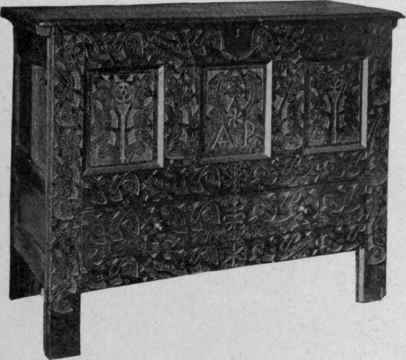
Illus. 6. - Carved Chest with One Drawer, about 1700.
Continue to:


My Books

