


Chests, Chests Of Drawers, And Dressing-Tables. Part 2
Description
This section is from the book "Furniture Of The Olden Time", by Frances Clary Morse. Also available from Amazon: Furniture of the Olden Time.
Chests, Chests Of Drawers, And Dressing-Tables. Part 2
The oak chest of drawers in Illustration 9 is owned by E. R. Lemon, Esq., of the Wayside Inn, Sudbury. It has four drawers, and the decoration is simply panelling. The feet are the large balls which were used upon chests finished with a deep moulding at the lower edge. The drop handles are of an unusual design, the drop being of bell-flower shape. This chest of drawers was found in Maiden.
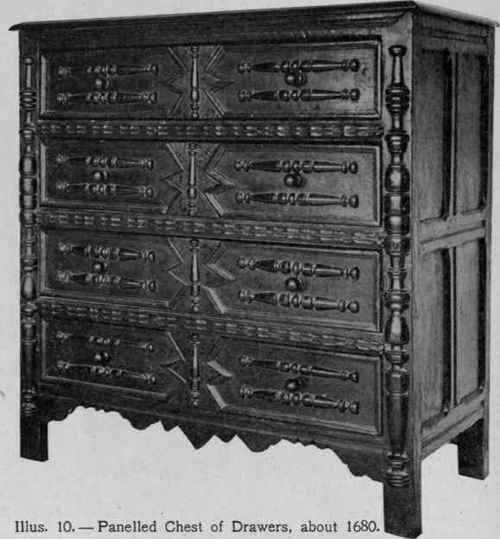
Illustration 10 shows a very fine oak chest of four drawers, owned by Dwight M. Prouty, Esq., of Boston. The spindles upon this chest are unusually good, especially the large spindles upon the stiles. There is a band of simple carving between the drawers. The ends are panelled and the handles are wooden knobs.
From the time that high chests of drawers were introduced, during the last part of the seventeenth century, the use of oak in furniture gradually ceased, and its place was taken by walnut or cherry, and later by mahogany. With the disuse of oak came a change in the style of chests, which were no longer made in the massive panelled designs of earlier years. The moulding around the drawers is somewhat of a guide to the age of a piece of furniture. The earliest moulding was large and single, upon the frame around the drawers. The next moulding consisted of two strips, forming a double moulding. These strips were in some cases separated by a plain band about half an inch in width. Later still, upon block front pieces a small single moulding bordered the frame around the drawers, while upon Hepple-white and Sheraton furniture the moulding was upon the drawer itself. Early in the eighteenth century, about 1720, high chests were made with no moulding about the drawers, the edges of which lapped over the frame.
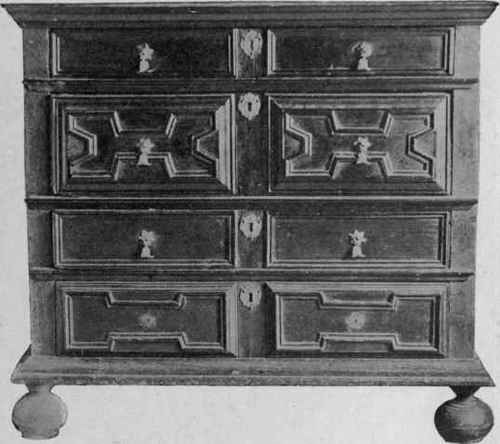
Illus 9. - Panelled Chest of Drawers, about 1680.
Another guide to the age of a piece of furniture made with drawers is found in the brass handles, which are shown in Illustration 11 in the different styles in use from 1675. The handle and escutcheon lettered A, called a. "drop handle," was used upon six-legged high chests, and sometimes upon chests. The drop may be solid or hollowed out in the back. The shape of the plate and escutcheon varies, being . round, diamond, or shield shaped, cut in curves or points upon the edges, and generally stamped. It is fastened to the drawer front by a looped wire, the ends of which pass through a hole in the wood and are bent in the inside of the drawer.
A handle and escutcheon of the next style are lettered B. They are found upon six-legged and early bandy-legged high chests. The plate of the handle is of a type somewhat earlier than the escutcheon. Both are stamped, and the bail of the handle is fastened with looped wires. Letter C shows the earliest styles of handles with the bail fastened into bolts which screw into the drawer. Letters D, E, and F give the succeeding styles of brass handles, the design growing more elaborate and increasing in size. These are found upon desks, chests of drawers, commodes, and other pieces of furniture of the Chippendale period.
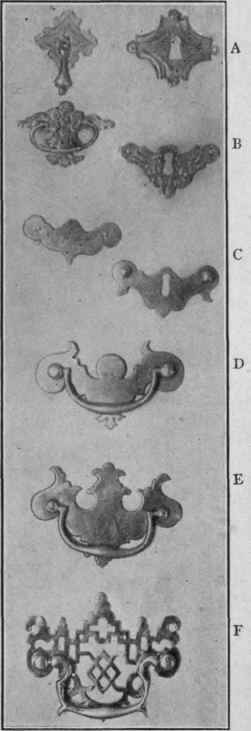
Illustration 11.
The earliest form of high chest of drawers had six turned legs, four in front and two in the back, with stretchers between the legs, and was of Dutch origin, as well as the high chest with bandy or cabriole legs, which was some years later in date. Six-legged chests were made during the last quarter of the seventeenth century, and were usually of walnut, either solid or veneered upon pine or whitewood; other woods were rarely employed. The earliest six-legged chests were made with the single moulding upon the frame about the drawers, and with two drawers at the top, which was always flat, as the broken arch did not appear in furniture until about 1730. The lower part had but one long drawer, and the curves of the lower edge were in a single arch.
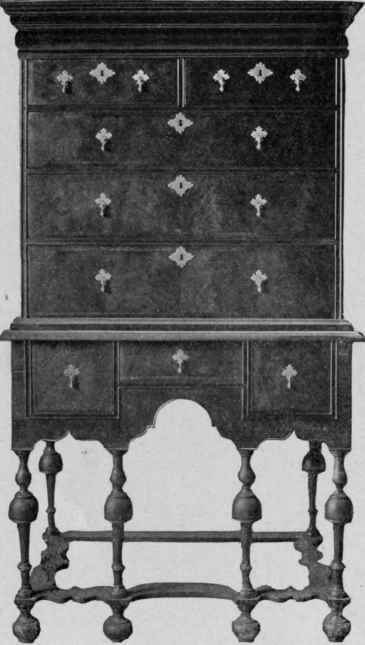
Illus. 12. - Six-legged High Chest of Drawers, 1705-1715.
The six-legged high chest of drawers in Illustration 12 belongs to F. A. Robart, Esq., of Boston. It is veneered with the walnut burl and is not of the earliest type of the six-legged chest, but was made about 1705-1715. The handles are the drop handles shown in letter A, and the moulding upon the frame around the drawers is double. There is a shallow drawer in the heavy cornice at the top, and the lower part contains three drawers.
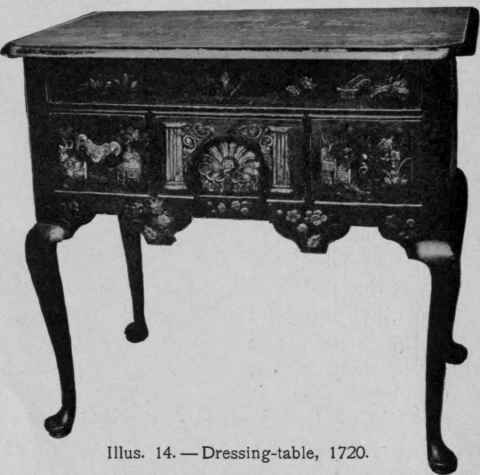
Dressing-tables were made to go with these chests of drawers, but with four instead of six legs. Their tops were usually veneered, and they were, like the high chests, finished with a small beading around the curves of the lower edge.
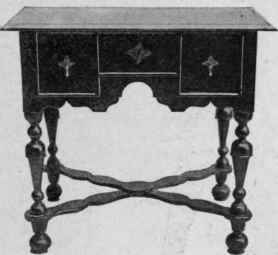
Illus. 13. - Walnut Dressing-table, about 1700.
The dressing-table in Illustration 13 also belongs to Mr. Robart, and shows the style in which that piece of furniture was made.
The names "high-boy" and "low-boy" or "high-daddy' and "low-daddy': are not mentioned in old records and were probably suggested by the appearance of the chests mounted upon their high legs.
Continue to:


My Books

