


Chapter V. Desks
Description
This section is from the book "Furniture Of The Olden Time", by Frances Clary Morse. Also available from Amazon: Furniture of the Olden Time.
Chapter V. Desks
FROM 1644 to about 1670 desks appear in colonial inventories. During those years the word "desk" meant a box, •which was often made with a sloping lid for convenience in writing, or to rest a book upon in reading. This box was also used to hold writing-materials and papers or books, and was sometimes called a Bible-box, from the fact that the Bible was kept in it. Illustration 92 shows two of these desks from the collection of Charles R. Waters, Esq., of Salem. The larger desk is twenty inches in length and thirteen and one-half in height, and formerly had a narrow shelf in the inside across the back. The front is carved with the initials A. W. and the date 1654. The smaller desk measures thirteen and one-half inches in length and eight in height.

The desk with flat top in Illustration 93 is also in the Waters collection. It measures twenty-six inches in length by seventeen in width. It is made of oak, like the smaller desk in the preceding illustration.
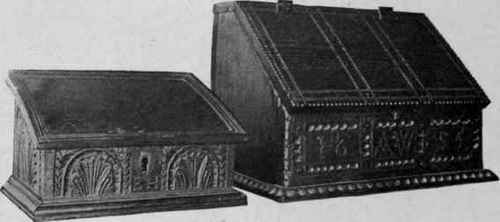
Illus. 92. - Desk-boxes, 1654.
The next style of desk made its appearance in the inventories of about 1660, under a name with French derivation: "scrutoir," "scriptor," "scrittore," "scrutor," "scriptoire," down to the phonetically spelled "screw-tor." About 1720 the word "bureau," also from the French, came into use in combination with the word "desk," or "table." It has continued to be employed up to the present time, for the slant-top desk is even now, in country towns, called a bureau-desk. As the word "desk" seems to have been more or less in use through these early years, while for the last hundred years it has been ! almost entirely employed, alone or in combination with other words, I have designated as desks all pieces of furniture made for use in writing.
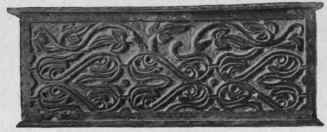
Illus. 93. - Desk-box, 1650.

Illus. 94. - Desk, about 1680.
A cabinet and writing desk used by perhaps all of the Dutch Patroons, of Albany, is shown in Illustration 94. It has stood in the same house, Cherry Hill, Albany, since 1768, when the house was built by-Philip Van Rensselaer, the ancestor of the present owner, Mrs. Edward W. Rankin. It was probably brought from Holland by Killian Van Rensselaer, and in it were kept the accounts of the manor. The desk is open in Illustration 95, showing the compartments for papers and books. The wood of this splendid piece is oak, beautifully panelled and carved, and the fine panel seen when the desk is closed forms, when lowered, the shelf for writing. Similar pieces appear in paintings by old Dutch masters.
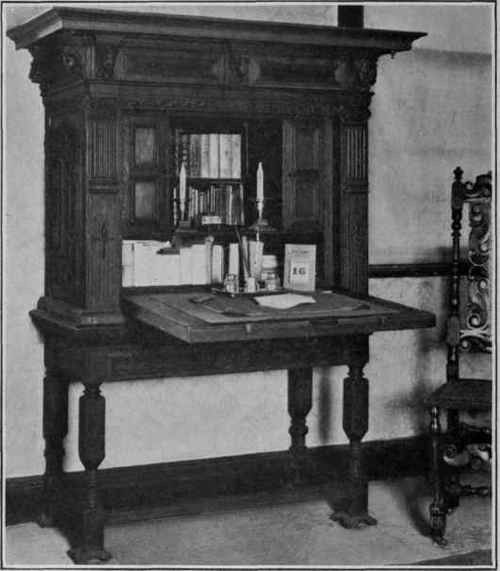
Illus. 95. - Desk, about 1680.
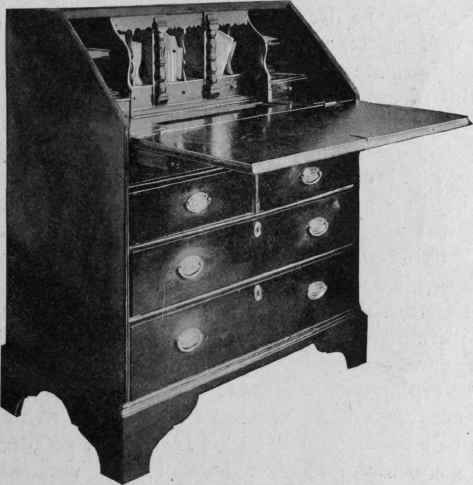
Illus. 96. - Desk, 1710-1720.
Illustration 96 shows a desk owned by Miss Gage, of Worcester, of rather rude construction, and apparently not made by a skilled cabinet-maker. It has two long drawers with two short drawers above them. The space above these two short drawers is reached from an opening or well with a slide, directly in front of the small drawers of the interior, which may be seen in the illustration. The pillars at each side of the middle compartment pull out as drawers. The handles are new, and should be drop handles, or early stamped ones. The characteristics which determine the date of this desk are the single moulding around the drawers, the two short drawers, and the well opening with a slide. The bracket feet would indicate a few years' later date than that of similar pieces with ball feet.
During the first half of the eighteenth century slant-top desks appeared with a bookcase or cabinet top. The lower or desk part was made usually with a moulding around the top, into which the upper part was set. The doors were of panelled wood or had looking-glasses set in them, but occasionally they were of glass.
The frontispiece shows an extraordinary piece of furniture owned by Samuel Verplanck, Esq., of Fish-kill, New York. It has belonged in the family of Mr. Verplanck since 1753, when it was bought by an ancestor, Governor James de Lancey, at an auction sale of the effects of Sir Danvers Osborne, who was governor of the Province of New York for the space of five days, as he landed at Whitehall Slip, New York, from the good ship Arundel on Friday, and the following Wednesday he committed suicide. Sir Danvers had brought his household goods with him upon the Arundel, and among them was this secretary.
Lacquered furniture was fashionable during the first quarter of the eighteenth century, and while the first lacquered pieces came through Holland, by 1712
"Japan work" was so popular, even in the American colonies, that an advertisement of Mr. Nehemiah Partridge appeared in a Boston paper of that year, that he would do "all sorts of Japan work."
The wood of this secretary is oak, and the entire piece is covered with lacquer in brilliant red, blue, and gold. The upper part, or cabinet, has doors which are lacquered on the inside, with looking-glasses on the outside. A looking-glass is also set into the middle of the top. These glasses are all the original ones and are of heavy plate with the old bevel upon the edges. Above the compartments, and fitting into the two arches of the top are semicircular-shaped flap doors, which open downward. Between these and the pigeonholes are two shallow drawers extending across the cabinet. The middle compartment has two doors with vases of flowers lacquered upon them, and there is a drawer above, while the spaces each side of the doors are occupied by drawers. The slides for candlesticks are gone, but the slits show where they were originally. The lower or desk part is divided by a moulding which runs around it above the three lower drawers, and the space between this and the writing-table is taken by two short drawers, but it has no well with a slide like the desk in Illustration 96. The arrangement of the small drawers and compartments is the same as in the desk in Illustration 96, and the lacquered pillars form the fronts of drawers which pull out, each side of the middle compartment, which has upon its door a jaunty little gentleman in European costume of the period. The moulding upon the frame around the drawers and the two short upper drawers would place the date of this piece early in the eighteenth century. The first thought upon seeing the feet of the desk, is that they were originally brackets which were sawed off and the large ball feet added, but it must have been made originally as it now stands, for both the brackets and the balls under them are lacquered with the old "Japan work" like the rest of the secretary.
Continue to:


My Books

