


Chapter XII. Looking-Glasses
Description
This section is from the book "Furniture Of The Olden Time", by Frances Clary Morse. Also available from Amazon: Furniture of the Olden Time.
Chapter XII. Looking-Glasses
A STRONG distinction was made in America during the seventeenth and eighteenth centuries between mirrors and looking-glasses; the name "mirror" was applied to a particular kind of glass, either convex or concave, and one old authority states that "a mirror is a circular convex glass in a gilt frame."
Looking-glasses appear in inventories in this country as early as 1650, and in 1658 William Bartlett of Hartford left no less than ten, the dearest valued at one pound.
In 1670 the Duke of Buckingham brought Venetian workmen to England, and established glass works in Lambeth; but up to that date the looking-glasses occasionally mentioned in inventories must have been made in Venice. Some of the records are "a great looking glass," - "looking glass with brasses," - "great looking glass of ebony," - "an olive wood diamond cut looking glass," - and "a looking glass with a walnut tree frame." The glass usually had the edge finished with a slight bevelling about an inch wide, made by hand, of course, which followed the outline of the inside of the frame.
Hungerford Pollen, in "Furniture and Woodwork," says : "The looking-glasses made in the seventeenth and eighteenth centuries . . . had the plates finished by an edge gently bevelled, of an inch in width, following the form of the frame, whether square or shaped in curves. It is of great difficulty in execution, the plate being held by the workman over his head, and the edges cut by grinding. . . . The angle of the" (modern) "bevel is generally too acute, whereby the prismatic light produced by this portion of the mirror is in too violent and showy contrast to the remainder."
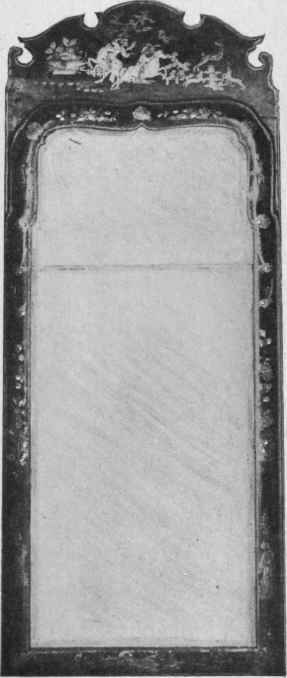
Illus. 363. - Looking-glass, 1690.
One can always distinguish an old bevel, by rubbing the finger upon it. The bevel is so slight that it can hardly be felt, where the modern bevel is sharp and distinct.
Looking-glasses of large size were made in two sections, the lower piece with the edge bevelled and lapped over the plain upper piece. This was to avoid the tax upon glass beyond a certain size.
The fashion for japanning or lacquering which obtained vogue at the close of the seventeenth century was followed in looking-glass frames. A London newspaper of 1689 thus advertised : "Several sorts of Screwtores,Tables, Stands and Looking-glasses of Japan and other work." Illustration 363 shows a looking-glass in a japanned frame, owned by Dwight M. Prouty, Esq., of Boston. The wood of the frame is walnut, and it is covered with lacquer in gold and colors. The shape of the frame around the glass is followed by the bevel, and the lower piece of glass laps over the upper. Illustration 364 shows the top section of a looking-glass with a lacquered frame. In this case the frame was made in sections, the lower section being lost. The curves in the frame are followed in the glass by the old shallow bevelling over an inch in width, and a star is cut in the middle of the glass. The frame is elaborately japanned with gold and bright colors, and is twenty-six inches in height, showing that the looking-glass, when whole, was of generous size. The design of the sawed edge is of a very early style. The glass is owned by the American Antiquarian Society, of Worcester.
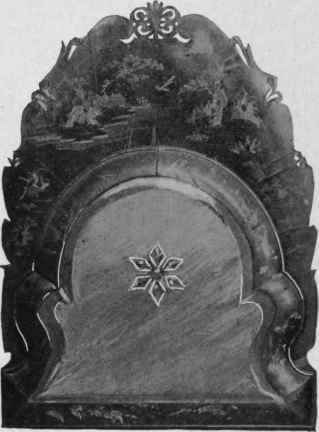
Illus. 364. - Looking-glass, 1690.
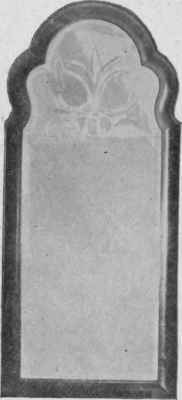
The looking-glass at the head of this chapter is owned by E. R. Lemon, Esq., of the Wayside Inn. It is of walnut veneer, and the old bevelled glass is in two sections, the upper one cut in a design, and with the lower edge lapped over the other piece of glass. Another glass of the same period, the first quarter of the eighteenth century, owned by Mr. Lemon, heads Chapter XI (Clocks). This frame has a top ornament of a piece of walnut sawed in curves which suggest those upon later frames.
Such a looking-glass as this was probably what Judge Sewall meant when he sent for "A True Looking Glass of Black Walnut Frame of the Newest Fashion (if the Fashion be good) as good as can be bought for five or six pounds." This was for wedding furniture for the judge's daughter Judith, married in 1720.
A looking-glass of the same date, with a carved wood frame, silvered, heads Chapter VI (Chairs). It was originally owned by an ancestor of the late Major Ben: Perley Poore, and was probably made in Europe. It has always, within the memory of the family, been silvered, and it is safe to say that it was so originally. The carving is rather crudely done, the ornament at the top containing a bird which is sitting upon a cherub's head. This glass is now at Indian Hill, Newburyport.
In nothing is the charm of association more potent than in an old looking-glass, when one considers the faces and scenes that have been reflected in it. Illustration 365 shows a looking-glass which hung in the Schuyler mansion at Stillwater, New York, in which Washington stopped over night; and although the quicksilver is somewhat worn off the back of the glass, the thought that it must have mirrored the face of Washington preserves it from being restored. The shape is extremely graceful, and the outline of the inside of the frame is followed by little scrolls cut in the glass. The frame is carved in wood, and gilt, and was probably made in Italy about 1730. It is now owned by the writer. The low-boy in the illustration is described upon page 39.
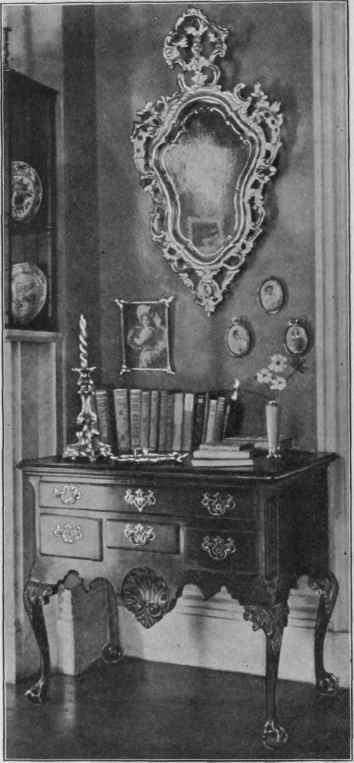
IIlus. 365. - Looking-glass, about 1730.
Rococo and Chinese designs were rampantly fashionable in frames for looking-glasses from 1750 to 1780. They present an astonishing combination of Chinese pagodas, shells, flowers, branches, animals, and birds, with occasionally a figure of a man or woman considerably smaller. than the flowers and birds upon the same frame.
Some of the famous designers of frames were Matthias Lock, who published "A Book New of Pier Frames, Oval Girandoles, Tables, etc.," in 1765; Edwards and Darley; and Thomas Johnson; besides the better-known cabinet-makers Ince and Mayhew and Chippendale. Lock and Johnson devoted much space to frames for girandoles, pier glasses, ovals, and chimney-pieces, all elaborately carved with scrolls and shells with dripping water, birds, and animals of every sort from a monkey to a cow, the latter unromantic and heavy creature figuring upon a dripping scroll in one of Johnson's frames.
Continue to:


My Books

