


Looking-Glasses. Part 2
Description
This section is from the book "Furniture Of The Olden Time", by Frances Clary Morse. Also available from Amazon: Furniture of the Olden Time.
Looking-Glasses. Part 2
Illustration 366 shows a looking-glass of the size which was called a "pier" glass, which must have been made about 1760. It is carved in walnut, and the natural wood has never been stained or gilt. It presents many of the characteristic designs fashionable at that time, of scrolls and dripping water, while no less than seven pagoda roofs form a part of the frame. The figure, probably a Chinese lady with a parasol, is missing from the pagoda at the top. Below the frame is carved a little monkey sitting in the lower scroll. The frame is rather unusual in having side branches for candles. This looking-glass and the one in the following illustration are owned by Mrs. Charles Barrell of Barren's Grove, York Corner, Maine, and are in the old Barrell house, which stands with its original furniture, as it stood one hundred and fifty years ago. These looking-glasses were bought by a Barrell ancestor at an auction in London, about 1795. The articles sold at this auction were the furnishings of one of the households of the Prince of Wales, which was, temporarily at least, given up by him upon his marriage, and these glasses have reflected many a gay scene in which the "First gentleman in Europe" figured, while Beau Brum-mel may have used them to arrange the wonderful toilettes which won him his name. What a change to the little Maine village!

Illus. 366. - Pier Glass in "Chinese Taste," 1760.
Another looking-glass of carved wood, with the same history, is shown in Illustration 367. This frame is gilded, and possesses none of the Chinese designs of the other frame, but is purely rococo. It has the old glass with bevelled edges. Both of these looking-glasses must have been made at least twenty-five years before the time when they were sold at auction by the royal bridegroom.
At the head of Chapter V (Desks) is shown a looking-glass with a frame of white with gilt ornaments. It formerly belonged to Governor Wentworth, and is now in the Poore collection at Indian Hill. It is similar in design and decoration to the looking-glasses seen in French palaces, and was probably made in France about 1760.
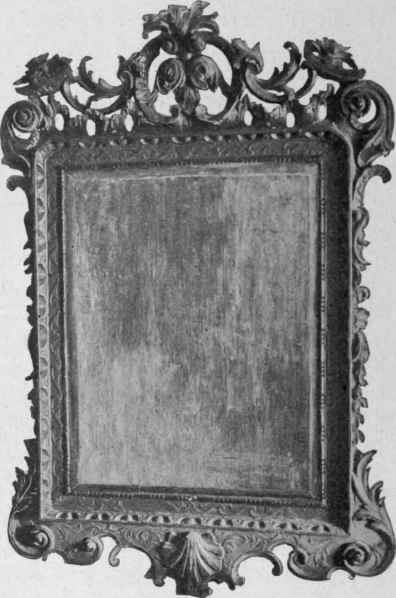
Illus. 367. - Looking-glass, about 1760.
A charming oval looking-glass which might be of the present latest fashion forms the heading to Chapter III (Bedsteads). It has the flowing ribbon bow-knot which Chippendale employed, and which has been fashionable ever since. This looking-glass was made about 1770, and was inherited by Miss H. P. F. Burn-side of Worcester from her great-grandmother.
Illustration 368 shows a fine looking-glass with a frame of carved wood. There is a small oval medallion below the frame with emblems of Freemasonry in gilt upon a black ground. A large medallion is above the glass, with Cupids painted upon a black ground, and the frame is surmounted by an eagle. This looking-glass is owned by Mrs.Charles R. Waters of Salem.
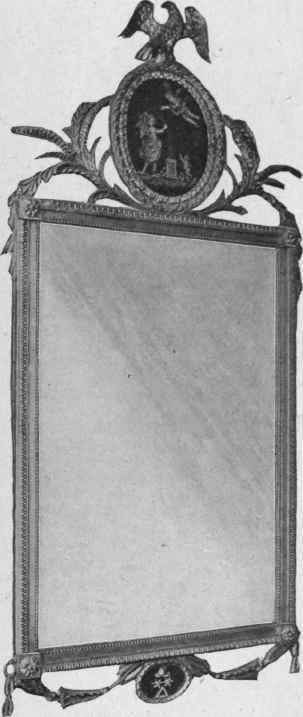
Illus. 368. - Looking-glass, 1770-1780.
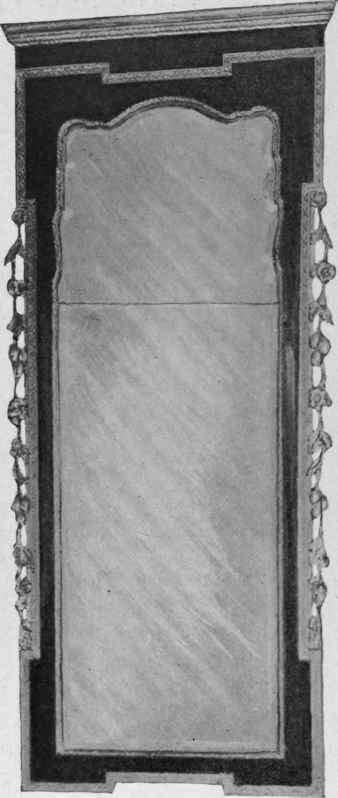
Illus. 369. - Looking-glass, 1725-1750.
Another of the same period, with a carved wood frame, is shown at the beginning of Chapter IV (Cupboards And Sideboards). This frame has a classical design of garlands of laurel with an urn at the top. The small oval medallion at the base of both of these frames seems to be a feature of such looking-glasses, together with the garlands of carved wood. This looking-glass is owned by the writer. Upon its back is an oak board which must have been prized highly, for it has been carefully repaired with two patches of wood set into it.
Illustration 369 shows a lookingglass made in the first half of the eighteenth century, of walnut. The gilt mouldings are carved in wood, as are the gilt leaves and flowers at the side. The waving line of the inside of the frame is followed in the bevelling of the glass. Glasses of this period were usually made in two pieces, to lessen the expense, the edge of one piece of glass being simply lapped over the other. This looking-glass is unusually large, seven and one-half feet high and three feet wide. It is now owned by the Philadelphia Library Association, and was used in 1778 at the famous Mischianza fete, where probably the lovely Peggy Shippen and the beautiful Jewess, Rebecca Frank, and perhaps the ill-fated Andre, used the glass to put the finishing touches to their toilettes, or to repair the damages wrought during the gay dances of that historic ball.
A looking-glass showing the development from the one in Illustration 369 may be seen in Illustration 26 upon page 39. The frame is more elaborate than the older one in its curves and in the pediment with the broken arch, and its date is about 1770. The original glass is gone, so we cannot tell if it was bevelled, but it probably was. This very fine frame came from the Chase mansion in Annapolis, and is now owned by Harry Harkness Flagler, Esq., of Millb rook, New York.
Another looking-glass owned by Mr. Flagler is shown in Illustration 370. The frame is of walnut veneer, and the shape of the glass without any curves at the top, and the garlands at the side more finely modelled and strung upon a wire, determine it to 2 c have been made some years later than the frame in Illustration 369.
Continue to:


My Books

