


Chapter III. Bedsteads
Description
This section is from the book "Furniture Of The Olden Time", by Frances Clary Morse. Also available from Amazon: Furniture of the Olden Time.
Chapter III. Bedsteads
ONE of the most valuable pieces of furniture in the household of the seventeenth and eighteenth centuries was the bedstead with its belongings. Bedsteads and beds occupy a large space in inventories, and their valuation was often far more than that of any other article in the inventory, sometimes more than all the others. In spite of the great value placed upon them, none have survived to show us exactly what was meant by the "oak Marlbrough bedstead' or the "half-headed bedstead " in early inventories. About the bedstead up to 1750 we know only what these inventories tell us, but the inference is that bedsteads similar to those in England at that time were also in use in the colonies. The greater portion of the value of the bedstead lay in its furnishings, - the hangings, feather bed, bolster, quilts, blankets, and coverlid, the bedstead proper, when inventoried separately, being placed at so low a sum that one concludes it must have been extremely plain. Several cradles made in the seventeenth century are still in existence. Illustration 51 shows one which is in Pilgrim Hall, Plymouth, and which is said to have sheltered Peregrine White, the first child born in this country to the Pilgrims. It is of wicker and of Oriental manufacture, having been brought from Holland upon the Mayflower, with the Pilgrims.
The cradle in Illustration 52 is of more substantial build. It is of oak, and was made for John Coffin, who was born in Newbury, January 8, 1680. Sergeant Stephen Jaques, "who built the meeting house with great needles and little needles pointing downward," fashioned this cradle, whose worn rockers bear witness to the many generations of babies who have slept within its sturdy frame. It is now in the rooms of the Newburyport Historical Society.
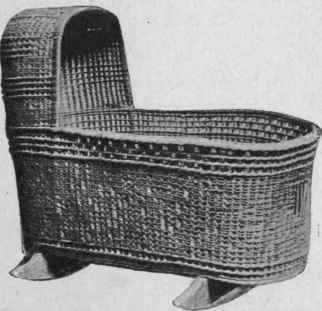
Illus. 51. - Wicker Cradle, 1620.
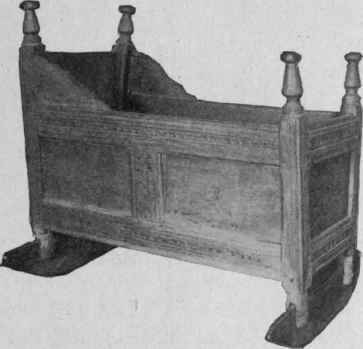
Illus. 52. - Oak Cradle, 1680.
Another wooden cradle is in Pilgrim Hall, made of oak and very similar, with the turned spindles at the sides of its wooden hood, to a cradle dated 1691, in the South Kensington Museum.
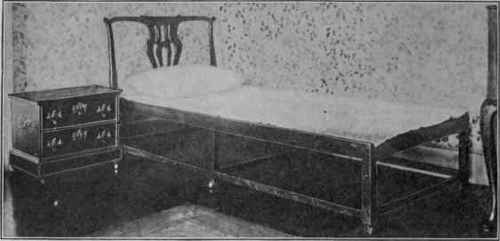
IIlus. 53. - Bedstead and Commode, 1750.
"Cupboard bedsteads" and "presse bedsteads" are mentioned in the inventories. They were probably the same as the Dutch "slaw-bank," and when not in use they were fastened up against the wall in a closet made to fit the bed, and the closet doors were closed or curtains were drawn over the bedstead. There is a slaw-bank in the old Sumner house in Shrewsbury, Massachusetts, built in 1797.
Illustration 53 shows a curious bedstead made about 1750, when it was used by Dr. Samuel Johnson, president of King's College, New York. It is now owned by his descendant, Mrs. Johnson-Hudson of Stratford, Connecticut. The slanting back of the bedstead is like the back of an early Chippendale chair, and the effect is similar to that of the couches shown in Illustration 205 and Illustration 206; but this piece was evidently intended for a bed, as it is considerably wider than the couches, which were "day beds." The wood of this bedstead is mahogany. The commode which stands beside the bed is of a slightly later date. It is also of mahogany, with massive brass handles.
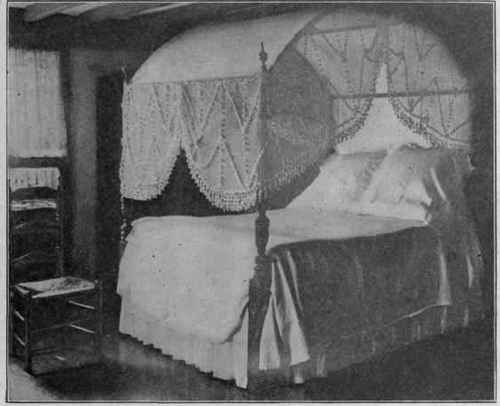
Illus. 54. - Field Bedstead, 1760-1770.
Illustration 54 shows a bedstead of about 1760-1770. It is what was called a field bed, the form of its top suggesting a tent. The frames for the canopy top were made in different shapes, but the one in the illustration was most common. The drapery is made of the netted fringe so much used in those days for edging bedspreads, curtains, and covers. This deep fringe was made especially for canopy tops for bedsteads. Its manufacture has been revived by several Arts and Crafts Societies. The slat-back chair is one of the rush-bottomed variety common during the eighteenth century. This room, with its wooden rafters, is in the Whipple house at Ipswich, built in 1650.
The claw-and-ball foot bedstead in Illustration 55 was a part of the wedding outfit of Martha Tufts, who was married in 1774, in Concord. It was then hung with the printed cotton draperies, hand spun and woven, which still hang from the tester, albeit much darned and quite dropping apart with age. The draperies are of a brownish color, possibly from age, but at all events they are now dingy and unattractive, whatever they may have been in 1774. The posts above the cabriole legs are small and plain, and there is no headboard. The wood is mahogany. This bedstead is now owned by the Concord Antiquarian Society. Although Chippendale's designs do not show a bedstead with claw-and-ball feet, he probably did make such bedsteads, and this may be called Chippendale, as it belongs to that period.
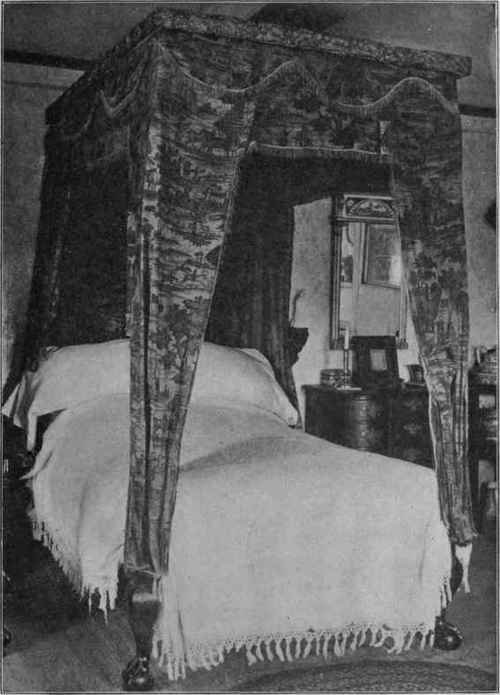
Illus. 55. - Claw-and-Ball Foot Bedstead, 1774.
A bedstead with plain, simple posts, with the cover and hangings of old netting, is shown in Illustration 56. There is a good comb-back Windsor armchair and a mahogany cradle of the period in the room, which is a bedroom in the Lee Mansion, Mar-blehead, Mass.
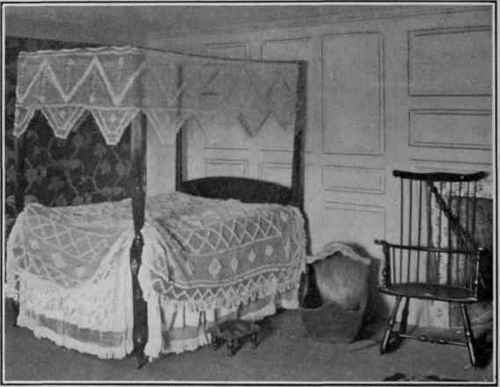
Illus. 56. - Bedstead, 1780.
A splendid bedstead found in Charleston, S. C, and now owned by J. J. Gilbert, Esq., of Baltimore, is shown in Illustration 57. All four posts are carved and reeded, and are after the manner of Chippendale. The tester and headboard show the Adam influence, placing the date of the bedstead about 1770.

Illus. 57. - Bedstead, 1775-1785.
Continue to:


My Books

