


Bedsteads. Continued
Description
This section is from the book "Furniture Of The Olden Time", by Frances Clary Morse. Also available from Amazon: Furniture of the Olden Time.
Bedsteads. Continued
Illustration 58 shows a bedstead made from one of Hepplewhite's designs, about 1789. The lower posts are slender and fluted, and end in a square foot. The cornice is japanned after the fashion which Hep-p1e white made so popular, and the style in which this bedstead is draped is extremely attractive. It is at Indian Hill, the residence of the late Major Ben: Per-ley Poore.
The four-post bed-steads had sometimes canvas stretched across the frame and laced with ropes, similar to the seat of the couch in Illustration 206, and in other cases they were corded entirely with ropes. Mrs. Vanderbilt in her "Social History of Flatbush" thus describes the process of cording a bed : "It required a man's strength to turn the machine that tightened the ropes, in cording these beds when they were put together. Some one was stationed at each post to keep it upright, while a man was exhausting his strength and perhaps his stock of patience and good temper, in getting the ropes sufficiently tight to suit the wife or mother. When the bedstead was duly corded and strung to the tension required, then a straw bed, in a case of brown home-made linen, was first placed over these cords, and upon this were piled feather beds to the number of three or four, and more if this was the spare-room bed." The height of the top one of these feather beds from the floor was so great that steps were required to mount into it, and sets of mahogany steps are sometimes found now, which were made for this purpose. A set is shown in Illustration 64.

Illus. 58. - Bedstead, 1789.
Illustration 59 shows one of the finest bedsteads known in this country. It is in the house of Charles R. Waters, Esq., of Salem. The two lower posts are exquisitely carved with garlands of flowers, and every detail is beautiful; the upper posts are plain. The size of the posts is somewhat larger than during the previous years, and the style of the lower part with the fluted leg would place the date of the bedstead about 1795-1800, when the influence of Sheraton was strong. The cornice is painted with flowers in colors, and the painted band is framed in gilt; the ornaments at the corners, the basket with two doves, and the ropes and tassels are all of gilt.
About 1800, when the Empire styles commenced to influence the makers of furniture, the posts of bedsteads became larger, and they were more heavily carved, with acanthus leaves twining around the post, or a heavy twist or fluting, with pineapples at the top.

Illus. 59. - Bedstead, 1795-1800.
Illustration 60 shows a bedstead at Indian Hill, with the heavy posts and tester, the lower posts being fluted. The bedstead is draped on the side and foot with curtains which could be let down at night in cold weather, thus shutting out the bitter draughts. The coverlid for this bed is made of linen, spun and woven by hand, and embroidered in shades of blue with a quaint design. The easy-chair at the foot of the bed is covered with old chintz, printed in figures that would afford a child unlimited entertainment.

Illus. 60. - Bedstead, 1800-1810.
A bedstead with massive twisted posts is shown in Illustration 61. The lower posts only are carved, as was usual, the draperies at the head of the bed concealing the plain upper posts. Twisted posts were quite common during the early years of the nineteenth century, and more bedposts are found that are carved in a twist than in any other design. The coverlid is similar to the one in Illustration 63. This bedstead stands in one of the panelled rooms of the Warner house in Portsmouth.
Illustration 62 shows a fine example of the fourpost bedstead made from 1805 to 1810. It is unusual in having all four posts carved, and for its splendid feet, which are carved in massive lions' claws. Each post is carved with festoons of drapery, and is surmounted with a pineapple. The headboard is elaborately carved with a basket of fruit. This mahogany bedstead is owned by Mrs. E. A. Morse of Worcester. Illustration 63 shows another bedstead with all four mahogany posts carved in the acanthus leaf and pineapple design. Each post is finished at the top with a pineapple, and the bases are set into brass sockets. Upon the plain sections of the posts may be seen pressed brass ornaments, of which there are six, two for each lower post and one for each upper one. These ornaments cover the holes through which the bed-screws are put in to hold the frame together. There is a headboard of simple design upon this bedstead. The coverlid is an old, hand-spun and woven, cotton one, with a design of stars in little cotton tufts. Such coverlids were made about 1815 to 1830. This bedstead is owned by the writer.

Illus. 61. - Bedstead, 1800-1810.

Iilus. 62. - Bedstead. 1800-1810.

Illus. 63. - Bedstead, 1800-1810.

Illus. 64. - Bedstead and Steps, 1790.
Illustration 64 shows a bed owned by the Colonial Dames, in their house, "Stenton," in Philadelphia. It has the large, plain and heavy posts found in the South. The hangings are the original ones. Beside the bed is a set of steps used to assist in mounting to the top of the feather beds used in those days. The cradle is of about the same date. Illustration 65 shows a low-post mahogany bedstead which is owned by Dr. S. B. Woodward of Worcester, having been inherited by him. It was made about 1825. The four posts are carved with the acanthus leaf, and both head and foot board are elaborately carved. It can be seen that the bed in this illustration is not so high from the floor as those of earlier date. The low French bedstead became fashionable soon after this time, and the high four-poster was relegated to the attic, from which it has of late years been rescued, and set up, draped with all of its old-time hangings.

Illus. 65. - Low-post Bedstead, about 1825.
The latest style of low-post bedsteads is shown in Illustration 66. It was probably made about 1820-1830, when the light woods, maple and birch, were, with cherry, largely used for such bedsteads. The wood of this bed is curly birch, and all four posts are carved alike with the pineapple and acanthus design, similar to the tall posts of the previous period. Low-post bedsteads are often found with posts plainly turned, of curly maple, beautifully marked.
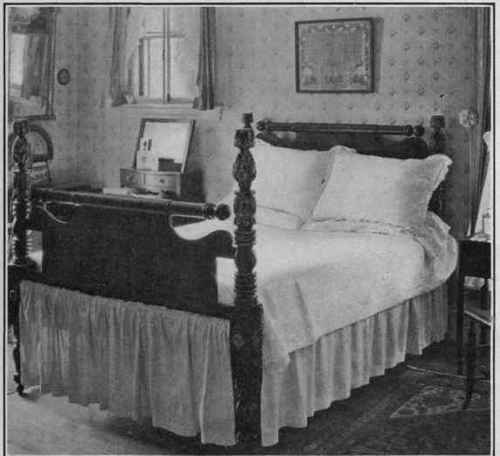
Illus. 66. - Low-post Bedstead, 1820-1830.
Illustration 67 shows a low French bedstead, found in Canada and owned by George Corbett, Esq., of Worcester. The bedstead is made of finely grained old walnut, the rounding top of the head and foot boards and the face of the large drawer under the footboard being veneered. This drawer may have been intended to use to keep blankets in. It has a little foot so that it remains firm when pulled out. At each side of the low bed is a carved shell, which slides out, showing a covered rest, perhaps for kneeling upon to pray. Both the head and foot boards are covered with canvas, which was probably, when the bedstead was new, about 1830, covered with a rich brocade. All the lines of the bedstead are most graceful, and the carving is unusually well done. Plainer bedsteads in this style were made, veneered with mahogany, and they are sometimes called sleigh beds, on account of their shape. These bedsteads were fashionable from 1830 to 1850, when they were superseded by the black walnut bedsteads familiar to everybody.
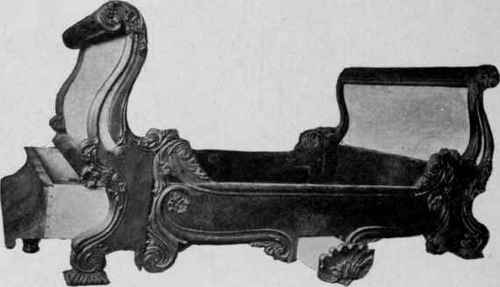
Illus. 67. - Low Bedstead, about 1830.
Continue to:


My Books

