


Bureaus And Washstands. Part 3
Description
This section is from the book "Furniture Of The Olden Time", by Frances Clary Morse. Also available from Amazon: Furniture of the Olden Time.
Bureaus And Washstands. Part 3
The charming little basin or wig stand in Illustration 45 is in the Metropolitan Museum of Art. The wood is mahogany and the feet are a flattened type of claw and ball, giving the little stand, with its basin and ewer, some stability, unless an unwary pointed toe should be caught by the spreading legs. The acanthus leaf is carved on the knees, and the chamfered corners above have an applied fret.
The drawings of Shearer, Hepplewhite and Sheraton show both square and corner washstands of mahogany with slender legs.
The washstand in Illustration 46 is of mahogany, and differs from the usual corner stand in having the enclosed cupboard. It was made from a Hepplewhite design and is owned by Francis H. Bigelow, Esq., of Cambridge.
The corner washstand in Illustration 47 is owned by the writer. It is of mahogany, and the drawers are finely inlaid, probably after a Sheraton design. The little towel-rack is of somewhat later date and is made of maple, stained. The washbowl and pitcher are dark-blue Staffordshire ware, with the well-known design of the "Tomb of Franklin" upon them.

Illus. 45. - Basin Stand, 1770.
While the corner wash-stand possessed the virtues of taking up but little room, and being out of the way, the latter consideration must have been keenly felt by those who, with head thrust into the corner, were obliged to use it.
A square washstand of more convenient shape, but still constructed for the small bowl and pitcher, is shown in Illustration 48. It is of mahogany and is in the style that was used from 1815 to 1830. This washstand is owned by Mrs. E. A. Morse of Worcester.
Both corner and square washstands have an opening in the top, into which was set the washbowl, and two - sometimes three - small openings for the little cups which were used to hold the soap.
Hepplewhite's book, published in 1789, shows designs of "night tables" like the one in Illustration 49, but they are not often found in this country. This table is of mahogany, with tambour doors, and a carved rim around the top, pierced at each side to form a handle. The wood of the interior of the drawer is oak, showing that the table was probably made in England. It is owned by the writer.
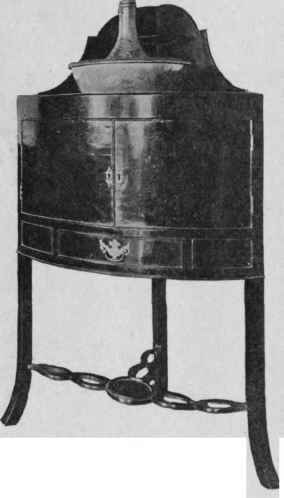
Illus. 46. - Corner Wash-stand, 1790.

Illus. 47. - Towel-rack and Washstand, 1790-1800.
There are several drawings in the books of Hep-plewhite and Sheraton of washstands and toilet-tables with complicated arrangements for looking-glasses and toilet appurtenances, but such pieces of furniture could not have been common even in England, and certainly were not in this country.
In Illustration 288 upon page 294 is shown a piano which can be used as a toilet-table, with a looking-glass and trays for various articles, but it must have been, even when new, regarded less from the utilitarian side, and rather as a novel and ornamental piece of furniture.

Illus. 48. - Washstand, 1815-1830.

Illus. 49. - Night Table, 1785.
A washstand of different design is shown in Illustration 50. The front is of bird's-eye maple and mahogany, and the top is of curly maple with mahogany inlay around the edge. The sides are mahogany. The two drawers are shams, and the top lifts on a hinge disclosing a compartment for a pitcher and bowl. The tapering legs end in a spade foot, and a large brass handle is upon each side. The other handles are brass knobs. This stand was made after instructions given by Sheraton thus, "The advantage of this kind of basin stand is, that they may stand in a genteel room, without giving offense to the eye, their appearance being somewhat like a cabinet." The washstand is owned by the writer.

Illus. 50. - Washstand, 1800-1810.
Continue to:


My Books

