


Bureaus And Washstands. Part 2
Description
This section is from the book "Furniture Of The Olden Time", by Frances Clary Morse. Also available from Amazon: Furniture of the Olden Time.
Bureaus And Washstands. Part 2
Looking-glasses made to swing in a frame are mentioned in inventories of 1750, and about that date may be given to the dressing-glass with drawers, shown in Illustration 36. It was owned by Lucy Flucker, who took it with her when, in opposition to her parents' wishes, she married in 1774 the patriot General Knox. It is now in the possession of the Hon. James Phinney Baxter, Esq., of Portland, Maine. Such dressing-glasses were intended to stand upon a dressing-table or bureau.
A bureau and dressing-glass owned by the writer are shown in Illustration 37. The bureau is of cherry, with the drawer fronts veneered in mahogany edged with satinwood. A row of fine inlaying runs around the edge of the top and beneath the drawers. This lower line of inlaying appears upon inexpensive bureaus of this period, and seems to have been considered indispensable to the finish of a bureau. The dressing-glass is of mahogany and satinwood with fine inlaying around the frame of the glass and the edge of the stand. The base of the bureau is of a plain type, while that of the dressing-glass has the same graceful curves that appear in Illustration 34.
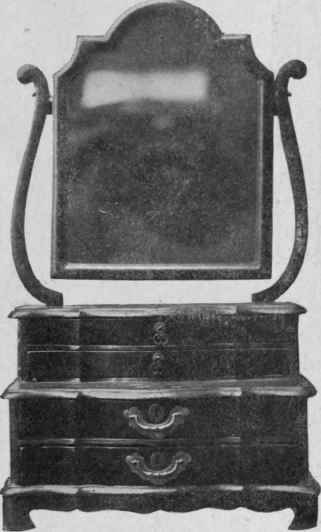
Illus. 36. - Dressing-glass, about 1760.
The bureaus in Illustration 34 and Illustration 37 are in the Hepplewhite style. The bureau and dressing-glass in Illustration 38 are distinctly Sheraton, of the best style. They are owned by Dwight Blaney, Esq., of Boston, and were probably made about 1810. The carving upon the bureau legs and upon the corners and side supports to the dressing-glass is finely executed. The handles to the drawers are brass knobs.
A bureau of the same date is shown in Illustration 39. It was owned originally by Will-iam F. Lane, Esq., of Boston. Mr. Lane had several children, for whom he had miniature pieces of furniture made, the little sofa in Illustration 228 being one. The small bureau upon the top of the large one was part of a bedroom set, which included a tiny four-post bedstead. This miniature furniture was of mahogany like the large pieces. The handles upon the large bureau are not original. They should be rosette and ring, or knobs similar to those upon the small bureau. The bureaus are now owned by a daughter of Mr. Lane, Mrs. Thomas H. Gage of Worcester.

Illus. 37. - Bureau and Dressing-glass, 1795.
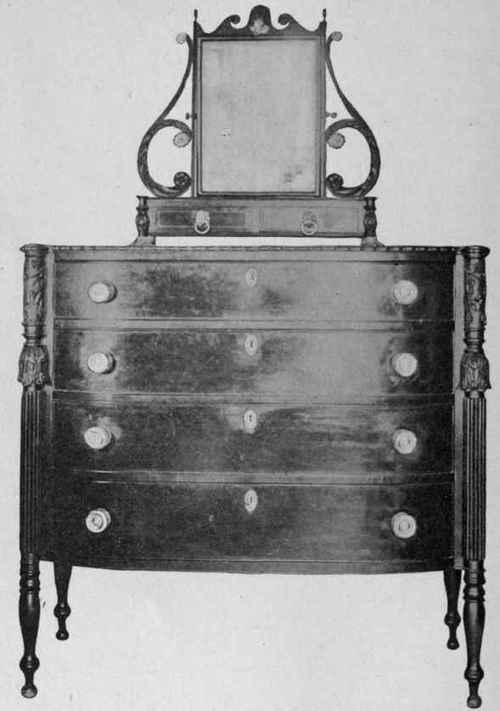
Illus. 38. - Bureau and Dressing-glass, about 1810.
Bureaus of this style were frequently made of cherry with the drawer fronts of curly or bird's-eye maple, the fluted pillars at the corner and the frame around the drawers being of cherry or mahogany.
There was added to the bureau about this time - perhaps evolved from the dressing-glass with drawers - an upper tier of shallow drawers, usually three. The dressing-table shown in Illustration 40 is owned by Charles H. Morse, Esq., of Charlestown, New Hampshire. It stands upon high legs turned and reeded, and a dressing-glass is attached above the three little drawers. The handles should be rings or knobs.

Illus. 39. - Bureau and Miniature Bureau, about 1810.
The case of drawers with closet above, in Illustration 41, is owned by Mrs. Thomas H. Gage, of Worcester. It is of mahogany, the doors of the closet being of especially handsome wood. The carving at the top of the fluted legs is fine, and the piece of furniture is massive and commodious.
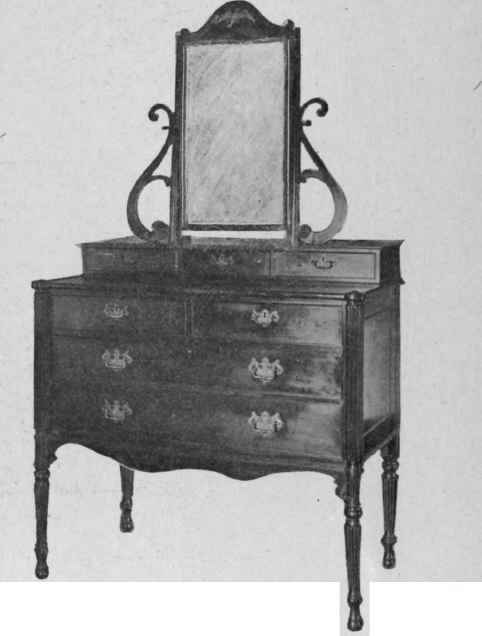
Illus. 40. - Dressing-table and Glass, 1810.
The bureau in Illustration 42 is also owned by Mrs. Gage, and is a very good specimen of the furniture in the heavy style fashionable during the first quarter of the nineteenth century. It was probably made to match a four-post bedstead with twisted posts surmounted by pineapples. The drawer fronts are veneered, like those of all the bureaus illustrated in this chapter except the first four, and there is no moulding upon the edge of the drawers. Illustration 43 shows the heaviest form of bureau, made about the same time as the last one shown, with heavily carved pillars and bears' feet. The drawer fronts are veneered and have no moulding upon the edge. This bureau is owned by Mrs. S. B. Woodward of Worcester, and it is a fine example of the furniture after the style of Empire pieces.

Illus. 41. - Case of Drawers with Closet, 1810.
The bureau in Illustration 44 is owned by Charles H. Morse, Esq., of Charlestown, and shows the latest type of Empire bureau, with ball feet, and large round veneered pillars. The three Empire bureaus shown have the last touch that could be added, a back piece above the tier of small drawers. The bureaus have the top drawer of the body projecting beyond the three lower drawers, and supported by the pillars at the sides. This and the shallow tier of small drawers, and the back piece are typical features of the Empire bureau, which may have the rosette and ring handle or the knob of brass or glass.

Illus. 42. - Bureau, about 1815.
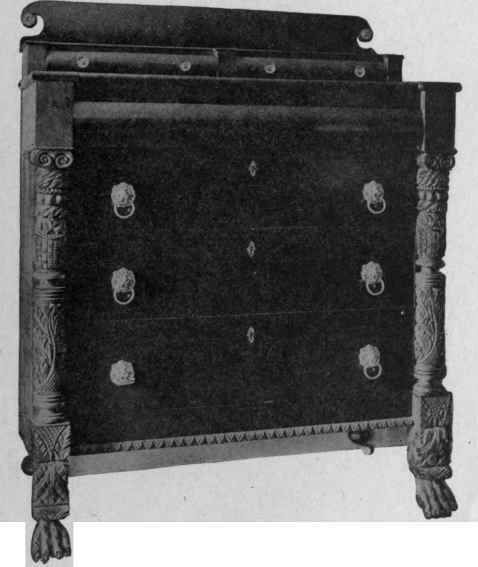
Illus. 43. - Bureau, 1815-1820.
The toilet conveniences of our ancestors seem to our eyes most inadequate, and it is impossible that a very free use of water was customary, with the tiny bowls and pitchers which were used and the small and inconvenient washstands. A "bason frame" appears in an inventory of 1654. Chippendale designed "bason stands" which were simply a tripod stand, into the top of which the basin fitted. They were also called wig stands because they were kept in the dressing-room where the fine gentleman halted to remove his hat, and powder his wig. The basin rested in the opening in the top, and in the little drawers were kept the powder and other accessories of the toilet. The depression in the shelf was for the ewer, probably bottle shaped, to rest in, after the gentleman had poured the water into the basin, to dip his fingers in after powdering his wig.

Illus. 44. - Empire Bureau and Glass, 1810-1820.
Continue to:


My Books

