


Chapter VII. Settles, Settees, And Sofas
Description
This section is from the book "Furniture Of The Olden Time", by Frances Clary Morse. Also available from Amazon: Furniture of the Olden Time.
Chapter VII. Settles, Settees, And Sofas
The first form of the long seat, afterward developed into the sofa, was the settle, which is found in the earliest inventories in this country, and still earlier in England. The settle oftenest seen in America is of simple construction, usually of pine, and painted; probably the work of c. country cabinet-maker, or even a carpenter. It was made to stand by the great fireplace, to keep the draughts out and the heat in, with its tall back, and the front of the seat coming down to the floor; and sadly was it needed in those days when the ink froze in the standish, as the minister sat by the fire to write his sermon. Illustration 201 shows a settle in the Deerfield Museum, in the kitchen. In front of the settle stands a flax-wheel, which kept the housewife busy on winter evenings, spinning by the firelight. Beside the settle is a rudely made light-stand, with a tin lamp, and a brass candlestick with the extinguisher on its top, and snuffers and tray beside it. Upon one side of the settle is fastened a candlestick with an extension frame. Behind the flax-wheel is a banister-back chair, the plain type of the chairs in Illustration 139, and at the right of the picture is a slat-back, flag-bottomed chair such as may be seen in Illustration 143.
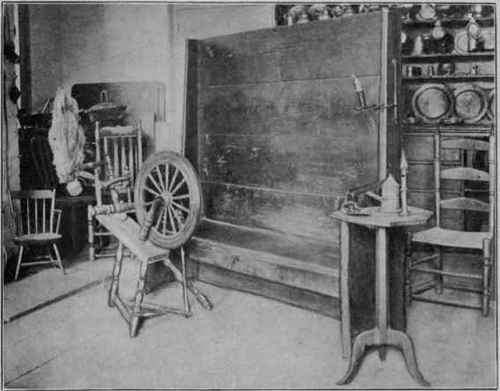
Illus. 201. - Pine Settle, Eighteenth Century.
Illustration 202 shows a settle of oak, which has upon the back the carved date 1708. The front of the seat has four panels, while the back has five lower panels, with a row of small panels above. The top rail is carved in five groups, the middle design of each group being a crown, and between each small panel is a turned ornament. The arms are like the arms of the wainscot chairs in Illustration 124 and Illustration 125. The top of the seat does not lift up, as was often the case, disclosing a box below, but is fastened to the frame, and probably there were provided for this settle the articles often mentioned in inventories, "chusshings," "quysyns," or cushions, which the hard seat made so necessary. This settle belongs to Dwight Blaney, Esq., of Boston.

Illus. 202. - Oak Settle, 1708.
The word "settee" is the diminutive of "settle," and the long seat which corresponded to the chairs with the frame of turned wood was called a settee or small settle, being of so much lighter build than the settle.
Illustration 203 shows a settee owned by the Essex Institute of Salem, and said to have been brought to this country by a Huguenot family about 1686. It is upholstered, like the chairs of the same style, in Turkey work, the colors in which are still bright. Turkey work was very fashionable at that time, rugs being imported from Turkey in shapes to fit the seat and back of chairs or settees. Another form of the long seat was one which was intended to serve as a couch, or "day-bed." It was really what its French name implies, chaise longue, or long chair, the back being an enlarged chair-back, and the body of the couch equalling three chair-seats. Illustration 204 shows a couch owned by the Concord Antiquarian Society, which formerly belonged to the descendants of the Rev. Peter Bulkeley. It had originally a cane seat, and evidently formed part of a set of furniture, for a chair of the same style is with it, which also belonged to the Bulkeley family. Both couch and chair are Flemish in design, with the scroll foot turning backward. The braces between the legs are carved in the same design as the top of the back.
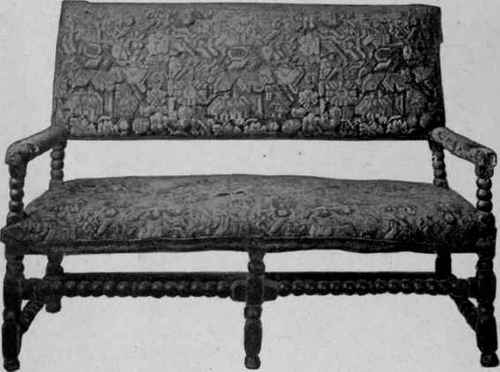
Illus. 203. - Settee covered with Turkey work, 1670-1680.
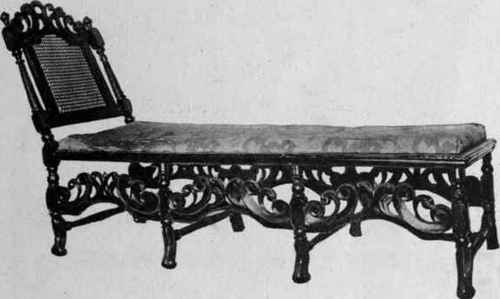
Illus. 204. - Flemish Couch, 1680-1690.
Illustration 205 shows a walnut couch made in the Dutch style about 1720-1730, with bandy legs and Dutch feet. The splat in the back is Dutch, but instead of the side-posts curving into the top rail like the Dutch chairs, in which the top and the side-posts apparently form one piece, these posts run up, with a finish at the top like the Flemish chairs, and like the posts in the back of the couch in Illustration 204. It is interesting to compare this couch, which is owned by the Misses Hosmer of Concord, Massachusetts, with the following one, Illustration 206, which belongs to Mr. Walter Hosmer of Wethersfield, Connecticut, and was made about 1770. This couch, of mahogany, has a back like one of the familiar Chippendale chairs, somewhat higher than the back of the couch in Illustration 205, which is longer than this Chippendale couch. The bandy legs with claw-and-ball feet are unusually well proportioned, and the effect of the piece of furniture is extremely elegant. The canvas seat is drawn tight by ropes laced over wooden knobs.
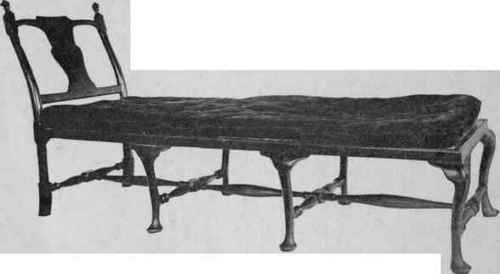
Illus. 205. - Dutch Couch, 1720-1730.
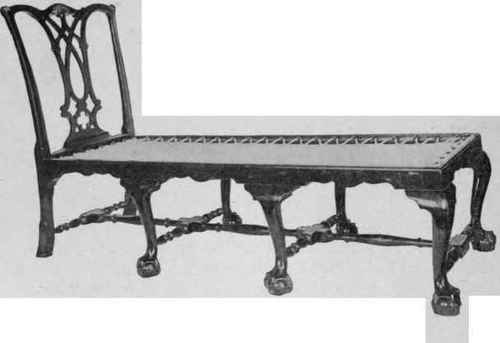
Illus. 206. - Chippendale Couch, 1760-1770.
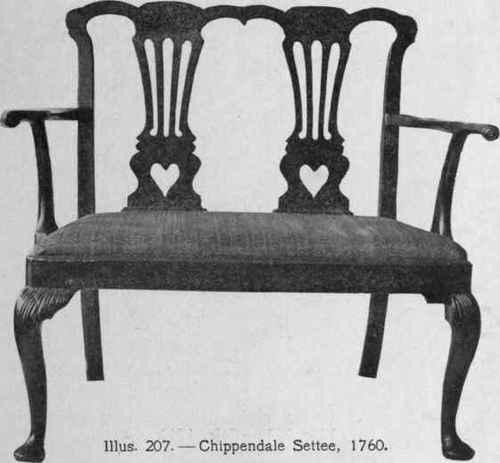
A double chair owned by Dwight M. Prouty, Esq., of Boston, is shown in Illustration 207. The splats are cut in an early design, with the heart-shaped opening in the lower part. The settee is not so wide as some, and the back is not equal to two chair backs, lacking the side rails which are usually carried down in the middle between the splats. The front legs have the acanthus carving upon the knees, and end in a Dutch foot. This settee is what was called a "Darby and Joan" seat, just wide enough for two.
Continue to:


My Books

