


Chairs. Part 8
Description
This section is from the book "Furniture Of The Olden Time", by Frances Clary Morse. Also available from Amazon: Furniture of the Olden Time.
Chairs. Part 8
Sheraton's chairs retained many of Hepplewhite's characteristics, but the great difference between them lay in the construction of the back, which it was Sheraton's aim to strengthen. His chairs, except in rare cases, do not have the heart or shield shaped back, '. which distinctly marks Hepplewhite chairs, but the back is rectangular in shape, the top rail being curved, straight, or with a raised piece in the centre, corresponding to the piece in the middle of the back. A rail extends across the back a few inches above the seat, and the splat or spindles end in this rail, and never extend to the seat.
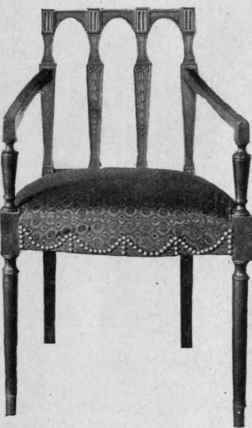
Illus. 191. - Sheraton Chair.

Illus. 192. - Sheraton Chairs.
Sheraton's designs show chairs with carved, twisted, reeded, or plain legs. The best Sheraton chairs found in this country usually have straight legs, slightly smaller than those upon the straight-legged Chippendale chairs. The tapering, reeded leg, which is characteristic of Sheraton, is not found so often upon his chairs as upon other pieces of furniture.
The chair in Illustration 191 is owned by the Misses Nichols of Salem, and it was brought with its mates to furnish the house built by Mclntire in 1783. The chairs were imported, and as the back is precisely like one of Sheraton's designs in his book, they may have been made by him, before the book was published in 1791. The impression given by this chair is of strength combined with lightness, the effect which Sheraton strove to attain, while at the same time he made the chairs strong not only in effect but in reality, an end which Hepple-white did not accomplish. The legs of the chair are plainly turned, but in the original design they are reeded.
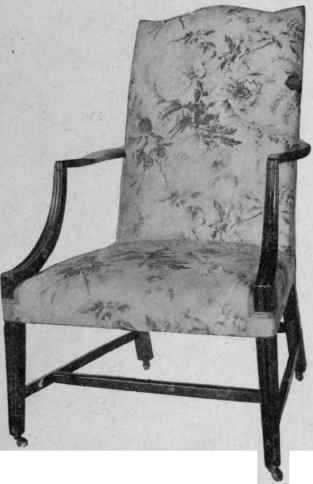
Illus. 193. - Sheraton Chair.
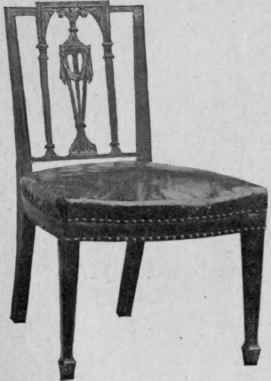
Illus. 195. - Sheraton Chair.
Illustration 192 shows two Sheraton chairs owned by Francis H. Bigelow, Esq. It will be seen that the carving in the back is similar in design to that of Hepplewhite chairs, and the carving and shape of the upper part of the chair-back with the curved top rail is often seen upon Hepplewhite's "bar-back" chairs.
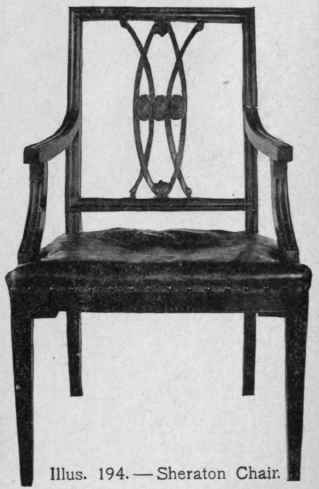
Mr. Bigelow also owns the upholstered arm-chair in Illustration 193, sometimes called a Martha Washington easy-chair, from a similar chair at Mount Vernon. This chair and one in Illustration 194, which belongs to Mr. Bigelow, are after the Sheraton style, although these designs do not appear in Sheraton's books. The arm-chair in Illustration 194 is said to have belonged to Jerome Bonaparte, but as Lucien and Joseph Bonaparte both had residences in this country, it would more probably have been owned by one of them rather than by Jerome, whose career in America was short and meteoric. The wood of this chair is cherry, said to have grown upon the island of Corsica, and the p style of the back, while upon the Sheraton order, differs from any of Sheraton's designs.
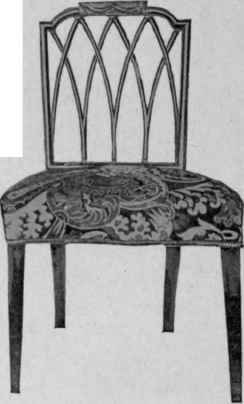
Illus. 196. - Sheraton Chair.
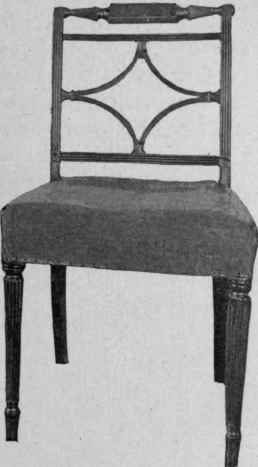
Illus. 197. - Sheraton Chair.
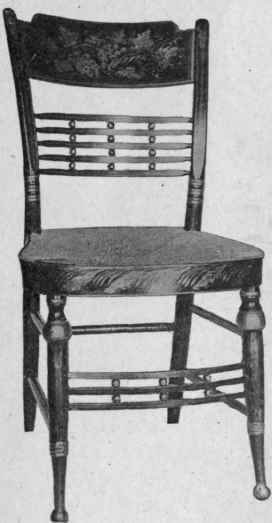
Illus. 198. - Painted Sheraton Chair, 1810-1815.
The chair in Illustration 195 belongs to Walter Bowne Lawrence, Esq., of Flushing, Long Island. It is one of the finest types of a Sheraton chair. The front legs end in what Hepplewhite called a "spade foot," which was frequently employed by him and occasionally by Sheraton.
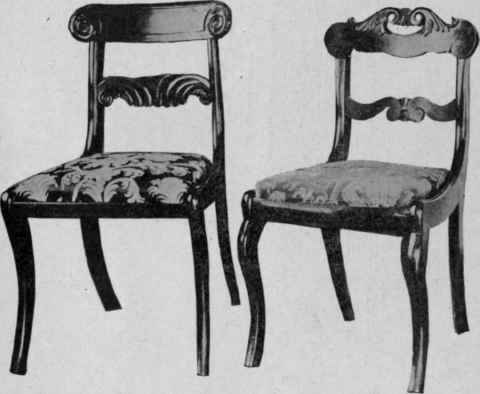
Illus. 199. - Late Mahogany Chairs, 1830-1845.
Illustration 196 shows a Sheraton chair owned by Mrs. E. A. Morse of Worcester. The top bar is carved with graceful festoons of drapery, and the back is in a design which is often seen.
A chair after Sheraton's later designs is shown in Illustration 197. It is one which was popular in the first decade of the nineteenth century. This chair is part of a set inherited by Waldo Lincoln, Esq., of Worcester.
The chair shown in Illustration 198 is owned by Mrs. J. C. Cutter of Worcester. It has a rush seat, and the back is painted in the manner called japanning, with gilt flowers upon a black ground. These chairs, which were called "Fancy chairs," were very popular during the first part of the nineteenth century, together with settees decorated in the same fashion.
Illustration 199 shows two mahogany chairs owned by Waldo Lincoln, Esq., of the styles which were fashionable from 1840 to 1850, examples of which may be found in almost every household, along with heavy sofas and tables of mahogany, solid or veneered.
In the first half of the nineteenth century and in the last quarter of the eighteenth, furniture was fashionable made of the light-colored woods; maple, curly and bird's-eye, and in the more expensive pieces, satinwood, which was used chiefly as a veneer on account of its cost. The two varieties of maple, being a native wood and plentiful, were always used lavishly, and rarely as a veneer. The thick maple drawers in old bureaus have been sawed into many thicknesses to use in violins, for which their seasoned wood is especially valuable. The parlor in John Hancock's house, in Boston, was "furnished in bird's-eye maple covered with damask brocade." As Governor Hancock was a man of inherited wealth and probably of fashion as well, his parlor would be furnished according to the mode of the day.
The three maple chairs in Illustration 200 belong to the writer. They were probably made about 1820 to 1830. The wood in all is beautifully marked curly maple, and in the upper rail of two is set a strip of bird's-eye maple. The design of the carved piece across the back is one that was used at this time in both maple and mahogany chairs.
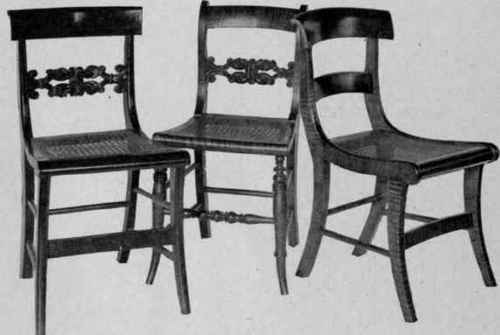
Illus. 200. - Maple Chairs, 1820-1830.
Continue to:


My Books

