


Chairs. Part 7
Description
This section is from the book "Furniture Of The Olden Time", by Frances Clary Morse. Also available from Amazon: Furniture of the Olden Time.
Chairs. Part 7
The chair in Illustration 181 is also in Mr. Gilbert's collection. Although the shield back is generally accredited to Hepplewhite, Adam made it before him and it was used by the other chair-makers of his time. This chair shows very strongly the Adam influence in the carved and reeded legs and the fine carving, which is called guilloche, upon the arms and around the back and the frame of the seat. The entire chair is beautifully carved.

Illus. 181. - Hepplewhite Chair, 1789.
The arm-chair shown in Illustration 182 has stood since 1835 in front of the pulpit in the Unitarian church in Leicester, Massachusetts, but of its history nothing is known for the years before that date, when it was probably given to the new church, then just starting with its young pastor, Rev. Samuel May. This chair, like the one in Illustration 181, which it resembles, has characteristics of different styles. It is probable that both Hepplewhite and Sheraton had practised their trade some years, and had made much furniture before their books were published in 1789 and 1791, and had adopted and adapted many ideas from the cabinet-makers and designers of the day, as well as from each other.

Illus. 182. - Hepplewhite Chair, 1789.
The chair in Illustration 183 was used by Washington in the house occupied as the Presidential mansion in Philadelphia. It is now owned by the Historical Society of Pennsylvania. This chair has the same guilloche carving as the chair in Illustration 181, extending entirely around the back. The legs are short and the chair low and wide, and this with the stuffed back indicates that the chair is French.

Illus. 183. - French Chair, 1790.

Illus. 184. - Hepplewhite Chair, 1790.
The chair in Illustration 184 is also in the rooms of the Historical Society, and is one of the set owned by Washington. The urn and festoons in the back show a marked Adam influence, but the three feathers above the urn are Hepplewhite's.

Illus 185. - Arm Chair, 1785.
A very fine arm chair is shown in Illustration 185, owned by Dwight M. Prouty, Esq. The mahogany frame is heavier than in later chairs of the same style, and the arms end in a bird's head and bill.
During the transition period between Chippendale and Hepplewhite, features of the work of both appeared in chairs.
The chair in Illustration 186 has the Chippendale splat, with the three feathers in it, and the top rail has the Hepplewhite curve. It belongs to Mrs. Clarence R. Hyde, of Brooklyn, N. Y. Illustration 187 shows one of a set of six very beautiful Hepplewhite chairs bought originally by the grandfather of their present owner, Charles R. Waters, Esq., of Salem. This chair is carved upon the legs with the bell-flower, and the three middle rails of the back are exquisitely carved. Chairs of this design, with the ornament of inlay instead of carving, are also found.

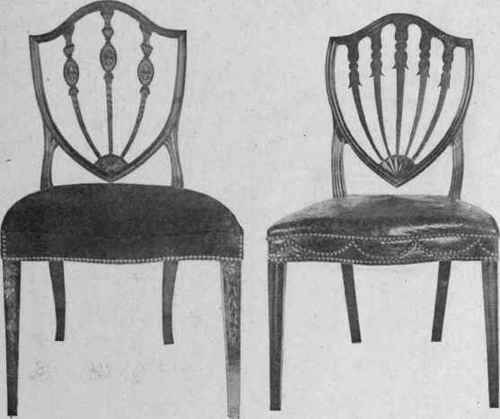
Illus. 187 and 188. - Hepplewhite Chairs.
The chair in Illustration 188 belongs to W. S. G. Kennedy, Esq., of Worcester. The rails are not carved or inlaid, but the fan-shaped ornament at the lower point of the shield back is of holly and ebony, inlaid. This design of Hepplewhite chair is more frequently found than any other.
A specialty of Hepple-white's was what he terms "a very elegant fashion." The chair-backs were finished with painted or japanned work. This was not the lacquering which had been fashionable during the first half of the eighteenth century, with Chinese figures, but it was a process of coating the chairs with a sort of lacquer varnish, and then painting them in gold or colors upon a black ground.

Illus. 189. - Hepplewhite Chair.
Haircloth was used for the seats of chairs; the edges were finished with brass-headed nails, arranged sometimes to simulate festoons, as in Illustration 191.

Illus. 190. - Hepplewhite Chair.
A Hepplewhite chair with a back of quite a different design from the examples described previously, is shown in Illustration 189. The back is heart-shaped, and the ornamentation is of inlaying in light and dark wood. This chair is one of four in the Poore collection at Indian Hill. They formed a part of the set bought by Washington for Mount Vernon, and were in use there at the time of his death.
A chair owned by Miss Mary Coates of Philadelphia is shown in Illustration 190. The characteristic bell-flower is carved in the middle of the back of this chair.
Hepplewhite in turn was superseded by Sheraton, whose book of designs was published in 1791, only two years later than Hepplewhite's; but that short time sufficed for Sheraton to say that "this book [Hepplewhite's] has already caught the decline"; while he asserted of Chippendale's designs, that "they are now wholly antiquated and laid aside, though possessed of great merit, according to the times in which they were executed."
Continue to:


My Books

