


Chairs. Part 6
Description
This section is from the book "Furniture Of The Olden Time", by Frances Clary Morse. Also available from Amazon: Furniture of the Olden Time.
Chairs. Part 6
The finest type of roundabout chair is shown in Illustration 169. It is of mahogany and has but one cabriole leg, the others being uncompromisingly straight, but the cabriole leg, and the top rail and arms are carved finely with the acanthus design, worn almost smooth on the arms. It belongs to Dwight M. Prouty, Esq.
Illustration 170 shows a chair owned by Albert S. Rines, Esq., of Portland, Maine.
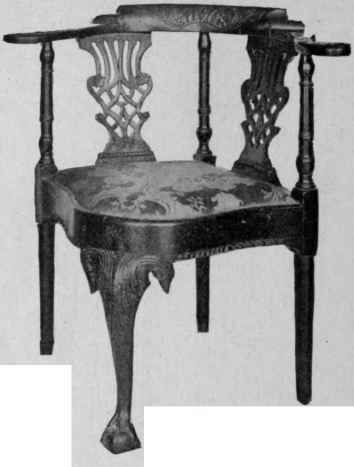
Illus. 169. - Roundabout Chair.
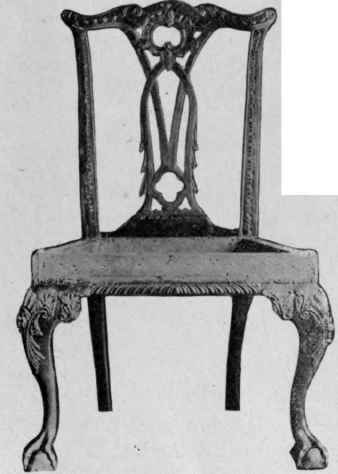
Illus. 170. - Chippendale Chair.
It is extraordinarily good in design and carving, fine in every detail. The gad-rooned edge upon this and the roundabout chair is found only upon the best pieces.
Illustration 171 shows one of six chairs owned by the writer.
The design of the chair-back in Illustration 172 is one that was quite common. The chair belongs to the writer.
The chair in Illustration 173 is owned by Mrs. E. A. Morse of Worcester; the one in Illustration 174 is in the Waters collection, in Salem, and is one of a set of six. The legs and the rail around the seat of the last chair are carved in a rosette design in low relief.

Illus. 171 and Illus. 72. - Chippendale Chairs.
About the middle of the eighteenth century it was fashionable to decorate houses and gardens in "Chinese taste," and furniture was designed for "Chinese temples" by various cabinet-makers. That the American colonies followed English fashions closely is shown by the advertisement in 1758 of Theophilus Hardenbrook, surveyor, who with unfettered fancy modestly announced that he "designs all sorts of Buildings, Pavilions, Summer Rooms, Seats for Gardens"; also "all sorts of rooms after the taste of the Arabian, Chinese, Persian, Gothic, Muscovite, Paladian, Roman, Vitruvian, and Egyptian."
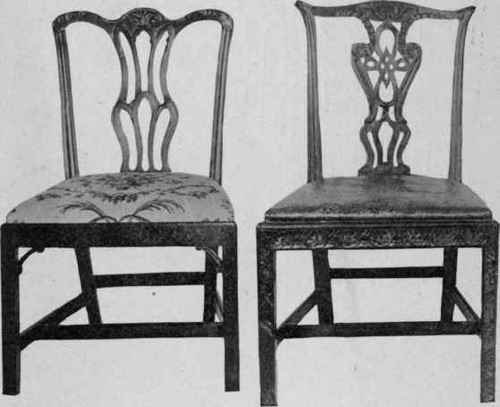
Illus. 173 and Illus. 174. - Chippendale Chairs.
Illustration 175 shows a Chippendale chair in "Chinese taste" owned by Harry Harkness Flagler, Esq., of Millbrook. The legs and stretchers are straight, like those of Chinese chairs, and the outline of the back is Chinese, but the delicate carving is English. A sofa and a chair in "Chinese taste" are shown in Illustration 211.
Illustration 176 and Illustration 177 show two Chippendale chairs with backs of entirely different design from the splat-back chairs previously illustrated. Their form was probably suggested by that of the slat-back chair. Illustration 176 is one of a set of six, originally owned by Joseph Brown, one of the four famous brothers of Providence, whose dignified names, John, Joseph, Nicholas, and Moses, have been familiarly rhymed as "John and Josey, Nick and Mosey." The six chairs are now owned by their kinswoman, Mrs. David Thomas Moore of Westbury, Long Island. Each slat is delicately carved, and the chairs represent the finest of this type of Chippendale chairs. Illustration 177 shows a chair owned by Charles R. Waters, Esq., of Salem, with carved slats in the back. Chairs with this back but with plain slats are not unusual.
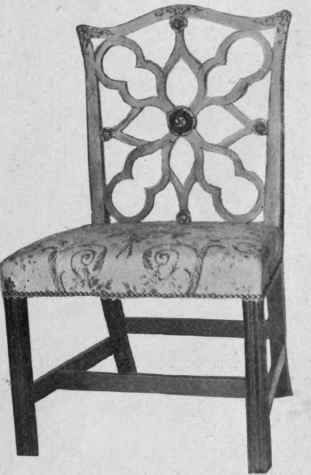
Illus. 175. - Chippendale Chair in " Chinese Taste.".
Hepplewhite's designs were published in 1789, and his light and attractive furniture soon became fashionable, superseding that of Chippendale, which was pronounced "obsolete." Hepplewhite's aim was to produce a light effect, and to this he often sacrificed considerations of strength and durability. While Chippendale used no inlaying, Hepplewhite's furniture is ornamented with both carving and inlay, as well as painting. His chairs may be distinguished by the shape and construction of the back, which was usually of oval, shield, or heart shape. The carving in Hepplewhite's chairs is of quite a different character from that of Chippendale. The three feathers of the Prince of Wales often form a part of the back, for Hepplewhite was of the Prince's party when feeling ran strong during the illness of George III. Carved drapery, wheat, and the bell-flower, sometimes called husks, are other characteristics of Hepple-white's chairs, two of which are shown in Illustration 178, belonging to Dwight Blaney, Esq., of Boston. The Prince's feathers appear in the middle of one chair-back and upon the top rail of the other.
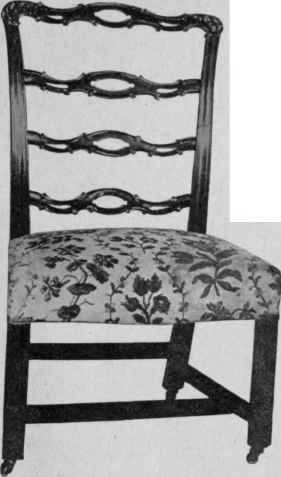
Illus. 176. - Chippendale Chair.
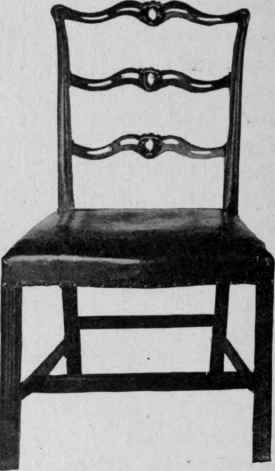
Illus. 177. - Chippendale Chair.
Illustration 179 shows an arm-chair from a set of Hepplewhite dining-chairs owned by Francis H. Bigelow, Esq., of Cambridge. The back is carved with a design of drapery and ears of wheat.
A chair is shown in Illustration 180, which has features of several styles. The legs are French and the width of the seat; the splat joins the seat in the manner of Chippendale; the anthemion design of the splat is in the Adam style and the carving on the top rail, but the rail is Hepple-white's. It is probably an early Hepple-white chair, made before his own style was fully formulated, and the combination has resulted in a beautiful chair. It belongs to J. J. Gilbert, Esq., of Baltimore.
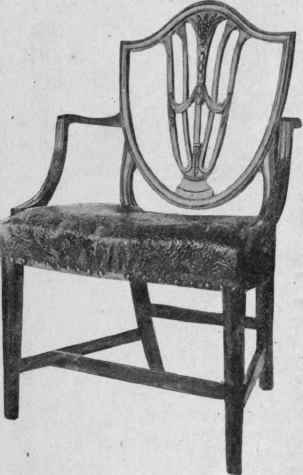
Illus. 179. - Hepplewhite Chair.
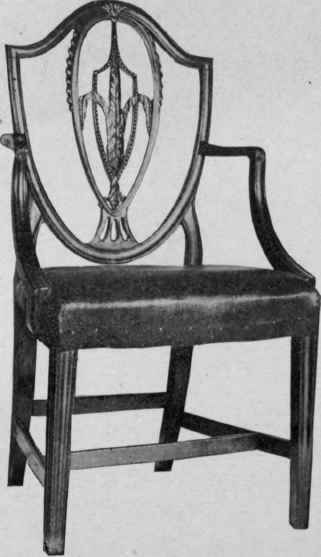
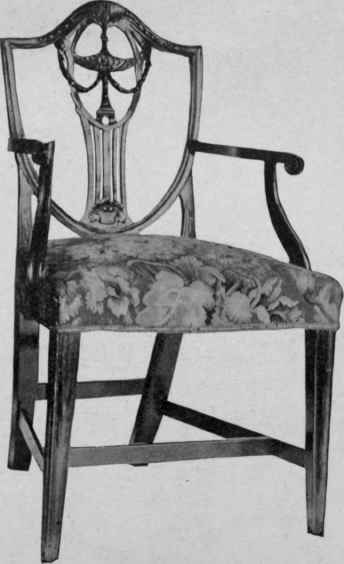
Illus. 178. - Hepplewhite Chairs.
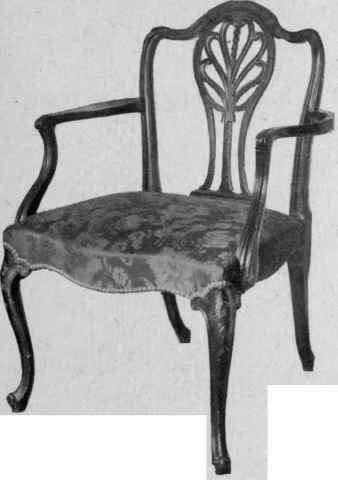
Illus. 180. - Hepplewhite Chair, 1785.
Continue to:


My Books

