


Chapter II. Bureaus And Washstands
Description
This section is from the book "Furniture Of The Olden Time", by Frances Clary Morse. Also available from Amazon: Furniture of the Olden Time.
Chapter II. Bureaus And Washstands
THE word "bureau" is now used to designate low chests of drawers. Chippendale called such pieces "commode tables "or" commode bureau tables." As desks with slanting lids for a long period during the eighteenth century-were called " bureaus " or "bureau desks," the probability is that chests of drawers which resembled desks in the construction of the lower part went by the name of "bureau tables" because of the flat table-top. Hepplewhite called such pieces "commodes" or "chests of drawers." As the general name by which they are now known is " bureau," it has seemed simpler to call them so in this chapter.
Bureaus were made of mahogany, birch, or cherry, and occasionally of maple, while a few have been found of rosewood. Walnut was not used in serpentine or swell front bureaus, although walnut chests of drawers are not uncommon, which look like the top part of a high chest, with bracket feet, and handles of an early design; and so far as the writer's observation goes, few bureaus with three or four drawers were made of walnut.
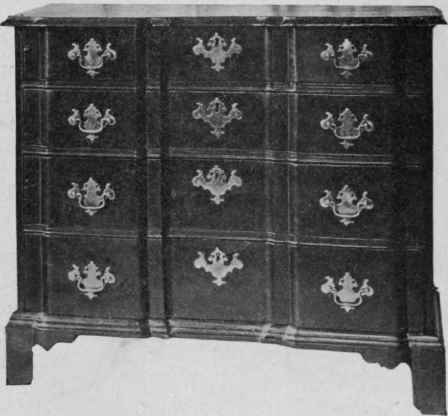
Illus. 28. - Block-front Bureau, about 1770.
The wood usually employed in the finest bureaus is mahogany, and the earliest ones are small, with the serpentine, block, or straight front, and with the top considerably larger than the body, projecting nearly an inch and a half over the front and sides, the edge shaped like the drawer fronts. The early handles are large and like letter E in Illustration II.
The block front is, like the serpentine or yoke front, carved from one thick board. It is found more frequently in this country than in England. The block-front bureau in Illustration 28 is owned by Dwight M. Prouty, Esq., of Boston, and is a very good example, with the original handles.
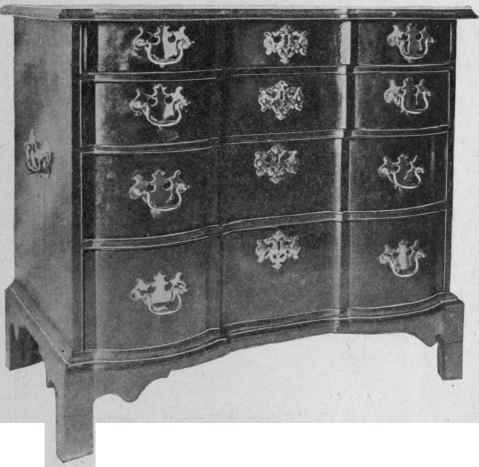
Illus. 29. - Block-front Bureau, about 1770.
The small bureau in Illustration 29 is in the Warner house in Portsmouth. It is of mahogany, with an unusual form of block front, the blocking being rounded. The shape of the board top corresponds to the curves upon the front of the drawers. The handles are large, and upon each end is a massive handle to lift the bureau by.
Illustration 30 shows a block-front bureau owned by the writer. Chippendale gives a design of a bureau similar to this, with three drawers upon rather high legs, under the name of "commode table."
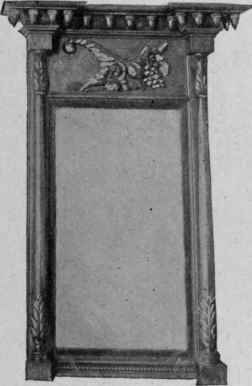
The height of the legs brings the level of the bureau top about the same as one with four drawers. One handle and one escutcheon were remaining upon this bureau, and the others were cast from them. The block front with its unusually fine shells would indicate that this piece, which came from Colchester, Connecticut, was made by the same Newport cabinetmaker as the writing-table in Illustration 106, and the double chest in Illustration 21, which were made about 1765. The looking-glass in the illustration is described upon page 410.
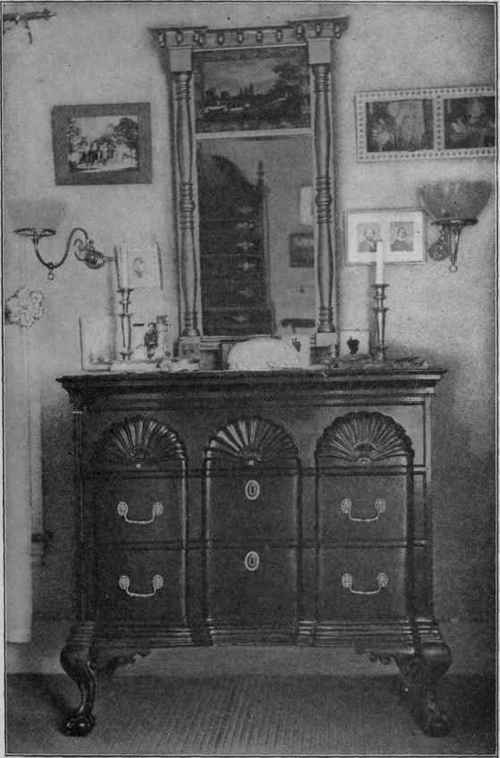
Illus. 30. - Block-front Bureau, about 1770.
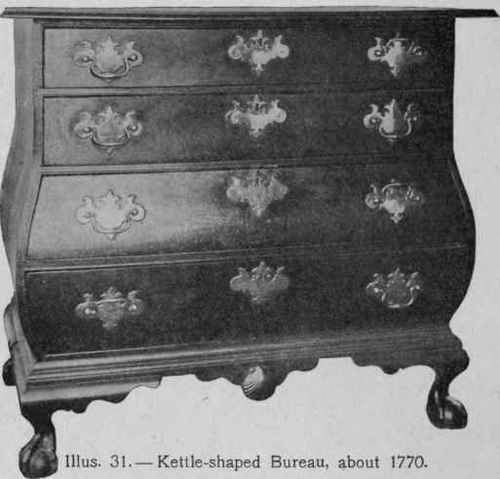
Illustration 31 shows a mahogany bureau of the style known as "kettle" shape, owned by Charles R. Waters, Esq., of Salem. Desks and secretaries were occasionally made with the lower part in this style, and many modern pieces of Dutch marqueterie with kettle fronts are sold as antiques. But little marqueterie furniture was brought to this country in old times, and even among the descendants of Dutch families in New York State it is almost impossible to find any genuine old pieces of Dutch marqueterie.
A bureau with serpentine front is shown in Illustration 32. It is made in two sections, the upper part with four drawers being set into the moulding around the base in the same manner as the top part of a high-boy sets into the lower part. The bureau is owned by Charles Sibley, Esq., of Worcester.
The bureaus described so far all have the small single moulding upon the frame around the drawer. From the time when the designs of Shearer and Hepplewhite became fashionable, bureaus were made with a fine bead moulding upon the edge of the drawer itself or without any moulding.
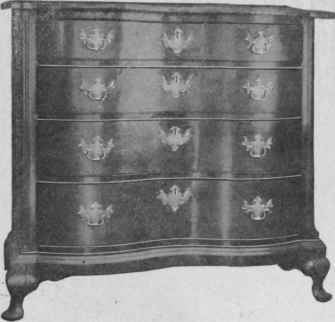
Illus. 32. - Serpentine-front Bureau, about 1770.
The serpentine-front bureau in Illustration 33 belongs to Mrs. Johnson-Hudson of Stratford, Connecticut. The corners are cut off so as to form the effect of a narrow pillar, which is, like the drawers and the bracket feet, inlaid with fine lines of holly. The bracket feet and the handles would indicate that this bureau was made before 1789.

Illus. 33. - Serpentine-front Bureau, about 1785.
A bureau of the finest Hepplewhite type is shown in Illustration 34, owned by Mrs. Charles H. Carroll of Worcester. The base has the French foot which was so much used by Hepplewhite, which is entirely-different from Chippendale's French foot. The curves of the lower edge, which are outlined with a line of holly, are unusually graceful; the knobs are brass.
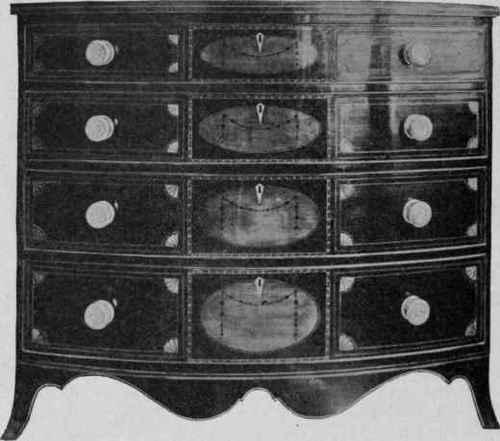
Illus. 34. - Swell-front Inlaid Bureau, about 1795.
Illustration 35 shows the styles of handles chiefly found upon pieces of furniture with drawers, after 1770. A is a handle which was used during the last years of the Chippendale period, and the first years of the Hepplewhite. B and C are the oval pressed brass handles found upon Hepplewhite furniture. They were made round as well as oval, and were in various designs; the eagle with thirteen stars, a serpent, a beehive, a spray of flowers, or heads of historic personages - Washington and Jefferson being the favorites. D is the rosette and ring handle, of which E shows an elaborate form. These handles were used upon Sheraton pieces and also upon the heavy veneered mahogany furniture made during the first quarter of the nineteenth century. F is the brass knob handle used from 1800 to 1820. G is the glass knob which, in clear and opalescent glass, came into use about 1815 and which is found upon furniture made for twenty years after that date, after which time wooden knobs were used, often displacing the old brass handles.
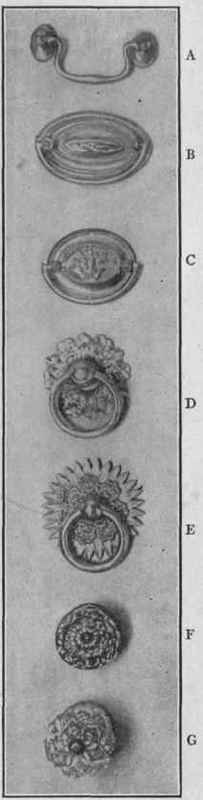
Illustration 35.
Continue to:


My Books

