


Settles, Settees, And Sofas. Part 2
Description
This section is from the book "Furniture Of The Olden Time", by Frances Clary Morse. Also available from Amazon: Furniture of the Olden Time.
Settles, Settees, And Sofas. Part 2
A sofa is shown in Illustration 208 from "Stenton," the fine old house in Philadelphia, now occupied by the Colonial Dames. The back and arms are upholstered, and the shape of the arms, and the curved outline of the back are like early Chippendale pieces. A distinction was made between the "sopha" and the settee, the sofa being a long seat with the back and arms entirely upholstered, like the sofa in Illustration 208.
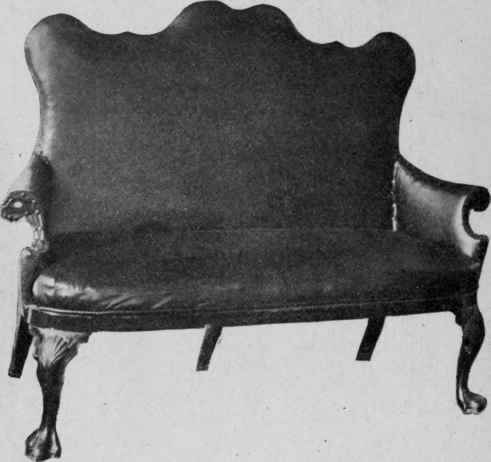
Illus. 208. - Sofa, 1740.

Illus. 209. - Chippendale Settee, 1765-1770.
Illustration 209 shows a Chippendale settee with beautifully carved cabriole legs, owned by Harry Harkness Flagler, Esq. The three front legs are carved with the scroll foot turned to the front. This foot was called the French foot by the cabinet-makers of that period, about 1765-1770.
Illustration 210 shows a double chair, also owned by Mr. Flagler. It has characteristics of various nationalities and styles, mainly Chippendale. The back consists of two chair backs, wider than arm-chair backs, which is almost always true of the double chair. The corners of the seat, and the ends of the top rails are rounding after the Dutch style, but the splats are Chippendale. The three front legs end in a small claw-and-ball, and the knees are carved. The most noticeable feature of this graceful piece is the rococo design at the top of the back and upon the front of the seat.
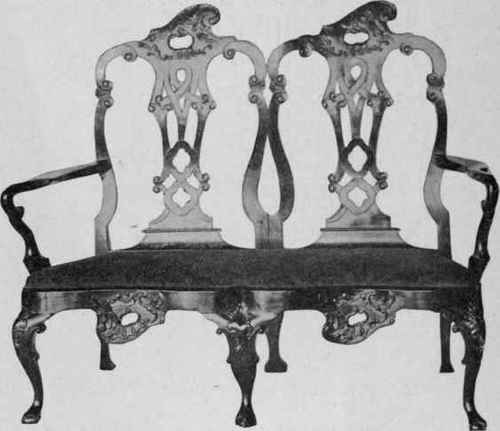
Illus. 210. - Double Chair, 1760.
Illustration 211 shows a Chippendale double chair and one of four arm-chairs, formerly owned by Governor John Wentworth, whose household goods were confiscated and sold at auction by the Federal government, in 1776. Since that time these pieces have been in the Alexander Ladd house at Portsmouth, New Hampshire, where they now stand. They are a perfect exemplification of Chippendale's furniture in the Chinese style, and are probably the finest examples of that style in this country. They are of mahogany, with cane seats. The design of the backs is more elaborate than any of the Chinese designs for furniture of either Chippendale, Manwaring, Ince, or Mayhew; an unusual thing, for a majority of the designs in the old cabinet-makers' books are far more elaborate than the furniture which has come down to us. Chippendale says that these "Chinese chairs are very suitable for a lady's boudoir, and will likewise suit a Chinese temple." One wonders if Governor Wentworth had a Chinese temple for these beautiful pieces of furniture. He had, we know, splendid gardens, which were famous in those days, and possibly a Chinese temple may have been one of the adornments, with these chairs for its furniture.
Illustration 212 shows a double chair, which is well known from representations of it in various books.
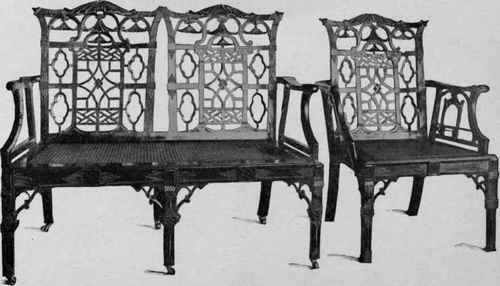
Illus. 211. - Chippendale Double Chair and Chair, in "Chinese Taste," 1760-1765.
It is one of the finest examples existing of the Chippendale period, and was undoubtedly, like the double chair in Illustration 211, made in England. The carving upon the three front legs is unusually good. The feet are carved with lions' claws, and the knees with grotesque faces, while the arms end in dragons' heads.
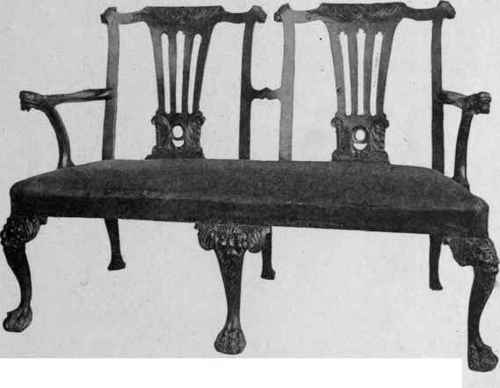
Illus. 212. - Chippendale Double Chair, 1750-1760,.
The corners of the back are finished with a scroll, turning to the back. The wood of this double chair is walnut, and it is covered in gray horsehair. This chair formerly belonged to John Hancock, and was presented to the American Antiquarian Society in 1838, with other pieces bought from the Hancock house, by John Chandler, of Petersham, Massachusetts.
The little settee in Illustration 213 is owned by Albert S. Rines, Esq., of Portland, Maine. It was evidently made from the same design as a long settee in the Pendleton collection in Providence, which has the same Chippendale carvings on the back at the centre and ends, and the same effect of the leg being continued up into the frame of the seat. This settee has the middle leg unevenly placed.

Illus. 213. - Chippendale Settee, 1770.
The settee in Illustration 214 is entirely unlike any shown. It is French, of the time of Louis the Sixteenth, and with the six chairs like it, was part of the cargo upon the ship Sally, which sailed from France in 1792, and landed at Wiscasset, Maine, with a load of fine furniture and rich belongings intended to furnish a home of refuge for Marie Antoinette, who did not live to sail upon the Sally. The sideboard in Illustration 75 has the same history and it can be traced directly to the Sally. The settee and chairs came from Bath, Maine, where there are also other chairs from the Sally, which are, however, like the sideboard, English in style.
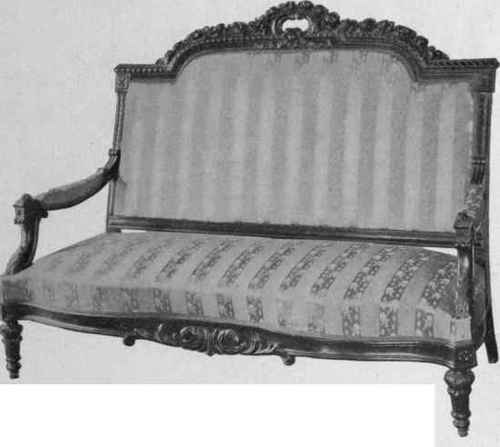
Illus. 214. - French Settee, 1790.
The settee is of solid rosewood, with the short legs of the Louis XVI period, and a very deep seat. The wood of the back is elaborately carved in a design distinctly French, of roses, with a bow of ribbon in the centre. The settee and chairs are now owned by Mrs. William J. Hogg, of Worcester.
Continue to:


My Books

