


Settles, Settees, And Sofas. Part 3
Description
This section is from the book "Furniture Of The Olden Time", by Frances Clary Morse. Also available from Amazon: Furniture of the Olden Time.
Settles, Settees, And Sofas. Part 3
A double chair owned by Francis H. Bigelow, Esq., is shown in Illustration 215. The back is made of two Hepplewhite chair-backs, which combine the outline of the shield back and the middle of the interlaced heart back shown in the chair in Illustration 189.
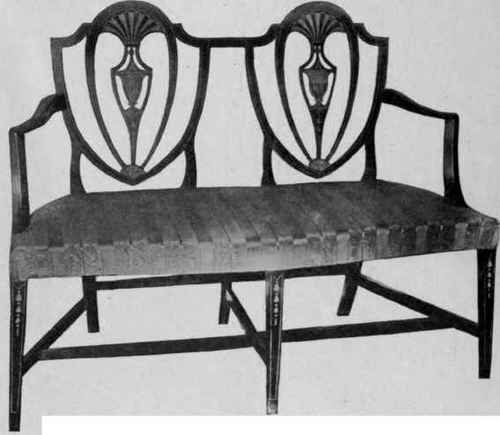
Illus. 215. - Hepplewhite Settee, 1790.
The three front legs are inlaid with fine lines and the bell flower, and the backs are very finely inlaid, with lines in the urn-shaped piece in the centre, and a fan above, while a fine line of holly runs around the edge of each piece. The stretchers between the legs are a very unusual feature in such settees.
Illustration 216 shows a Sheraton settee, now in Girard College, Philadelphia. It was a part of the furniture belonging to Stephen Girard, the founder of that college. It has eight legs, the four in front being the typical reeded Sheraton legs. The back has five posts dividing it into four chair-backs. The seat is upholstered.
The Sheraton sofa in Illustration 217 was probably made in England about 1790-1800. It is owned by Francis H. Bigelow, Esq., of Cambridge. The frame is of mahogany, and the rail at the top of the back is exquisitely carved with festoons and flowers. The front of the seat is slightly rounding at the ends, and the arm, which is carved upon the upper side, extends beyond the upholstered frame, and rests upon a pillar which continues up from the corner leg. This style of arm is quite characteristic of Sheraton. The legs of the sofa are plainly turned, not reeded, as is usual upon Sheraton sofas.
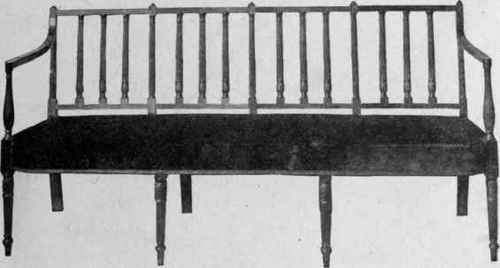
Illus. 216. - Sheraton Settee, 1790-1795.
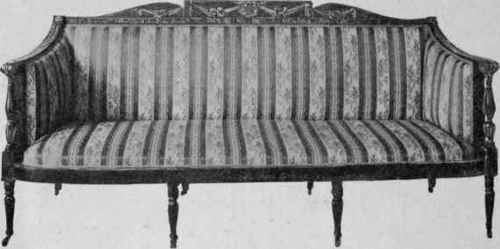
Illus. 217. - Sheraton Sofa, 1790-1800.
The sofa in Illustration 218 is a typical Sheraton piece, of a style which must have been very fashionable about 1800, for such sofas are often found in this country. The frame is of mahogany, with pieces of satinwood inlaid at the top of the end legs. The arms are like the arms of the sofa in Illustration 217, and they, the pillars supporting them, and the four front legs are all reeded. This sofa is owned by W. S. G. Kennedy, Esq., of Worcester.
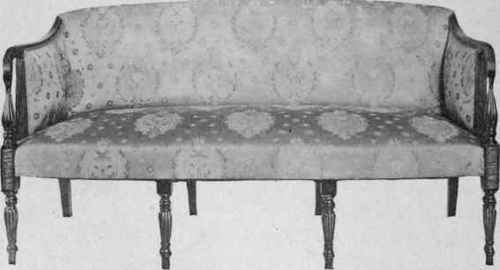
Illus. 218. - Sheraton Sofa, about 1800.
Illustration 219 shows a Sheraton settee which came from the Flint mansion in Leicester, Massachusetts, and is now owned by the writer. It has a rush seat, and the frame was originally painted black, with gilt flowers. It is very long, settees of this style usually equalling three chairs, while this equals four. It measures seventy-six inches in length, and from front to back the seat measures seventeen inches. It makes an admirable hall settee, and seems to be substantial, although extremely light in effect. Another settee is shown in Illustration 220, with a cane seat, and painted in the "japanning" of the period in black with gold figures. It is owned by Mrs. Clarence R. Hyde, of Brooklyn, N. Y.
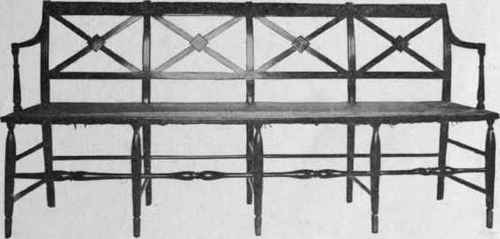
Illus. 219. - Sheraton Settee, about 1805.
An Empire settee of graceful shape, owned by Barton Myers, Esq., of Norfolk, Virginia, is shown in Illustration 221. The lines of the many curves are all unusually good. The wood of the settee is mahogany, and the seat is rush. The ornaments upon the front and the rosettes at the tip of each curve are brass.-
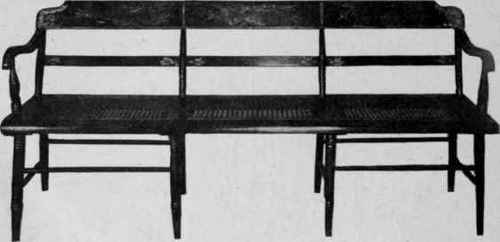
Illus. 220. - Sheraton Settee, about 1805.
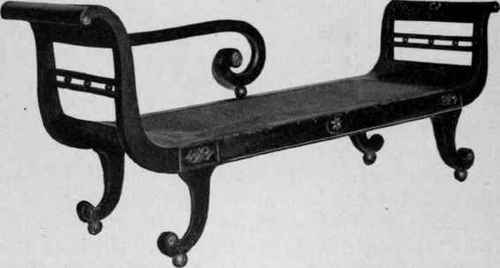
Illus. 221. - Empire Settee, about 1805.
In 1816 there was launched in Salem the yacht called Cleopatra's Barge, built and owned by Capt. George Crowninshield, who had been a partner with his brothers in the East India trade and had lived from a boy upon his father's ships. Finally retiring from business, he built this splendid yacht with the intention of spending years in travel, but he died after the first long voyage to the Mediterranean. The yacht was the wonder of the day and was visited by thousands, not alone in Salem but in every foreign port. She was furnished with great magnificence, in the Empire style, the woods used in the saloon being mahogany and bird's-eye maple, and the two settees in the saloon were each eleven feet in length. One is shown in Illustration 222, now owned by Frederic B. Crowninshield, Esq., of Marblehead. The backs are lyre-shaped, and when new the seats were covered with crimson velvet and edged with wide gold lace. The hook upon the back leg was probably to hold the settee to the wall in bad weather. Illustration 223 shows the influence of the fashion for heavier and more elaborate frames, which came in with the nineteenth century. The arms are made after the Sheraton type shown in Illustration 217 and Illustration 218, but where a simple pillar was employed before, this settee has a carved pineapple forming the support to the arm, which ends in a scroll. Instead of four front legs either plain or fluted, there are two of larger size carved with the same leaves which sheathe the pineapple. The covering is horsehair, which was probably the original cover.
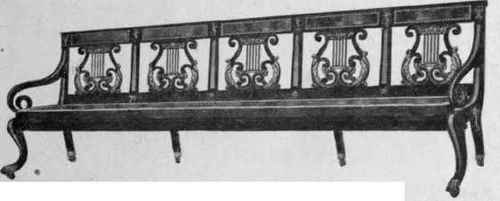
IIllus. 222. - Empire Settee, 1816.
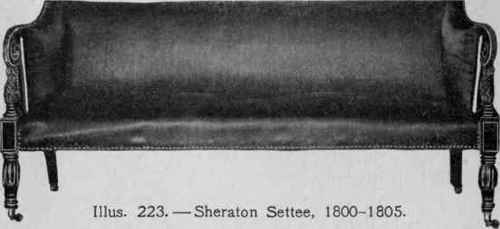
This settee now belongs to the Concord Antiquarian Society, and was owned by Dr. Ezra Ripley, who was minister of the old Congregational Church of Concord from 1777 to 1840, and who lived in the Old Manse, afterward occupied by Hawthorne. The settee remained in the manse until comparatively recent years.
Continue to:


My Books

