


Looking-Glasses. Part 3
Description
This section is from the book "Furniture Of The Olden Time", by Frances Clary Morse. Also available from Amazon: Furniture of the Olden Time.
Looking-Glasses. Part 3
A looking-glass with a mahogany and gilt frame, owned by the writer, is shown in the heading to Chapter IX (Musical Instruments). This looking-glass dates between the last two described; the curved form of the upper edge of the glass in Illustration 26 leaving a slight reminder in the cutoff, upper corners of this glass, which vanishes in the square corners of the one in Illustration 370. The garlands at each side are carved from wood, without wire. These looking-glasses are now reproduced in large numbers and are sometimes called Washington glasses, from the fact that one hangs upon the wall in a room at Mount Vernon.
A very unusual looking-glass is shown in Illustration 371, a long mantel looking-glass of very early date, probably not later than 1750. The glass is made in three sections, the two end sections being lapped over the middle one. The glasses are not bevelled. Short garlands carved in wood are upon the sides, and the moulding around the glass is made in curves, while the upper and lower edges of the frame are perfectly straight. A glimpse may be caught above the frame of the two pieces of metal fastened to the back, which are found upon such frames, with a hole for a screw to fasten the heavy frame to the wall. This looking-glass belongs to Dwight M. Prouty, Esq.

Illus. 370. - Looking-glass, 1770-1780.
The looking-glasses in Illustrations 372 and 373 also belong to Mr. Prouty. Glasses of this style are not uncommon. They are never large, and as they are always about the same size, they must have been made for a certain purpose, or to follow a certain fashion. The decorations vary, but are always applied in gilt upon the high top above the frame, and upon the piece below, while the sides are straight and plain.
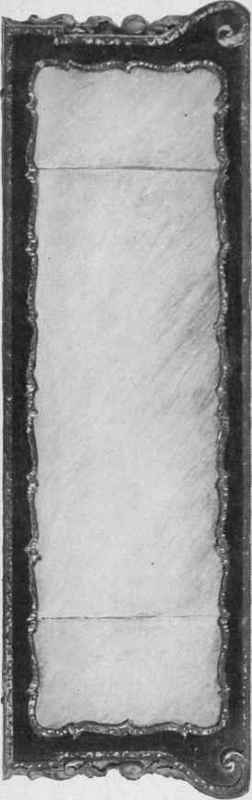
Illus. 371. - Mantel Glass, 1725-1750.

Illus. 372. - Looking-glass, 1770.

Illus. 373. - Looking-glass, 1770.

Illus. 374. - Looking-glass, 1776.
Illustration 374 shows a beautiful looking-glass in the Chase mansion in Annapolis. It is carved in wood and gilt, and four pieces of glass are set in the frame, which is surmounted by the eagle holding a shield with stars and stripes.
Illustration 375 shows a very large looking-glass, from the Ogle house in Annapolis. It is finished in white and gold and has the original bevelled glass.
The looking-glass which heads Chapter XIII (Doorways, Mantels, And Stairs) is in the Metropolitan Museum of Art and is of the same period as the glass in Illustration 371. A looking-glass is shown in the heading to Chapter VIII (Tables) in which the decoration is produced by both carving and sawing, as well as by gilt ornaments. The sawing of ornamental outlines appears upon the earliest frames, such as Illustration 364, and is found upon frames made during the eighteenth century until its close.

Illus. 375. - Looking-glass, 1780.
During the last quarter of the eighteenth century frames which are apparently a cheaper form of the mahogany and gilt looking-glasses described, were most popular, and are commonly found. These frames are veneered with mahogany or walnut, and are sawed in outlines similar to those of the richer frames of walnut or mahogany and gilt. The inside of the frame next the glass has a narrow hand-carved gilt moulding, and there is sometimes a gilt bird flying through the opening sawed in the upper part of the frame, while in other frames the opening is partially filled by three feathers, a conventional shell, or a flower in gilt. Occasionally a line of inlaying follows the gilt moulding next the glass. In smaller looking-glasses a gilded plaster eagle was glued upon the frame above the glass. Such frames may be found, or rather might have been found, in almost any old house.
Illustration 376 shows two of these looking-glasses. The larger glass is owned by the writer, the smaller by W. S. G. Kennedy, Esq., of Worcester.
A looking-glass with some variations from those previously shown forms the heading to Chapter X (Fires And Lights). The lower part of the frame has the sawed outlines which appear upon so many, while the upper part has a broken arch cornice of a high and slender design, showing the influence of the lighter Hepple-white styles. A colored shell is inlaid in the top of this frame, and there are two rows of fine inlaying around the glass. The frame is surmounted by an urn or vase with flowers and stalks of wheat, upon wires, like the slender garlands at the sides. This looking-glass belongs to H. H. Kohn, Esq., of Albany.

Illus. 376. - Looking-glasses, 1750-1790.
Illustration 377 shows another looking-glass of the same style, with the wheat and flowers upon wires springing from an urn at the top, and leaves of plaster strung upon wires at the sides.
Illustration 378 shows a looking-glass carved and sawed in fantastic outlines, with ribbons at the sides. These two looking-glasses are in the Metropolitan Museum of Art.

Illus. 377. - Looking-glass, 1790.

Illus. 378. - Looking-glass, 1780.
Wooden frames with sawed outlines continued fashionable until the close of the century.
It was customary for these mahogany-framed glasses to rest upon two mirror knobs, which fitted into the lower curves of the frame and were screwed into the wall. These knobs were sometimes made of brass, but the most fashionable mirror knobs were those with a medallion, round or oval, of Battersea enamel upon copper, framed in brass. The design of the medallions varied, heads of historical personages being very popular, while flowers, landscapes, fancy heads, the eagle and thirteen stars, and the ever-favorite design of the monument and weeping willow appear in the bright tints of the enamel. Dwight Blaney, Esq., of Boston, has a collection of over one hundred knobs. Washington, Lafayette, Franklin, Lord Nelson are some of the heads found upon mirror knobs. Four pairs of enamelled knobs, owned by the writer, appear in Illustration 379. The head of Lord Nelson figures upon one pair.

Illus. 379. - Enamelled Mirror Knobs, 1770-1790.
Continue to:


My Books

