


Looking-Glasses. Part 4
Description
This section is from the book "Furniture Of The Olden Time", by Frances Clary Morse. Also available from Amazon: Furniture of the Olden Time.
Looking-Glasses. Part 4
"A circular convex glass in a gilt frame" is shown in Illustration 380. Such glasses were advertised as "mirrors," in distinction from the looking-glasses which were in ordinary use, and they were sold in pairs, for sconces, the convex or occasionally concave glass precluding the possibility of its use for a literal looking-glass, as any person will agree who has caught in one a glimpse of a distorted reflection of face or figure.
These mirrors were fashionable during the last quarter of the eighteenth century, and were made in various sizes, frorn twelve inches in diameter to three feet. The eagle formed the most popular ornament for the top, but many were made with a winged horse, or a sort of dragon, instead of the eagle. These mirrors were called girandoles, like others with branches for candles.
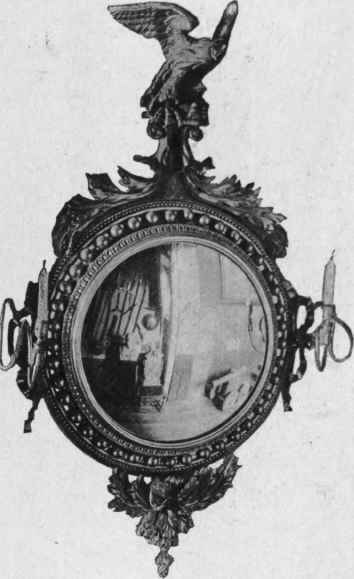
Illus. 380. - Girandole, 1770-1780.
The girandole in Illustration 380 is owned by the Albany Historical Society.
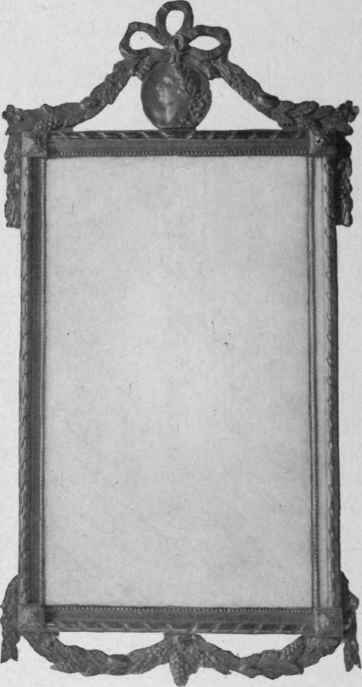
Illus. 381. - Looking-glass, 1780.
The looking-glass in Illustration 381 belongs to the writer, and is in the same style as the glass at the head of Chapter IV (Cupboards And Sideboards), which is described upon page 384. The garlands upon this frame are carved in fruit, grapes and plums with leaves, instead of the laurel which is generally the design, and the medallion above the frame has a classic head in profile, and is surmounted by a ribbon bow-knot of three loops. The glass is of quite a large size. Illustration 382 shows a looking-glass owned by Mrs. William Preston of Richmond, Virginia. The upper section of the glass is divided from the lower by a gilt moulding, and is delicately painted, in black and gold upon a white ground, with three panels, the middle one having a classical design. The pyramid-shaped pieces at the top are of painted glass and from them go chains, held by an eagle above.
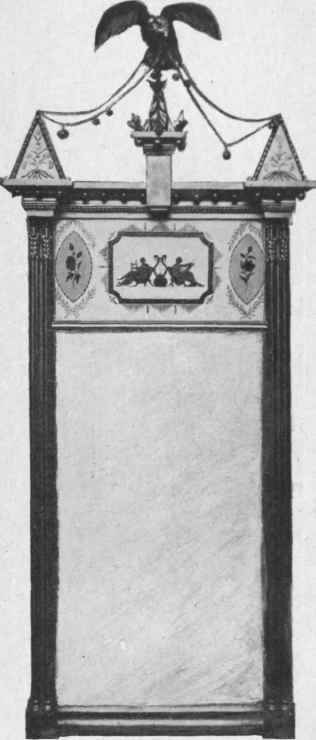
Illus. 382. - Looking-glass, 1790.
Illustration 383 shows a large and handsome looking-glass made in the fashion of Hepplewhite's designs, the fan-shaped ornament below the glass being quite characteristic of Hepplewhite's frames. The eagle at the top holds in his beak chains which extend to the urns upon the upper corners of the frame. This looking-glass was made about 1790, and is owned by Mrs. Thomas H. Gage of Worcester.
A looking-glass made to fit the panel over the mantel is shown in Illustration 384. This mantel with the looking-glass is in the Nichols house, in Salem, in a room built in 1783 for a young bride. The upper part of the frame has the lattice and ornaments in gilt upon a white ground, and the overhanging cornice has a row of gilt balls beneath it. The pillars framing the three sections of glass are fluted and bound with garlands.
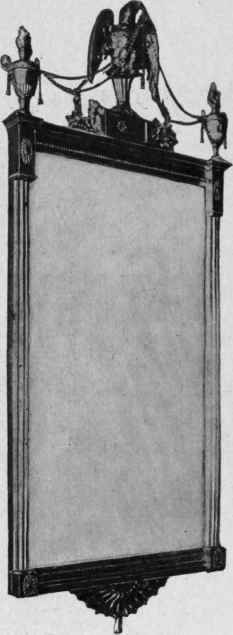
Illus. 383. - Hepplewhite Looking-glass, 1790.
Another large looking-glass of a similar design, but of a few years' later date, is shown in Illustration 385. It is owned by Dwight Blaney, Esq., and was probably made to fit some space, as it is of unusual shape and very large. The three panels at the top are painted upon glass, the middle panel having one of the mortuary subjects which were so popular with our ancestors, of a monument with a willow carefully trained to weep over the urn, and a despondent female disconsolately gazing upon the ground. The glass may have been ordered by the grief-stricken lady who is depicted in the panel, as evidence that while the looking-glass was a tribute to the vanities of life, the doleful scene in the panel above the glass should serve as a reminder that such vanities are fleeting. The cornice and the capitals of the pillars are very elaborate, and around the top runs a fluted band wound with garlands similar to the pillars in Illustration 384.
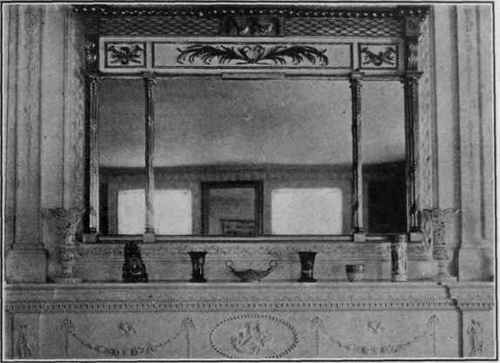
Illus. 384. - Mantel Glass, 1783.
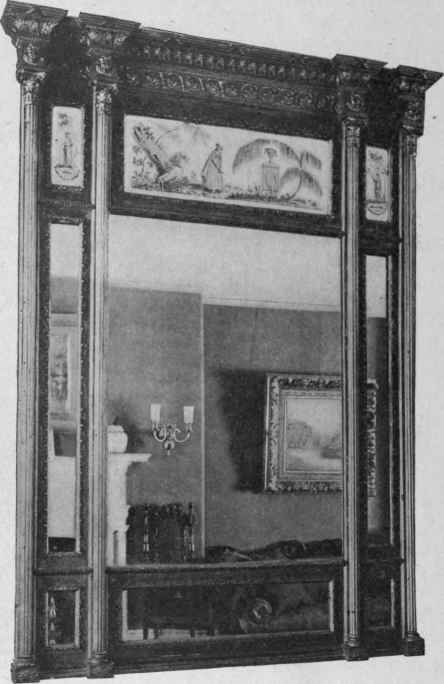
Illus. 385. - Looking-glass, 1790-1800.
Illustration 386 shows a looking-glass in a frame the main portion of which is of salmon-colored marble, which is glued or cemented to the wood in small thin pieces. Upon the edges of this marble is a narrow gilt moulding, and the ornaments at the top and bottom are of gilt, the fine scrolls at the top being made of wire. Such looking-glasses have been found in New England, chiefly in Massachusetts, and the majority that have been traced have Marblehead as their starting-point in this country. In Marblehead they are known as "Bilboa glasses," and the story of the old wives of Marblehead is that these glasses were all brought home by sailors who had been to Bilboa, "In the bay of Biscay, oh," and that the looking-glasses were either given as presents to wives or sweethearts, or more prosaically exchanged for a cargo of Marblehead dried fish. The frames, however, would appear to be of Italian origin, if one wishes to be accurate, and discard the picturesque Marblehead legend.
The looking-glass in Illustration 386 is now in the Boston Art Museum. The "Bilboa glasses" are nearly all similar to this in design, with marble pillars at the side and gilt ornaments at the top and bottom. The glass is the original one with the shallow, wide bevel, and the frame, exclusive of the ornaments at the top and bottom, measures twenty-five inches in height and eighteen in width.
Another "Bilboa glass" is shown in the heading to Chapter VII (Settles, Settees, And Sofas). This glass is owned by Mrs.
Continue to:


My Books

