


Looking-Glasses. Part 5
Description
This section is from the book "Furniture Of The Olden Time", by Frances Clary Morse. Also available from Amazon: Furniture of the Olden Time.
Looking-Glasses. Part 5
M. G. Potter of Worcester, and the story in the family is that this looking-glass was made by Captain John Potter of North Brookfield, a well-known clock-maker and metal-worker, as a present to his bride, about 1790. The glass has always been fastened to the black panel behind it, within the memory of the family. The probability is that the black panel was made by Captain Potter, the frame of marble with its fine gilt ornamentation having been brought originally with other Bilboa looking-glasses to Marblehead, from Italy or Spain, whichever place they may have been brought from. The top of this glass is distinctly different from the one in Illustration 386, and is on the order of Chippendale or other designers of his day. Several "Bilboa" frames have been found with this little fence at the top. Other Bilboa frames have an oval or round painted panel in the centre of the light, open gilt ornament at the top. Two Bilboa glasses are in the collection of Francis H. Bigelow, Esq., with the marble in the frame dark with white veins, instead of the usual salmon color, but made in the same design with the columns at the sides.

Illus. 386. - "Bilboa Glass," 1770-1780.

Illus. 387. - Mantel Glass, 1790.
During the eighteenth century, particularly the latter years, it was fashionable to have a looking-glass on the mantel, extending nearly the length of the shelf, and divided into three sections, the larger section in the middle. The line where the glass was joined was covered by a narrow gilt moulding. Such a looking-glass is shown in Illustration 387. It has the overhanging cornice which was a feature of these glasses, and which was used as early as 1783. A panel of black basalt with a classical design is set into the cornice above the glass, and two small panels above the side columns. Francis H. Bigelow, Esq., owns this looking-glass. It probably was made about 1790, when Wedgwood and Flaxman designs were popular. Another mantel glass of simpler style is shown in Illustration 334. It has the projecting cornice but not the balls beneath. The design of the frame is in the usual classical style, with pillars at the sides. Another similar looking-glass is shown in Illustration 335. Both of these glasses belong to Francis H. Bige-low, Esq., of Cambridge, and they were made from 1800 to 1810.

Illus. 388. - Mantel Glass, 1800-1810.
Illustration 388 shows a very handsome mantel glass owned by Harry Harkness Flagler, Esq., of Millbrook, made about 1810.
Cheval glasses were not common in early times, to judge from the small number of old specimens found. Illustration 389 shows one with a frame and stand of mahogany, owned by Mrs. N. F. Rogers of Worcester, and made about 1830 to 1840.

Illus. 389. - Cheval Glass, 1830-1840.
Looking-glasses were made from 1810 to 1825, following the heavy designs which were fashionable at that period, and these glasses are commonly found. By this time the shallow bevel upon the glass had disap-peared, and the glass in these heavy gilt frames is always plain. The overhanging cornice, often with acorns or balls beneath, is a feature of these glasses, one of which is shown in Illustration 390, with a classical design below the cornice, and with the upper section filled with a gilded panel. It is owned by Francis H. Bigelow, Esq., of Cambridge.

Illus. 390. - Looking-glass. 1810-1825.
A glass of the same period is shown in Illustration 391, with the glass in two sections, separated by a gilt moulding. The sides of the frame are made in a double column, ending at the division in the glass. The frame continues from there in a bracket effect, with a heavy cornice above, and is more classical in design than one with twisted columns. This looking-glass is owned by the writer.
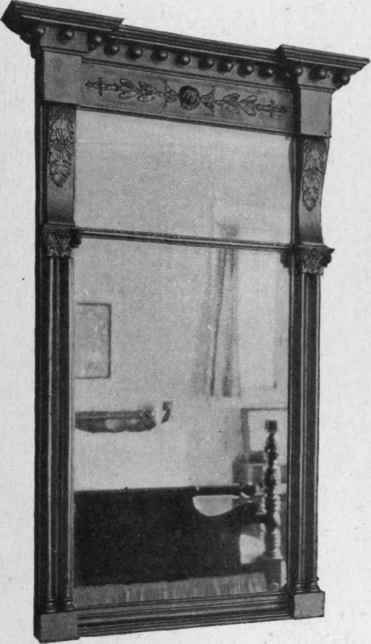
Illus. 391. - Looking-glass, 1810-1815.
The glass in Illustration 392 is owned by Dwight M. Prouty, Esq. The frame is gilt, and the heavy drapery is carved in wood and gilded.
The richest and largest form of the looking-glass with a projecting cornice is shown in Illustration 393. It is nearly the height of the room as it rests upon a low shelf. The plain surface of the columns at the side is broken by ornaments, and there are no capitals, but the same round moulding with ornaments extends across the frame between the heavy overhanging cornice and the top section, which is very large, with scrolls and a basket of flowers in high relief, in gilt. This fine looking-glass belongs to George W. Holmes, Esq., of Charleston, South Carolina.

Illus. 392. - Looking-glass, 1810-1828.

Illus. 393. - Looking-glass, 1810-1820.
The glass with a heavy frame in Illustration 394 belongs to the writer. Looking-glasses were made in this style of mahogany also, with pillars twisted, fluted, or carved with the acanthus leaf. The glass was sometimes divided in two sections, separated by a narrow moulding, and the upper section was often filled by a gilded panel, as in Illustration 390. The frame at the head of Chapter II (Bureaus And Washstands) shows a looking-glass owned by Mr. Bige-low. The panel above the glass is gilded, and its design, of a cornucopia, was extremely popular at this period. The upper section was frequently filled with a picture painted upon glass. A looking-glass with such a picture is shown in Illustration 31, and another, owned by Mrs. H. H. Bigelow of Worcester, heads Chapter I (Chests, Chests Of Drawers, And Dressing-Tables).

Illus. 394. - Looking-glass, 1810-1825.
Continue to:


My Books

