


Desks. Part 2
Description
This section is from the book "Furniture Of The Olden Time", by Frances Clary Morse. Also available from Amazon: Furniture of the Olden Time.
Desks. Part 2
A style of desk of a somewhat later date is occasionally found, generally made of maple. Its form and proportions are similar to those of a low-boy with the Dutch bandy-leg and foot, and a desk top, the slanting lid of which lets down for use in writing. The top sets into a moulding around the edge of the lower part, in the same manner as the top part of a high-boy is set upon its base. Illustration 97 shows a desk of this style in the building of the Pennsylvania Historical Society, labelled as having belonged to William Penn, but which is of a later date than that would imply, as it was made from 1720 to 1730, while Penn left this country in 1701, never to return to it.
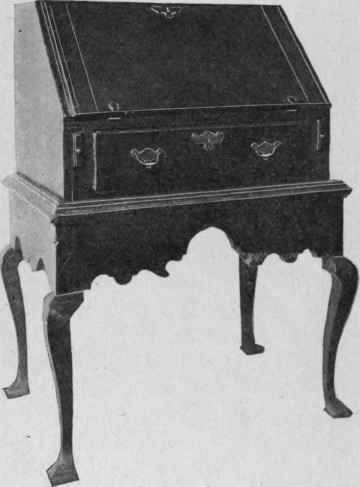
Illus. 97. - Cabriole-legged Desk, 1720-1730.
The mahogany desk shown in Illustration 98 belongs to Walter Hosmer, Esq., and is a most graceful and charming little piece, intended probably for a lady's use. It measures twenty-four and a half inches in length and forty-one and a half inches in height. There are three square drawers in the lower part, and the upper part has two small square drawers for pens, with a third between them. The two pen drawers pull out and support the lid when lowered. The interior of the desk has eighteen small drawers, shaped and placed so that their fronts form a curve, and each little drawer at the top is carved with the rising sun, or fan, like the middle drawer in the lower part. The entire design of the interior is like that in a large block-front desk now owned by George S. Palmer, Esq., of Norwich, which was made by Benjamin Dunham in 1769, and it is possible that the two pieces were made by the same Connecticut cabinetmaker.
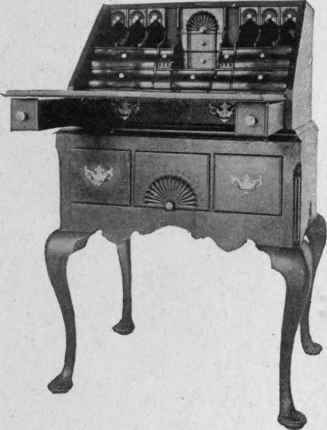
Illus. 98. - Cabriole-legged Desk, 1760.
Another desk belonging to Mr. Hosmer is shown in Illustration 99. The bandy-legs end in a claw-and-ball of a flattened shape, and instead of the drawer, plain or with a carved sunburst, usually seen between the side drawers of the lower part, the wood of the frame is sawed in a simple design. The upper part has three drawers, and the lid when down rests upon two slides which pull out for the purpose. The interior is quite simple, having four drawers with eight small compartments above. This desk measures twenty-six inches in width and thirty-nine inches and a half in height.
The desk in Illustration 100 is now owned by the American Antiquarian Society of Worcester, and belonged formerly to Governor John Hancock. It measures four feet six inches from the floor, and is of the sturdy, honest build that one would expect in a desk used by the man whose signature to the Declaration of Independence stands out so fearless and determined. The slanting lid has a moulding across the lower edge, probably to support a large book, or ledger, and as it is at the right height for a man to write standing, or sitting upon a very high stool, it may have been used as an office desk. Below the slanting lid are two doors behind which are shelves. Two drawers extend across the lower part, and at each end of the desk two small, long drawers pull out. The desk was made about 1770. Illustration 101 shows a mahogany block-front desk with cabinet top, owned by Charles R. Waters, Esq., of Salem, which was bought by Mr. Waters's grandfather, about 1770. It is a fine example of the best style of secretary made during the eighteenth century. The doors are of panelled wood. The lid of the desk is blocked like the front, and like the lid of the desk in Illustration 109, requiring for the blocked lid and drawer fronts wood from two to three inches thick, as each front is carved from one thick plank.
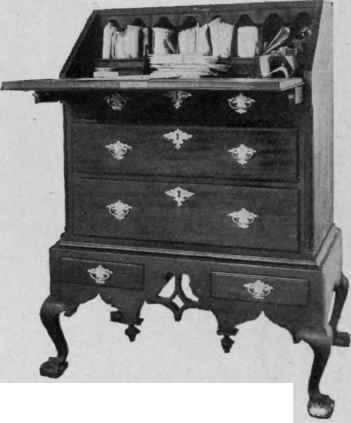
Illus. 99. - Desk, 1760.
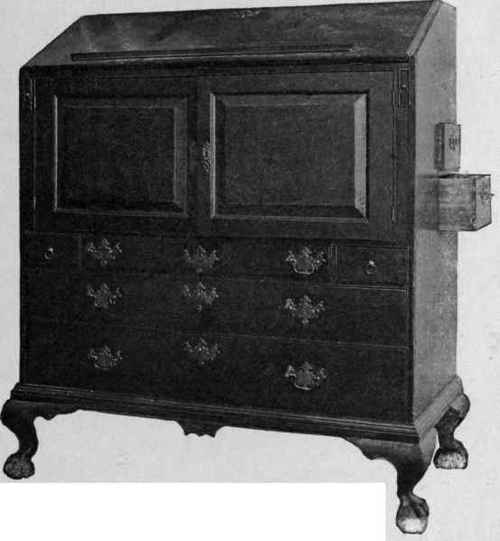
Illus. 100. - Desk, about 1770.
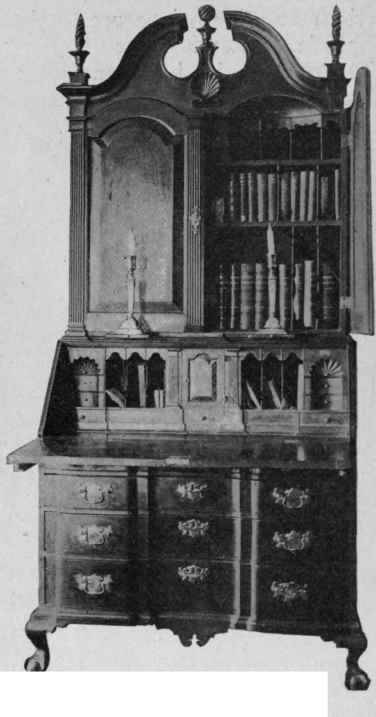
Illus. 101. - Block-front Desk. Cabinet Top, about 1770.
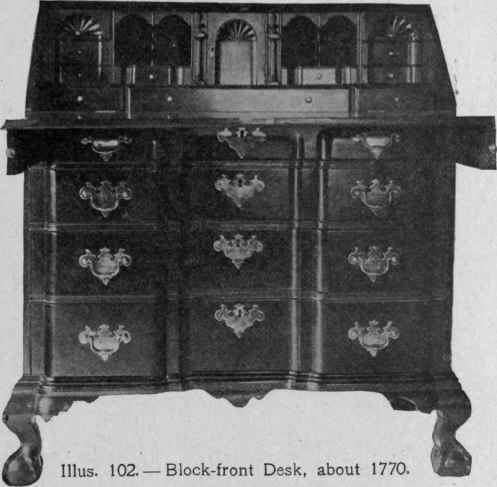
Illustration 102 shows a block-front mahogany desk, owned by Francis H. Bigelow, Esq., of Cambridge. It formerly belonged to Dr. John Snelling Popkin, who was Professor of Greek at Harvard University from 1826 to 1833, and probably descended to him, as it was made about 1770. The legs, with claw-and-ball feet, are blocked like the drawers, as was usual in block-front pieces, another feature of which is the moulding upon the frame around the drawers.
In all the desks shown, the pillars at each side of the middle door in the interior pull out as drawers. These were supposed to be secret drawers. Often the little arched pieces above the pigeonholes are drawer fronts. The middle compartment is sometimes a drawer, or if it has a door, behind this door is a drawer which, when taken entirely out, proves to have a secret drawer opening from its back. Occasionally an opening to a secret compartment is found in the back of the desk. All these were designed at a time when banks and deposit companies did not abound, and the compartments were doubtless utilized to hold papers and securities of value. There are traditions of wills being discovered in these secret compartments, and novelists have found them of great convenience in the construction of plots.
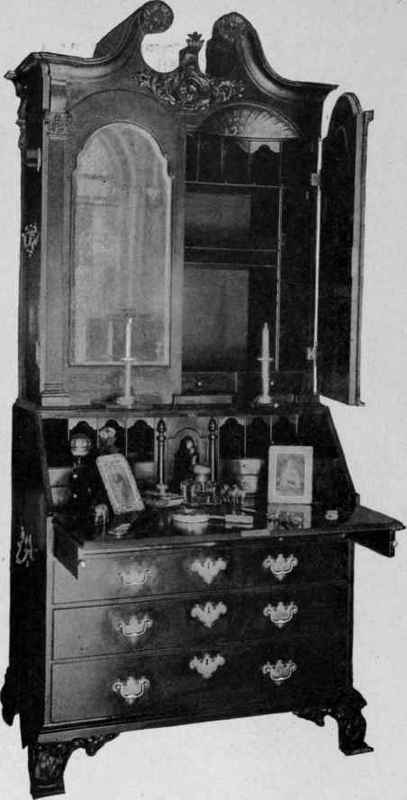
Illus. 103. - Desk with Cabinet Top, about 1770.
The secretary in Illustration 103 is an extraordinarily fine piece. It is of mahogany, and tradition says that it was brought from Holland, but it is distinctly a Chippendale piece, from the fine carving upon the feet and above the doors, and from the reeded pilasters with exquisitely carved capitals. There are five of these pilasters, - three in front and one upon each side, at the back. The doors hold looking-glasses, the shape of which, straight at the bottom and in curves at the top, is that of the early looking-glasses. The two semicircular, concave spaces in the interior above the cabinet are lacquered in black and gold.
Continue to:


My Books

