


Desks. Part 3
Description
This section is from the book "Furniture Of The Olden Time", by Frances Clary Morse. Also available from Amazon: Furniture of the Olden Time.
Desks. Part 3
The middle compartment in the desk, between the pigeonholes, has a door, behind which is a large drawer. When this drawer is pulled entirely out, at its back may be seen small drawers, and upon taking out one of these and pressing a spring, secret compartments are disclosed.
Dr. Holmes, in "The Professor at the Breakfast Table," has written of this secretary thus: -
"At the house of a friend where I once passed a night, was one of those stately, upright cabinet desks and cases of drawers which were not rare in prosperous families during the past century [i.e. the eighteenth]. It had held the clothes and the books and papers of generation after generation. The hands that opened its drawers had grown withered, shrivelled, and at last had been folded. in death. The children that played with the lower handles had got tall enough to open the desk, - to reach the upper shelves behind the folding doors, - grown bent after a while, - and followed those who had gone before, and left the old cabinet to be ransacked by a new generation.
"A boy of twelve was looking at it a few years ago, and, being a quick-witted fellow, saw that all the space was not accounted for by the smaller drawers in the part beneath the lid of the desk. Prying about with busy eyes and fingers, he at length came upon a spring, on pressing which, a secret drawer flew from its hiding-place. It had never been opened but by the maker. The mahogany shavings and dust were lying in it, as when the artisan closed it, and when I saw it, it was as fresh as if that day finished.
"Is there not one little drawer in your soul, my sweet reader, which no hand but yours has ever opened, and which none that have known you seemed to have suspected? What does it hold? A sin? I hope not."
The "quick-witted boy, with busy eyes and fingers," was the present owner of the secretary, the Rev. William R. Huntington, D.D., of Grace Church, New York, and since Dr. Holmes wrote of the secretary, new generations have grown up to reach the handles of the drawers and to ransack the old cabinet.
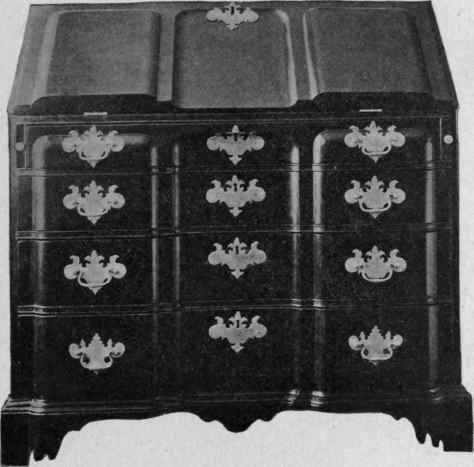
Illus. 104. - Block-front Desk, about 1770.
The middle ornament upon the top was gone many years ago, but Dr. Huntington remembers, as a boy with his brother, playing with the two end figures which, it is not astonishing to relate, have not been seen since those years. The figures were carved from wood, of men at work at their trade of cabinet-making, and the boys who were given the carved figures for toys played that the little workmen were the ones who made the secretary. The great handles upon the sides are large and heavy enough for the purpose for which they were intended, to lift the massive piece of furniture.
The block-front mahogany desk in Illustration 81 shows the blocked slanting lid. The brasses are original and are unusually large and fine. This desk belongs to Dwight Blaney, Esq., of Boston.
A splendid mahogany secretary owned by Albert S. Rines, Esq., of Portland, Maine, is shown in Illustration 105. The lower part is bombe or kettle-shaped, but the drawers, which swell with the shape in front, do not extend to the corners, like the kettle-shaped bureau in Illustration 30, but leave a vacant space in the interior, not taken up at the ends. Three beautiful, flat, reeded columns with Corinthian capitals are upon the doors, which still hold the old bevelled looking-glasses. The handles are original, but are not as large as one usually finds upon such a secretary. There are larger handles upon the sides, as was the custom. The cabinet in the upper part is very similar to the one in Illustration 103, but there is no lacquering upon the curved tops behind the doors. With the thoroughness of workmanship and dislike of sham which characterized the cabinetmakers of the eighteenth century, there are fine pieces of mahogany inside at the back of the looking-glasses. The cabinet in the desk proper, which is covered by the slanting lid when closed, is unusually good, with the curved drawers, set also in a curve. This secretary is generous in secret compartments, of which there are six. The centre panel of the cabinet is the front of a drawer, locked by a concealed spring, and at the back of this drawer are two secret drawers; beneath it, by sliding a thin piece of mahogany, another drawer is disclosed; a fourth is at the top, behind a small drawer, and at each end of the curved drawers is a secret drawer. The secretary is over eight feet in height.
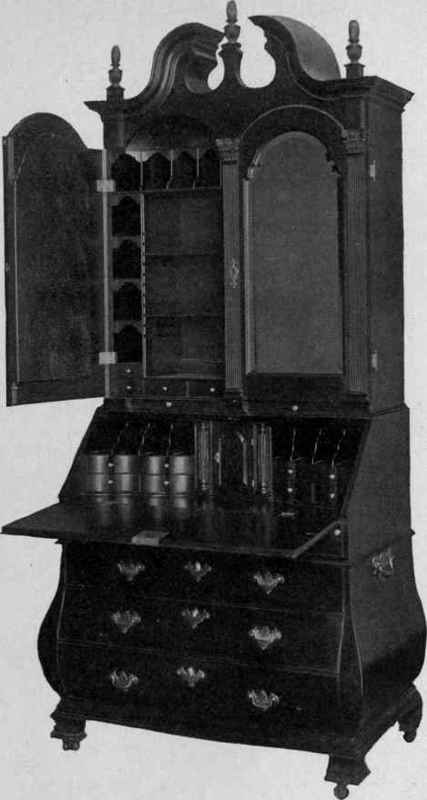
Illus. 105. - Kettle-front Secretary, about 1765.

Illus. 106. - Block-front Writing-table, 1760-1770.
Illustration 106 shows a beautiful little piece of furniture, modelled after what Chippendale calls a writing-table or a bureau table, by the latter term meaning a bureau desk with a flat top. The same unusually fine shells are carved upon this as upon the double chest of drawers in Illustration 21, and upon the low chest of drawers in Illustration 31. In the inside of one of the drawers of this writing-table is written in a quaint old hand a name which is illegible, and "Newport, R.I., 176-," the final figure of the date not being sufficiently plain to determine it. Desks, secretaries, and chests of drawers have been found with block fronts and these fine shells. All were originally owned in Rhode Island or near there, and nearly all can be traced back to Newport, probably to the same cabinet-maker. This writing-table was bought in 1901 from the heirs of Miss Rebecca Shaw of Wick-ford, Rhode Island. Miss Shaw died in 1900 at over ninety years of age. The writing-table is now owned by Harry Harkness Flagler, Esq., of Millbrook, New York. It measures thirty-four inches in height and thirty-six and three-quarters inches in length. A door with a shell carved upon it opens into a recessed cupboard. A writing-table like this is in the Pendleton collection, also found in Rhode Island.
Continue to:


My Books

