


Desks. Part 4
Description
This section is from the book "Furniture Of The Olden Time", by Frances Clary Morse. Also available from Amazon: Furniture of the Olden Time.
Desks. Part 4
Illustration 107 shows a desk with cabinet top and serpentine or ox-bow front. It is made of English walnut of a fine golden hue which has never been stained or darkened. The doors are of panelled wood, with fluted columns at each side. It was owned in the Bannister family of Newburyport until 1870, when it was given to the Newburyport Library. It now stands in the old Prince mansion, occupied by the Library.

Illus. 107. - Serpentine-front Desk, Cabinet Top, 1770.

Illus. 108. - Serpentine or Bow-front Desk, about 1770.

Illus. 109. - Bill of Lading, 1716.
Illustration 108 shows a mahogany desk with serpentine front and claw-and-ball feet, owned by Mrs. Alice Morse Earle, of Brooklyn. The serpentine drawers of this piece and the one preceding are carved from a solid block, not quite so thick as is necessary for the block-front drawers. This desk was made at about the same time as the secretary in the last illustration.
The bill of lading in Illustration 109 is preserved in the house known as the "Warner House," in Portsmouth, New Hampshire, built by Archibald Macphaedris, a member of the King's Council. It was commenced in 1712, and occupied in 1716, but not finished until 1718. Mr. Macphaedris died in 1729, and his widow, upon her second marriage, gave the house to her daughter, married then to Colonel Jonathan Warner, and the house has remained ever since in the possession of their descendants.
The rooms are panelled, and are filled with the furniture bought by successive generations. Upon the walls hang Copley portraits of Colonel Warner and his wife and her haughty mother, Mrs. Macphaedris (who was a daughter of Lieutenant-Governor Wentworth), and of Colonel Warner's young daughter Mary, in her straight little stays, which are still preserved, along with the garments, stiff with gold embroideries, which Colonel Warner and his wife wore upon state occasions. A number of the illustrations for this book were taken in the Warner house, which is one of the best-preserved old houses in the country, and which, with its furnishings and decorations, presents an unusually good picture of the home of the wealthy colonist.
The quaint wording of this bill of lading, and the list of furniture mentioned, make it interesting in this connection, but none of the pieces of that date remain in the house, which was evidently refurnished with great elegance, after 1760, when the old furniture was probably discarded as "old-fashioned."
Illustration no shows a bookcase built into the Warner house. It is made of mahogany, and stands in every particular exactly as it was originally made. The bill of lading of 1716, shown in Illustration 85, mentions a bookcase, but this bookcase is of later date, and was probably bought by Colonel Warner for his daughter, as the books in the case are all bound alike in a golden brown leather, with gilt tooling, and each book has "Miss. Warner" stamped in gilt letters upon the cover. The books are the standard works of that time, - Shakespeare, Milton, Spenser, "The Spectator," Fox's "Book of Martyrs," and all the books which a wealthy man of those days would buy to furnish a library. The dates of the editions vary from 1750 to 1765, so the latter date may be given to this bookcase. It was once entirely filled with "Miss. Warner's' books, but early in the nineteenth century, during a great fire in Portsmouth, the books were removed for safety, and all were not brought back.

Illus. 110 - Bookcase and Desk, about 1765.
At the top of the bookcase is a row of Chinese fretwork, which, together with the massive handles, would also place its date about 1765. The case is divided into three sections, the sides of the lower part being devoted to drawers. The lower middle section has four drawers, above which is a wide flap which lets down, disclosing a desk with drawers andpigeon-holes.
A bookcase owned by J. J. Gilbert, Esq., of Baltimore, is shown in Illustration Ill. It is made after Chippendale designs, and is richly carved. The base and feet are very elaborate, and the cornice and pediment, are wonderfully fine. The broken arch has delicate sprays of carved wood, projecting beyond the edge, and laid over the open fretwork, and the crowning ornament in the centre is a carved urn with a large spray of flowers. The ornaments and mouldings separating the sections of glass in the doors are as fine as the other rich carving upon this bookcase.

Illus. 111. - Chippendale Bookcase, 1770.
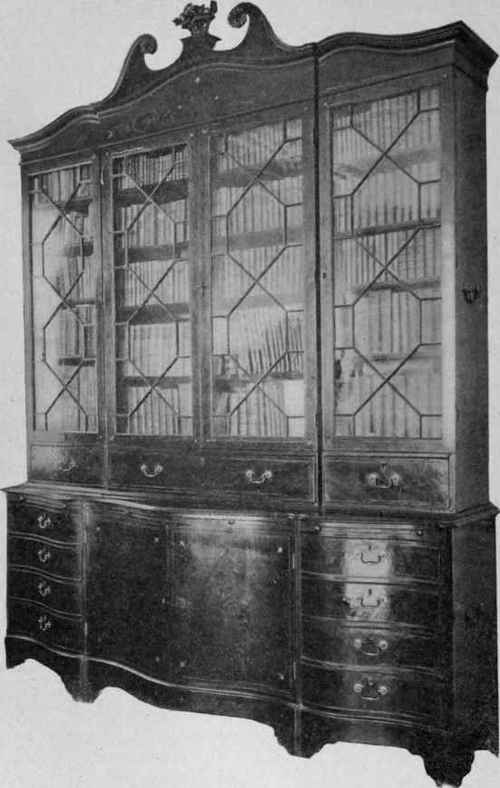
Illus. 112. - Hepplewhite Bookcase, 1789.
A wonderful Hepplewhite bookcase is shown in Illustration 112. It is owned by George W. Holmes, Esq., of Charleston, South Carolina, and carries with it an impression of the wealth and luxury in Charleston, before the Civil War and the other disasters that befell that city in the latter half of the nineteenth century.
This bookcase is nearly nine feet in length, and is made of unusually fine mahogany. The lower part is designed in a series of curves which prevents the plain look that a straight front would give in such length. The doors form one curve and a part of the other two, which are completed by the drawers at each side; a skilful management of a long space. The curves at the top of the pediment follow the same lines, and the bookcase was evidently designed by a master hand. It was probably brought from England, together with a secretary to match it. Above the doors and drawers, shelves pull out, on which to rest books. A fine line of holly runs around each door and drawer, with a star inlaid at the corners of the doors, while a very beautiful design is inlaid in light and dark woods, in the space on the pediment, which is finished with the broken arch, of the high, slender type, with carved rosettes. The centre ornament, between the rosettes, is a basket of flowers carved in wood.
Continue to:


My Books

