


Chairs. Part 2
Description
This section is from the book "Furniture Of The Olden Time", by Frances Clary Morse. Also available from Amazon: Furniture of the Olden Time.
Chairs. Part 2
A chair of some later date, about 1680, is shown in Illustration 127, also from the Waters collection, the back and seat of which were originally of Turkey work. The frame is similar to that in Illustration 126, with the exception of the carved brace across the front, which feature leads one to give the chair a later date than the one in Illustration 126. The feet have been sawed off. Other coverings beside Turkey work were used, - velvet, cam-lett, plush, or cloth, as well as an occasional cover "wrought by hir owne hand." Until the latter part of the seventeenth century a somewhat architectural style prevailed in chairs, settles, and tables. This was succeeded by the graceful lines and carving of the cane furniture which came into fashion during the last quarter of that century. It is called Jacobean furniture, although that name would not seem to be strictly accurate, for the Jacobean period was ended before cane furniture was introduced into England, about 1678. The cane chairs form a complete contrast to the heavy wainscot or turned chairs in use previously, the light effect coming not only from the cane seat and back, but also from the frame, which was usually carved in a graceful design. Illustration 128 shows a chair which belonged to Sir William Pepperell, made possibly for his father, for Sir William was not born until 1697. The front legs, carved with the scroll foot turning forward, are in the pure Flemish style. The brace in front, carved to correspond with the top of the back, appears in cane chairs with a carved frame. The seat was originally of cane. This chair is now in the Alexander Ladd house in Portsmouth.

Illus. 126. - Leather Chair, about 1660.
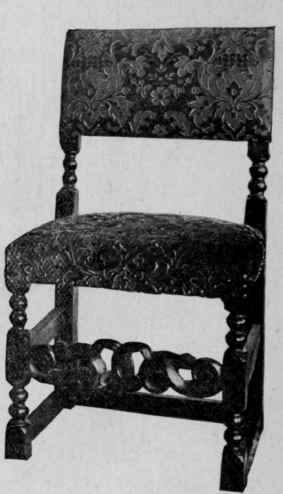
Illus. 127. - Chair originally covered with Turkey work, about 1680.
A chair of similar effect, but with turned legs, and carved in a different design, with the crown as the central figure of the underbrace and top, is shown in Illustration 129. It belongs to Miss Mary Coates of Philadelphia, to whom it has descended from Josiah Langdale, in whose inventory this chair, with its mates, was mentioned. Josiah Langdale took ship with his family and belongings, from England for America, in 1723.
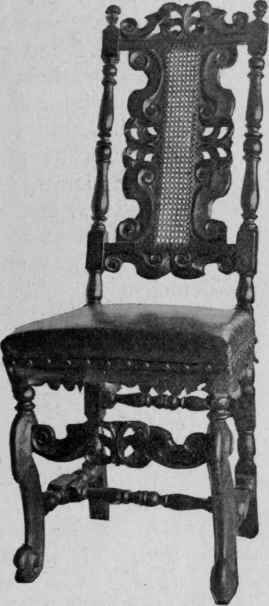
Illus. 128. - Flemish Chair, about 1690.
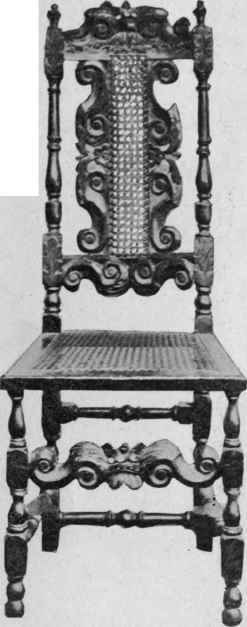
Illus. 129. - Flemish Chair. about 1690.
Before sailing he became very ill and prayed that he might die and be buried in the old graveyard, but his wish was not granted, and he was carried on board, taking his coffin with him. Three days out (but not far from land) he died, and was buried in his coffin, at sea. The coffin was not sufficiently weighted, however, and it drifted back to land, where it was opened, and its occupant identified, and Josiah Langdale was buried from the old Quaker meetinghouse, as he had prayed. His widow came safely to America with her furniture, among which was this chair. Both Flemish and Spanish characteristics appear in the chair in Illustration 130. The front legs are in the Flemish style, the scroll foot turning back as it often does. The twisted stretchers and back posts show the influence of Spanish or Portuguese fashions. This chair is in the Poore collection at Indian Hill, Newburyport.
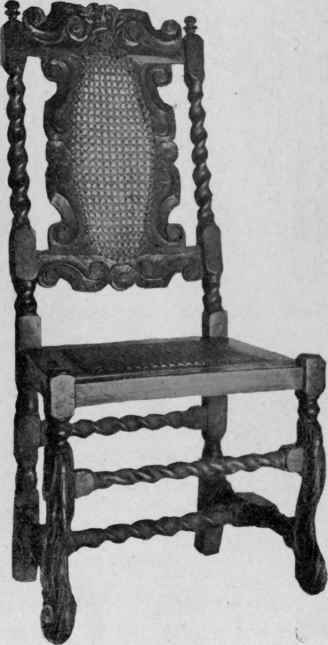
Illus. 130. - Cane Chair, 1680-1690.
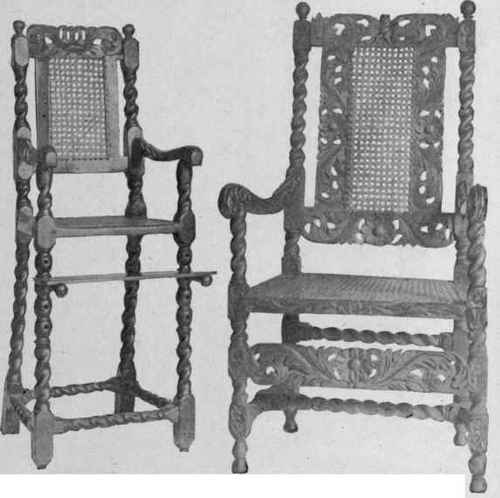
Illus. 131. - Cane High-chair and Arm-chair, 1680-1690.
Illustration 131 shows two beautiful chairs owned by Dwight Blaney, Esq., of Boston. The Portuguese twist has an unusually graceful effect in the tall legs of the little high chair. It will be noticed that, instead of being twisted, the upper part of the front legs is turned in balls to provide a stronger hold for the pegs which support the foot-rest. There are four holes for these pegs, at different heights, in order that the rest might be lowered as the infantile legs lengthened. The crown appears in the top of the high chair, while the arm-chair has a child's figure carved in the centre of the top. The arms of both chairs are carved with the acanthus leaf.
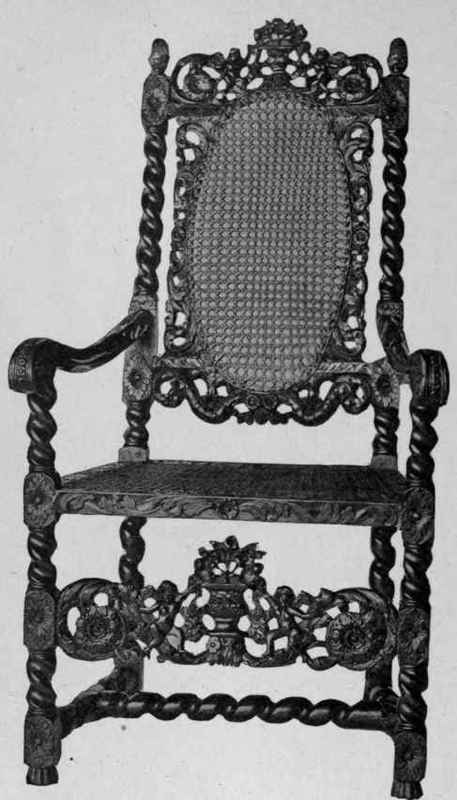
Illus. 132. - Cane Chair, 1680-1690.
An example of the finest carving attained in cane furniture is shown in Illustration 132. This exquisite chair is owned by Harry Harkness Flagler, Esq., of Millbrook. The design of the top is repeated in the front brace, but much enlarged. The frame of the seat and the arms are carved like those in Illustration 131. The legs end in a curious form of the Spanish foot.
The popularity of the cane chair, as well as its strength, is attested by the number which have survived the centuries, in fair condition for chairs so light in appearance.
The cane chair in Illustration 133 is owned by Dwight M. Prouty, Esq., of Boston. The top of the under brace is carved in a crescent-shaped design, which is used again in the top rail. The front leg is a Flemish scroll with a ball beneath it. The cane back is unusual in design, the carved wood on each side making a diamond-shaped effect.
The chair in Illustration 134 belongs to the writer. The cane extends up into the curve made in the top rail of the back, which is, like the underbrace and the sides of the back, more elaborately carved than the chairs in Illustrations 128 and 129.
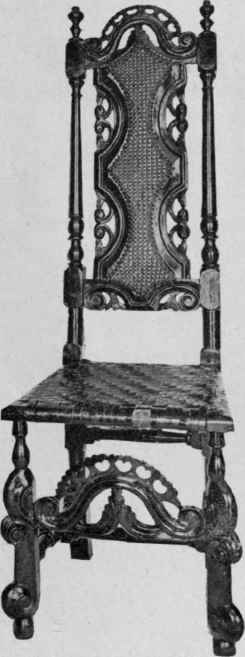
Illus. 133.
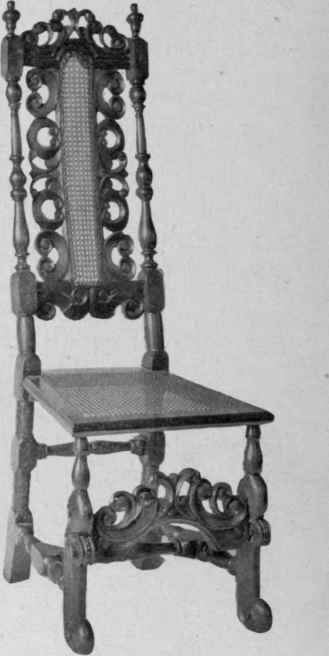
Illus. 134. - Cane Chairs, 1680-1690.
Stools were not common, but are occasionally found, following the styles in chairs. With the wainscot chairs were joined or joint stools.
The stool in Illustration 135 was used with the turned chair, like the one in Illustration 126.
Illustration 136 shows a very rare piece, a Flemish stool, with a carved underbrace, probably like the ones upon the cane-back chairs used with it. These two fine stools are in the collection of Dwight M. Prouty, Esq., of Boston.
A chair once owned by General Henry Dearborn of Revolutionary fame is shown in Illustration 137. The back and seat were originally cane, and it has a perfect Spanish foot.
The chair in Illustration 138 is of the style called Queen Anne. It has Spanish feet but the back shows the first use of the Dutch splat, afterward developed and elaborated by Chippendale and others. This chair and the one in Illustration 137 belong to the writer.
A chair which retained some characteristics of the cane chair was the banister-back chair, which appears in inventories of the first half of the eighteenth century.

Illus. 135. - Turned Stool, 1660.
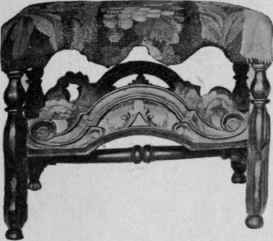
Illus. 136. - Flemish Stool, 1680.
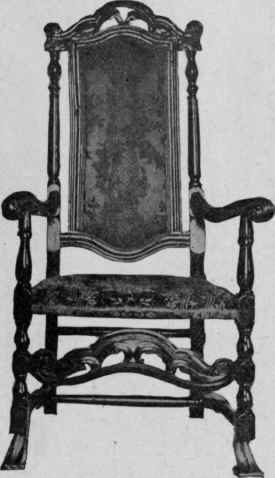
Illus. 137. - Cane Chair, 1690-1700.

Illus. 138. - Queen Anne Chair, 1710-1720.
Continue to:


My Books

