


Clocks. Part 3
Description
This section is from the book "Furniture Of The Olden Time", by Frances Clary Morse. Also available from Amazon: Furniture of the Olden Time.
Clocks. Part 3
Illustration 349 shows a tall clock and a miniature one, both made about 1800, with painted faces. The tall clock has the name upon its face of Philip Holway, Falmouth. The case is mahogany, and the twisted pillars have brass bases and caps. The brass ornaments upon the top are rather unusual, a ball with three sprays of flowers. The clock was bought in Falmouth by the writer. The small clock has the name of Asa Kenney upon the face. Its case is inlaid with satinwood and ebony. This little clock belonged to the late Sumner Pratt of Worcester, and is now owned by his daughter, Miss E. A. Pratt.

Illus. 349. - Miniature Clock and Tall Clock, about 1800.
Illustration 350 shows a clock owned by Mrs. E. A. Morse of Worcester. The case is beautifully inlaid with satinwood, holly, ebony, and two varieties of mahogany. It has the painted moon above the dial, and plays seven tunes - one tune being played each hour during the day. The tunes are Hob or Knob, Heathen Mythology, Bank of Flowers, Paddy Whack, New Jersey, Marquis of Granby, Amherst.
Amherst is the psalm tune which this pious clock plays upon Sundays, to atone for the rollicking jigs which are tinkled out upon week-days. All of the tall clocks illustrated in this chapter have brass works, but many were made with wooden works, and in buying a clock one should make sure that the works are of brass.
Illustration 351 shows two sizes of a kind of clock occasionally found, which winds by pulling the chain attached to the weights. These clocks were made in Europe; the smaller one, which is owned by the writer, having the label of a Swiss clock-maker. The larger clock belongs to Irving Bigelow, Esq., of Worcester. Both date to the first quarter of the nineteenth century.

Illus. 350. - Tall Clock, 1800-1810.
The most famous name among American clock-makers is Willard. There were three Willard brothers, - Benjamin, Simon, and Aaron, - clock-makers in Grafton, Massachusetts, in 1765. Benjamin and Simon established a business in Rox-bury, and in December, 1771, Benjamin advertised in the Boston Evening Post his "removal from Lexington to Roxbury. He will sell house clocks neatly made, cheaper than imported." February 22, 1773, he advertised that he "at his shop in Roxbury Street, pursues the different branches of clock and watch work, and has for sale musical clocks, playing different tunes, a new tune each day, and on Sunday a Psalm tune. These tunes perform every hour. . . . All the branches of the business likewise carried on in Grafton." The third brother, Aaron, may have remained in Grafton, for he went from there later to Roxbury, as fifer of a company of minute-men, in the first days of the War of the Revolution. Simon Willard remained in the same shop in Roxbury for over seventy years, dying in 1848 at the great age of ninety-six years. Aaron Willard buiit a shop in Boston and made a specialty of tall striking clocks. Illustration 352 shows a clock owned by Dr. G. Faulkner of Jamaica Plain. Inside the clock is written in a quaint hand, "The first short timepiece made in America, 1784." Dr. Faulkner's father was married at about that date, and the clock was made for him. It has always stood upon a bracket upon the wall, and has been running constantly for one hundred and seventeen years. Upon the scroll under the dial is the inscription "Aaron Willard, Roxbury." The case is of mahogany, and stands twenty-six inches high. Upon the lower part are very beautiful scroll feet, turning back. The upper part stands upon ogee feet, and can be lifted off. The glass door is painted so that it forms a frame for the dial. Mr. Howard, the founder of the Howard Watch Company, has told me that the Willards invented this style of clock as well as the style known as the banjo clock. Mr. Howard was born in 1813 and when he was sixteen he started to learn his trade in Boston, in the shop of Aaron Willard, Jr. I have not been able to find that clocks of this style were made in England at all, and they seem to be purely American, but in Britten's "Old Clocks and Watches and their Makers" is an illustration of an astronomical clock made by Henry Jenkins, 1760 to 1780, with a case very similar in shape to these clocks, and with a top like the centre one of the three in Illustration 353. Aaron Willard may have obtained his idea from such a clock. The clock in Illustration 352 is the earliest one that I have heard of.

Illus. 351. - Wall Clocks, 1800-1825.
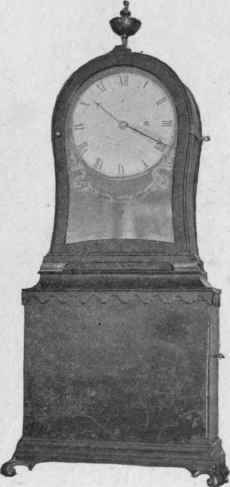
Illus. 352. - Willard Clock, 1784.

Illus. 353. - Willard Clocks, 1800-1815.
Illustration 353 shows three clocks made some years later, probably about 1800 to 1815. The clock with the ogee feet is a Willard clock, and belongs to W. S. G. Kennedy, Esq. The clock with the door of bird's-eye maple and the inlaid fan-shaped top is owned by Mrs. E. A. Morse. The third clock is owned by the writer.
Another New England clock-maker of long and picturesque life was Stephen Hassam, sometimes called Hasham. He was born in 1761, and is said to have lived to be over one hundred years old. He was a witness, when a boy, of the battle of Bunker Hill from the steeple of a church in Boston, and he lived until after the beginning of the Civil War. He moved from Boston to Grafton and then to Worcester, where he learned the clock-maker's trade, perhaps with the Willards who lived in those towns at about that time. He established himself finally in Charlestown, New Hampshire, where he lived and made clocks, which are highly valued for their excellent qualities, as well as for the associations with the name of the centenarian clock-maker.
Continue to:


My Books

