


Musical Instruments. Part 4
Description
This section is from the book "Furniture Of The Olden Time", by Frances Clary Morse. Also available from Amazon: Furniture of the Olden Time.
Musical Instruments. Part 4
Illustration 292 shows a piano of most elaborate design, made about 1826. There is no maker's name upon the piano. The frame is of mahogany and has a brass moulding around the body, and brass rosette handles to the drawers. Around each square carved panel upon the front legs is a brass beading, and the lions' claws on the front legs and the sockets upon the back legs are of brass. The front legs are elaborately carved like table bases, and the three pedals have a support that is a cross between a lyre and a wreath. The keyboard has six octaves, and the music-rack is very simple.
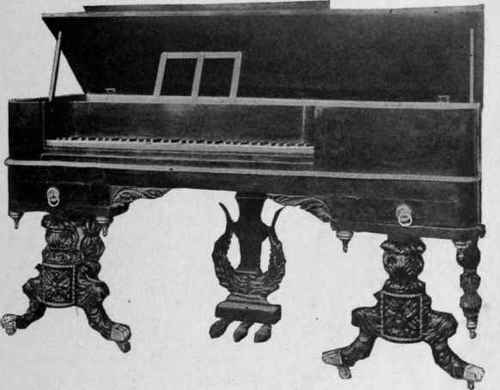
Illus. 292. - Piano, 1826.
Illustration 293 shows two piano-stools made between 1825 and 1830. The stool with four fluted legs was sold with a piano made by Wood, Small, & Co., of London, which has six legs fluted in the same manner. The other stool has a base like the claw-and-pillar table, and the sides of the seat are carved dolphins, whose tails turn up and support a carved rail to form a low back for the seat. This stool belongs to the writer.

Illus. 293. - Piano-stools, 1825-1830.
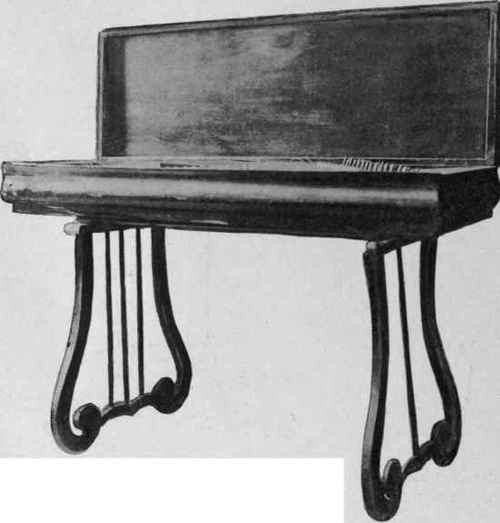
The "table piano" in Illustration 294 is marked as being made by John Charters, Xenia, Ohio, which alone would attract attention, aside from the curious construction of the base, which places the date of the piano about 1835. The pedals are quite concealed as one stands by this piano, and the whole design is clumsy and poor. The music-rack seems to have remained unchanged for many years, and from the earliest piano shown, made in 1800, until the large square piano of 1840, the music-rack is the same, simply constructed of four pieces of wood which are put together with pivots, so that by pushing one end of the top piece they all slide and fold down together, in order that the piano may be closed.

Illus. 294. - Table Piano, about 1835.
Illustration 295 shows a Chickering piano made in 1833, of a design entirely different from the other pianos shown, and of great elegance and richness. The mahogany case is inlaid with the heavy bands of plain brass, and the legs are pillars with Ionic capitals.
The music-rack is of the same simple form as the one upon the preceding piano, and the one pedal is fastened into a lyre-shaped support.
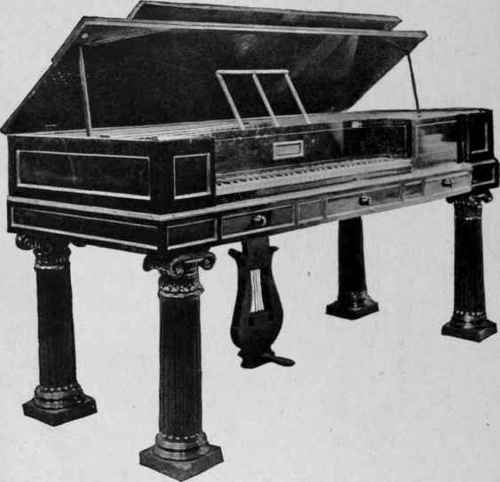
Illus. 295. - Chickering Piano, 1833.
Illustration 296 shows a music-stand made about 1835, owned by Mrs. John D. Wing, of Millbrook, New York. The rest for the music is of the favorite lyre shape, which seems especially adapted to this purpose. The stand is of mahogany and is very pretty and graceful.
Illustration 297 shows a music-stand owned by Dwight Blaney, Esq., of Boston. It is of mahogany, and its date is about 1835. The upper part with the music-rest can be lowered or raised, and is held in place by pins thrust through the small holes in the supports. The stand is somewhat heavy in effect, but very firm and secure.
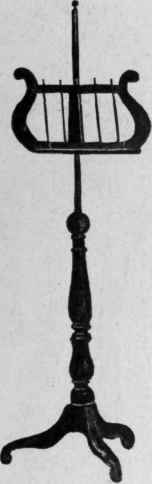
Illus. 296. - Music-stand, about 1835.
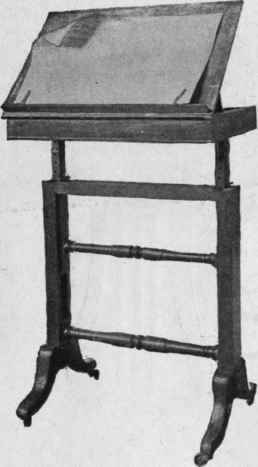
Illus. 297. - Music-stand, about 1835.
Illustration 298 shows a dulcimer which is in the Deerneld Museum. It has an extremely plain case, and must have been, when new, an inexpensive instrument. The dulcimer of early times was a small, triangular-shaped instrument, to be laid upon a table. Above the sounding-board were stretched wire strings, which were struck with small hammers held in the hand, and doubtless the piano was first suggested by the dulcimer and its hammers. The heads of the hammers were covered with hard and soft leather to give a loud or soft tone. The instrument in the illustration was probably made from 1820 to 1830, during which time the dulcimer was quite popular, especially in the country, where the piano was too costly a luxury. Music-books were published for the dulcimer, and it retained some popularity in country villages until ousted by the melodeon.
Illus. 298. - Dulcimer, 1820-1830.
Illustration 299 shows a set of musical glasses called a harmonica. The fine ladies in "The Vicar of Wakefield" would talk of nothing but "pictures, taste, Shakespeare, and the musical glasses." This was in 1761, and the musical glasses were fashionable before that, for Gliick in 1746 played "a concerto on twenty-six drinking glasses, tuned with spring water." Franklin invented an instrument for the musical glasses, which he called the Armonica, for which famous composers wrote music, x and in which the glasses were arranged upon a rod which turned with a crank, while below was a trough of water which moistened the glasses as they dipped into it. There is a Franklin Armonica in the Metropolitan Museum of Art in the Brown collection. In Watson's "Annals" is a description of a visit to Franklin in Paris. It says: "He conducted me across the room to an instrument of his own invention which he called the 'Armonica.' The music was produced by a peculiar combination of hemispherical glasses. He played upon it and performed some Scotch pastorales with great effect. The exhibition was truly striking."
Continue to:


My Books

