


Chippendale. Part 10
Description
This section is from the book "Style In Furniture", by R. Davis Benn. Also available from Amazon: Style In Furniture.
Chippendale. Part 10
Chippendale, like most people who depend upon the public favour for their livelihood, had, of course, to cater for the requirements of the less-monied portion of the community as well as for those of the wealthier classes, and when considering the demands of both, it is hard to decide which were the more exacting, and which the easier, to satisfy. In much, perhaps in most, of his work, considerations of price altogether prohibited him from indulging in those fantastic extravagances which his admiration for the French, and his flirtation with the Chinese, led him to commit in his productions when cost was not a great object.
By way of concluding my review of his work, therefore, I shall deal briefly with what we may term, for the sake of convenience, "Inexpensive Chippendale"; and we shall see, when we examine it, that our "upholder" had amazingly little that was very fresh, or in any way striking, to offer his customers when he was forced by circumstances to fall back entirely upon his own originality. From the point of view of good taste, his least costly, and consequently plainest, furniture, strangely enough, must be regarded as by far his best. It is notably free from all extravagance and eccentricity, and is almost invariably characterised by excellence of proportion, and a refinement in such detail as there is, which are altogether charming and restful to the eye, and stand out in marked contrast with most of the creations already referred to on the preceding pages.
Some people may consider that in the foregoing paragraph, and perhaps in my remarks throughout this chapter, I have done this old master but scant justice. If such be the case, I am sorry, but I have endeavoured, to the best of my ability, to defend and justify the position I have taken up. Be that as it may; in support of my contention as to his plainer furniture, I cannot do better than point to the clothes-press or wardrobe in the lower group on Plate I., the two chests on Plate III., the simpler of the two tables on Plate VI., the bookcase on Plate VII., the two bookcases and secretaire on Plate IX., the chest on Plate X., and the two.
"Chippendale." VIII. Plate 39

Reference In Text
Page | |||
Fig. | 1 | See | 118 |
" | 2. | " | 118 |
" | 3. | " | 118 |
Page | |||
Fig. | 4. | See | 245 |
" | 5. | " | 118 |
" | 6. | " | 118 |
Page | |||
Fig. | 7. | See | 118 |
" | 12. | " | 118 |
Page | |||
Fig. | 15. | See | 124 |
" | 16. | " | 124 |
Chippendale, however, fully understood where it should and should not be introduced, and properly appreciated its value as a decorative termination or superstructure. As a consequence, he took generous advantage of its aid, sometimes enriching it with small dentil mouldings (tiny square or oblong blocks of wood, arranged in succession a small distance apart from each other, underneath a square "member" of an ordinary moulding, and somewhat resembling a row of teeth - hence "dentil" moulding), and leading up to it by introducing a frieze of applied fret-work, as in the secretaire on Plate IX. The centre of the pediment at the "break" was usually furnished with a broad moulding, or shelf, left plain for the reception of a bust or vase, either of which formed a capital finish. Occasionally it had some such lumpy and ugly excrescence as that on the lower bookcase on Plate IX.
Apart from this pediment, Chippendale's work of the class under consideration was peculiarly free from carving or other enrichment of any kind; and what little he did introduce was invariably of the most restrained and pleasing character. Referring again, for a moment, to this designer's cabinet work generally, a word may be said of the cupboard doors, both large and small. Where glass was introduced - and its employment was by this time becoming more general - it was usually "broken up" by tracery such as that shown in one of the lower cabinets, Plate VI., in the bookcases, Plates VII., IX., and XI., and in Figs. 15 and 16, Plate VIII., drawn to a larger scale. As much of this tracery will be encountered in bookcases and similar pieces of a later period it will be well for the reader, in order to avoid confusion, to note particularly that most examples designed by Chippendale were essentially angular in character, curves being very seldom and sparingly introduced. There are, however, a few notable exceptions, one of which is portrayed in Fig. 16, Plate VIII. When the doors were not panelled-in with glass, but were of wood throughout, the larger surfaces were often relieved by applied carving, as in the upper wardrobe, Plate I., the large press, Plate III., the two secretaires, Plate V., and other pieces shown.
"Chippendale." IX. Plate 40
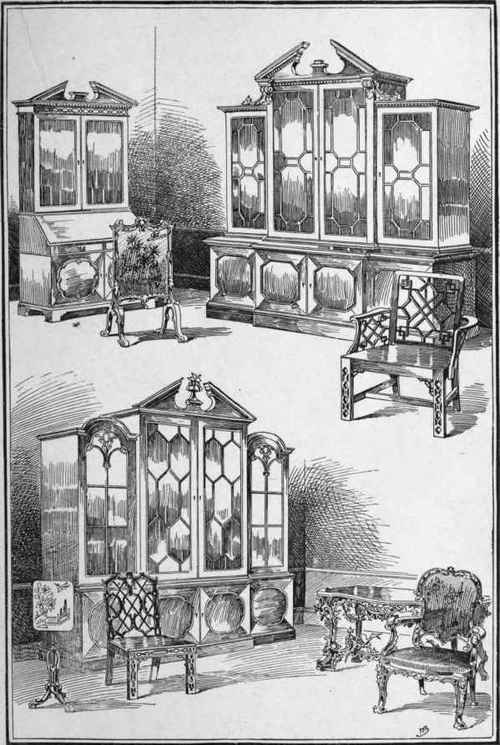
Reference In Text
Page | |||||
Chairs. | See | 105, | 112, | 115 | 245 |
Secretaire. | " | 122, | 124 | ||
Bookcases. | " | 122, | 124 | ||
Page | ||
Door tracery. | See | 124 |
Screen. | " | 126 |
Table. | " | 245 |
Earlier in the chapter I have mentioned that Chippendale was among the first cabinet makers in this country to employ mahogany for the manufacture of furniture, and I do not think it necessary for me to occupy space here by repeating the oft-told tale of the introduction of that wood into England by Dr. Gibbon, in or about the year 1742, as it is to be found in almost any encyclopaedia. So often indeed has it been repeated, in one form or another, that many people have come to believe that no furniture was ever made in mahogany prior to that date; such people are prepared to insist most emphatically that argument to the contrary reveals lamentable ignorance. With regard to that point perhaps I need only say that I myself have actually sat in old Dutch chairs, made in mahogany, of which ample documentary evidence exists to prove conclusively that they were used by Charles the Second during his enforced exile at the Hague. But to return to Chippendale.
At the period of which I am now writing the furnishing of the British home was becoming far more extensive and varied than in earlier times, and such necessary articles as bedsteads, chairs, tables, bookcases, drawers, cupboards, and presses of different kinds, were supplemented by other pieces which partook more of the nature of luxuries, and whose services at a pinch could be very well dispensed with without any serious inconvenience, though they certainly add to the comforts of life. All manner of dainty knick-knacks crept into the furnishing show-rooms - little wall-brackets and hanging cabinets for books and china; small "occasional" tables, girandoles, decorative pedestals, "Banner," "Shield," and "Horse" screens, tea caddies, and the like; and last, but by no means least, the "Grandfather's Clock." The field open to the designer and maker of cabinet work was thus vastly extended; as a natural consequence, the opportunities he enjoyed for the exercise and display of whatever taste and ingenuity in design and skill in craftsmanship he might possess were far greater than those with which his predecessors had been forced to rest content. It is more than probable that Chippendale was responsible for the introduction of some of these novelties - for they were novelties then - and it is only proper, therefore, that a few of his designs or them should be included among our typical studies. Two clock-cases of the "Grandfather" type, and two smaller ones, for the table or mantelpiece, thoroughly characteristic as regards both form and detail, are shown on Plate II., together with an extravagant girandole on French lines, to which reference has previously been made. A neat and sensible little hanging bookcase or medicine cupboard appears on Plate III., and another of a similar type on Plate IV.; "Pole" and "Horse" screens on Plates IV. and IX.; a small wall-bracket and pedestals on Plates V., VII., and X.; two tea caddies on Plates VI. and VII., and other small pieces dotted about here and there on the remaining plates, may be taken as examples of the class of fancy furniture to which I refer. None of these requires lengthy description, as all are types in every particular of one or the other of the four distinct phases of "Chippendale" which have been exhaustively dealt with in the preceding pages.
Continue to:


My Books

