


Chippendale. Part 11
Description
This section is from the book "Style In Furniture", by R. Davis Benn. Also available from Amazon: Style In Furniture.
Chippendale. Part 11
It is one thing to examine articles of furniture individually and separately, and often quite another to see them grouped together in a room, with a proper decorative setting of wall hangings, carpet, window draperies, and other accessories, so as to form one harmonious and consistent whole. A completely adequate conception of their true and full merit, not as individual pieces but as actual "furnishings" - that is to say, adjuncts to something else, integral parts of a complete scheme - is to be gained only by having these household gods grouped together in a room for our inspection. Bearing this in mind, in the consideration of each style I have made a special point of illustrating complete interiors, thoroughly representative in every way of the respective periods dealt with. To show, therefore, in some measure, how "Chippendale" really appeared in the home in the days of its prime, the window corner of a dining room, or morning room, true to style in every particular, is portrayed on Plate VII. Here, in the table by the window, we have a simple and dignified reading of the " Louis-Quatorze," together with a less faithful rendering of the same style in the somewhat unsafe-looking pedestal which supports the fern pot; the arm-chair is, of course, inspired by the "Louis-Quinze," and is a refined example; while the pelmet of the window drapery partakes of the same character, as do the "small" chairs also, but in a lesser degree. The bookcase and table are "Chippendale" pure and simple, hardly touched at all by French influence, and are, I think, none the worse for that.
"Chippendale." X.Plate 41
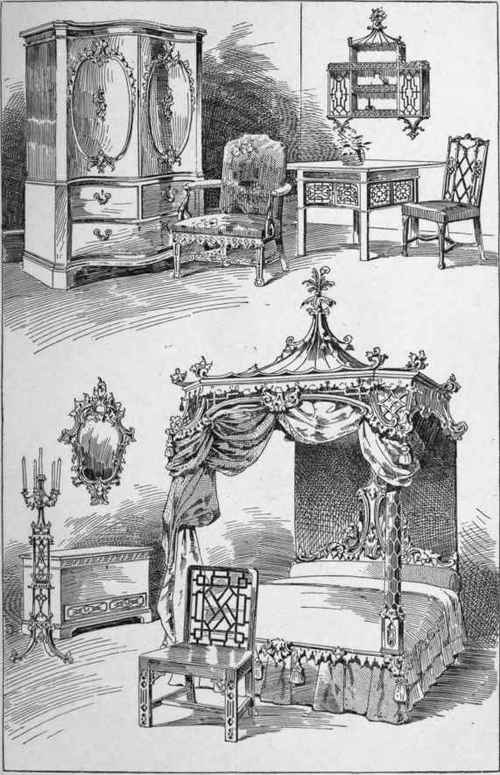
Reference In Text
Page | ||
Chairs. | See | 115 |
Table. | " | 115 |
Wall bookshelves. | " | 117 |
Page | ||
Bedstead. | See | 121 |
Chest | " | 122 |
Pedestal. | " | 126 |
Before leaving the consideration of the style, I must mention one other point which remains to be noticed in connection with it, and upon which emphasis must be laid. The importance of not turning to another branch of our study without referring to this may be indicated by the brief relation of an incident which came within my experience not so very many years ago. I spent an evening at one of a series of lectures on the history of furniture, arranged by a highly respected educational body specially for the benefit of young workers in the London cabinet making industries, and the lecturer, during the course of his remarks, gravely informed the students that it was his intention to deal with "'Chippendale' inlaid and painted furniture!" This lecturer, be it noted, was a man of no mean ability in other branches of art, enjoying a coveted reputation and one fairly won. He was not, however, "great" on the subject in which he had been appointed to instruct the rising generation. Yet, I fancy some one may enquire: "But why do you take exception to his statement which you have quoted?" I take exception simply because Chippendale did not cultivate either inlay or painting in the enrichment of his productions, and in cases where it is found some other description must be sought.
It is more than a little curious that the opportunities for the attainment of richness of effect and variety of colour afforded by the decorative media mentioned should not have appealed to, and been freely used by, this designer, but it is absolutely certain that he cared for neither. Indeed, he left them severely alone. Nor is it really difficult to account for this attitude when we remember that Chippendale was, in the first place, trained as a carver. His father was a carver of picture frames, and it was natural, perhaps, that the son should remain a carver at heart to the very end. He was more than satisfied with the effects to be obtained by the skilled and vigorous plying of the chisel and gouge, though for economy's sake, it is true, he did call the fret to his aid. The lighter, more graceful - some might say more effeminate - results to be secured by the employment of the marquetry cutter's saw, and the palette and brush, he left to others to use as they might feel disposed. What excellent use they did make of them will be fully demonstrated in succeeding chapters.
It must be clearly and unmistakably understood, then, that whenever painted (that is to say, decorated with painted enrichment) or inlaid furniture is described as "Chippendale," no matter where or by whom, it is a million chances to one that the description is incorrect.
In conclusion, so far as "Chippendale" is concerned, to those who regard old furniture from the commercial as well as from the artistic point of view, the mention of a few prices paid for genuine old examples of the style during recent years may be of interest; though it is impossible to set up any fixed standard of market value.
Continue to:


My Books

